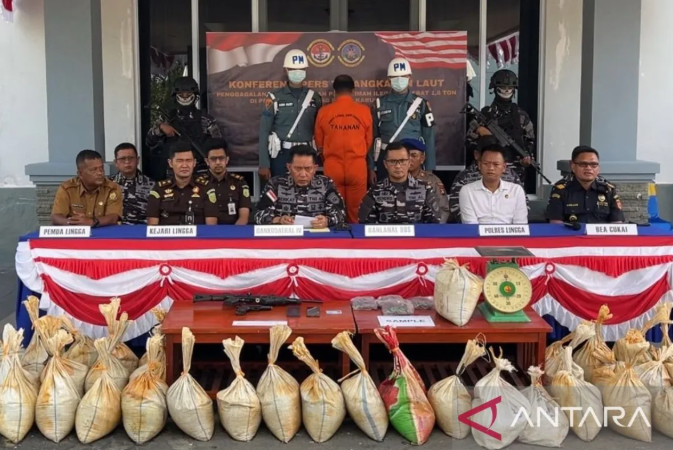
Indonesia's military maritime forces have successfully prevented the illicit export of around 75.7 tonnes of tin sand—material obtained through illegal mining operations—destined for Malaysia, marking a significant seizure in the region's ongoing battle against resource smuggling. The contraband, originating from the Bangka Belitung Islands positioned off eastern Sumatra's coastline, carries an estimated value of Rp76.04 billion (approximately US$79,300), according to statements made by Indonesian Fleet Command leadership during official proceedings disclosed this week.
The discovery emerged from a routine interception by naval personnel stationed at a jetty in East Belitung on August 2, when officers stopped a vehicle transporting roughly eight tonnes of the illicit material. This initial apprehension proved instrumental in unravelling what authorities now suspect represents an organized smuggling network, prompting the military to conduct sequential enforcement operations targeting the broader supply chain. Vice Admiral Denih Hendrata, commanding the Indonesian Fleet Command, disclosed that subsequent raids systematically recovered additional quantities across the region, demonstrating the scale and coordination of the trafficking operation.
Following the preliminary August 2 seizure, authorities expanded their enforcement activity to encompass multiple raids across subsequent days. A search conducted on August 3 in Lenggang village yielded approximately 50 tonnes of tin sand, constituting the largest single recovery. The momentum continued when officers discovered ten tonnes carefully packaged in 200 sacks the following day, followed by an additional five-tonne haul recovered on August 8. These successive discoveries indicated that the smuggling scheme involved multiple storage facilities and distribution points rather than a solitary operation, suggesting a more sophisticated criminal enterprise.
The scale of the enforcement response reflects Indonesian authorities' determination to dismantle trafficking networks systematically. Vice Admiral Hendrata emphasized during a public briefing conducted in Tanjungpandan, Belitung, on Wednesday that the investigation transcended the simple recovery of contraband materials. Authorities deliberately expanded their operational scope beyond initial seizures to identify the complete network infrastructure, tracing connections between suppliers, intermediaries, and facilitators involved in moving the materials toward Malaysian destinations. This methodical approach aims to prevent the rapid reconstitution of smuggling channels following the immediate confiscations.
As of the current investigative phase, authorities have not publicly identified specific individuals responsible for the operation, though the inquiry has broadened to encompass five distinct geographical locations across the region. The distributed nature of the investigation suggests that authorities are pursuing leads connecting production sites where illegal mining occurs, transit points where materials are consolidated, storage facilities, and departure zones where goods are prepared for export. This territorial expansion underscores the complexity investigators face when confronting organized smuggling operations that deliberately compartmentalize their activities to minimize detection risks.
Technical analysis of the seized materials remains underway, with laboratory examinations being conducted to establish precise mineral composition and quality grades. These analytical procedures serve multiple investigative purposes, including confirming that the materials indeed originated from illegal mining sources rather than legitimate operations, and potentially matching the composition against known mining sites or processing facilities. The chemical signatures embedded within the tin sand may ultimately assist authorities in identifying specific extraction locations and linking recovered materials to particular criminal actors.
The question of international cooperation emerged as a critical consideration during official discussions regarding the investigation's trajectory. Vice Admiral Hendrata acknowledged that determining the ultimate recipients and understanding how the smuggled materials were intended to be utilized would necessitate coordination between Indonesian authorities and their counterparts in Malaysia and potentially other destination nations. Cross-border cooperation frameworks, while theoretically established between regional governments, frequently encounter practical limitations when tracing complex supply chains involving multiple intermediaries and jurisdictions. The success of such multinational investigations often depends on intelligence sharing mechanisms, mutual legal assistance agreements, and political will to pursue cases that might implicate private commercial interests or well-connected individuals.
The Bangka Belitung Islands have long represented a contested zone where the tension between resource extraction economics and environmental governance manifests acutely. Tin mining constitutes a historically significant industry across these territories, yet the combination of declining ore grades in licensed operations and rising global commodity prices has incentivized illegal extraction by unregulated miners operating outside formal regulatory oversight. These clandestine operations avoid compliance costs associated with environmental remediation, worker protections, and mineral royalties owed to the Indonesian state, creating cost advantages that facilitate smuggling into international markets where origin documentation may be difficult for foreign buyers to verify.
For Malaysia, which maintains substantial downstream processing capacity for tin and tin-based products, the influx of smuggled materials represents both an economic opportunity and a potential legal liability. Importers acquiring tin sand without proper certification face exposure to regulatory sanctions and reputational damage, particularly as global supply chain transparency requirements intensify. The seizure serves as a reminder that Malaysia's role as a regional tin trading and processing hub creates vulnerabilities to illicit material flows, requiring enhanced due diligence protocols from importing firms regarding material sourcing and documentation.
The broader regional context reveals an ongoing struggle across Southeast Asia to combat natural resource smuggling, which encompasses timber, minerals, and processed commodities. Indonesia's anti-smuggling enforcement capacity, while demonstrating periodic successes like this tin sand interception, operates within resource constraints that limit sustained operations targeting the most sophisticated trafficking networks. The coordination required to trace materials across supply chains, identify financial flows supporting such operations, and prosecute individuals often exceeds the organizational capacity available to regional enforcement agencies operating independently.
Looking forward, the investigation's outcomes may establish precedents for inter-agency cooperation and potentially inform policy discussions regarding licensing, monitoring, and export controls for tin sand and similar raw materials. Successful prosecution of individuals identified through the current inquiry could raise barriers for future smuggling attempts by demonstrating enforcement credibility. However, addressing the underlying economic incentives driving illegal extraction requires complementary initiatives addressing the competitiveness of legitimate mining operations and the capacity of regulatory bodies to monitor extraction sites effectively across geographically dispersed island environments.

