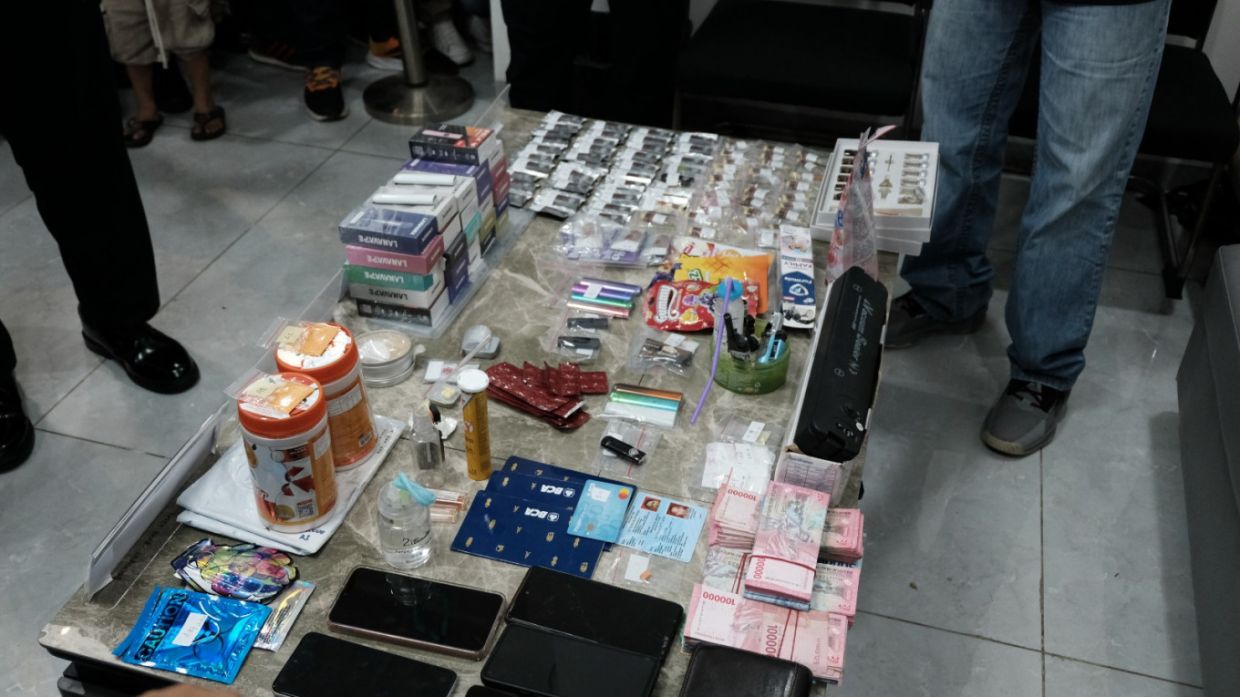
Indonesian law enforcement has successfully broken up a sophisticated cross-border narcotics operation centred in Batam, marking a significant victory in the ongoing battle against transnational drug trafficking in Southeast Asia. The National Narcotics Agency (BNN) and the Customs and Excise Directorate General announced the results of coordinated raids on Friday, revealing the dismantling of a highly structured criminal network that had been funnelling dangerous synthetic drugs into the Riau Islands through carefully orchestrated smuggling routes and distribution channels.
The investigation began when customs officers at Soekarno-Hatta International Airport in Jakarta intercepted a suspicious package arriving from Malaysia that had been disguised as an innocent shipment of Orange Fiber Xtra food supplement. Laboratory testing at the Customs and Excise Laboratory (BLBC) in Jakarta exposed the deception, revealing the presence of MDMA, ketamine and other controlled substances hidden within the packaging. This discovery triggered an intensive joint investigation between BNN and Customs personnel, setting in motion a series of strategic operations that would ultimately lead to the arrest of six Indonesian nationals connected to the operation.
According to BNN deputy for enforcement Insp. Gen. Aswin Sipayung, the syndicate operated with remarkable sophistication, employing a well-coordinated pipeline that began with illegal border crossings and continued through drug repackaging and systematic distribution across the Riau Islands. Officers conducted simultaneous raids on four locations linked to the network, including a shophouse in the Sakura Garden area in Batu Ampar where the initial press conference was held. The first breakthrough came when authorities apprehended a suspect identified as BAP at a location in Batam on Wednesday as he attempted to collect the intercepted package. Following BAP's interrogation, officers quickly moved against three additional suspects—ED, NC and TFS—at a hotel in Baloi, where ED was identified as the individual who had ordered the shipment.
The enforcement sweep subsequently expanded to search TFS's apartment in Teluk Tering and a boarding house in Sakura Garden occupied by two other suspects, AJ and DA. At these locations, authorities uncovered an alarming cache of drugs and paraphernalia, including dozens of electronic cigarette pods laced with etomidate, quantities of methamphetamine (sabu), Happy Five tablets and sachets of Happy Water drinks. The deployment of a K-9 unit from the Batam Customs and Excise Office during the raid at Batu Ampar underscored the scale and professional nature of the enforcement operation. In a complementary action, customs officers at Batam Centre International Ferry Terminal intercepted a separate attempt to smuggle 48 etomidate-containing cartridges from a Malaysian passenger arriving from Stulang Laut International Ferry Terminal in Johor Bahru.
The total quantity of narcotics and precursor chemicals seized demonstrates the operation's scale: 1,076.18 grams of MDMA, 50 grams of methamphetamine, 25.6 grams of ketamine powder, 86 Happy Five tablets, 10 ecstasy pills, 170 vape cartridges containing etomidate, 12 vials of etomidate weighing 226 grams, 88 vape devices, nine paraphernalia items used for methamphetamine consumption, three plastic sealing devices and six digital scales. Law enforcement also impounded multiple vehicles including a Toyota Alphard van, a Toyota Agya hatchback, a Chery SUV and two motorcycles, which had been utilised in the distribution network.
The syndicate's operational tradecraft reveals a sophisticated understanding of modern smuggling techniques. The criminal network deliberately employed innocuous food and supplement packaging as a cover, then resealed containers using plastic sealing devices to maintain the appearance of legitimate commercial products during transit and distribution. This approach, designed to circumvent inspection at borders and ports, reflects the evolving sophistication of regional drug trafficking operations that increasingly exploit commercial supply chain vulnerabilities to move contraband across international boundaries.
However, the operation remains incomplete. Indonesian authorities are actively pursuing two Malaysian nationals, identified as SL and WKC, who have been designated as the primary suppliers orchestrating the cross-border pipeline. Both men have been placed on wanted lists as the investigation continues to establish the full scope of their involvement and identify potential connections to other criminal networks operating in the region. The BNN and Customs authorities are investigating whether the dismantled syndicate maintains connections to a drug manufacturing facility recently raided in Batam, suggesting the possibility of a more extensive clandestine operation.
The arrested individuals face severe legal consequences under Indonesian narcotics legislation. Suspects are being prosecuted under Article 114(2) in conjunction with Article 132(1) and/or Article 112(2) in conjunction with Article 132(1) of Indonesia's Law No. 35/2009 on Narcotics, offences carrying minimum sentences of five years imprisonment, with conviction potentially resulting in capital punishment. Additionally, convicted defendants face maximum fines of Rp10 billion, representing a significant financial deterrent.
Batam Customs and Excise Office head Agung Widodo emphasised the public health dimensions of the enforcement action in a written statement, noting that the operation effectively protected approximately 6,770 individuals from potential drug consumption and prevented an estimated Rp10.8 billion (approximately US$599,000) in state healthcare and rehabilitation costs. This calculation underscores how narcotics enforcement agencies increasingly frame drug interdiction not merely as crime prevention but as public health intervention, reflecting the broader regional recognition that combating transnational drug trafficking protects vulnerable populations and alleviates strain on already stretched healthcare systems.
The successful dismantling of this Malaysian-led operation reflects intensifying cooperation between Indonesian law enforcement agencies and demonstrates the region's growing capacity to track and disrupt sophisticated cross-border criminal networks. The case highlights the particular vulnerability of Batam and the Riau Islands to narcotic smuggling due to geographical proximity to Malaysia and extensive maritime access points. For Malaysia, the revelation that nationals are operating as primary suppliers in cross-border networks underscores the urgent need for enhanced domestic enforcement and stronger bilateral coordination with Indonesian counterparts. The continued manhunt for SL and WKC will test bilateral cooperation frameworks and potentially establish precedents for information-sharing and joint operations targeting transnational criminal syndicates operating across the Strait of Malacca region.

