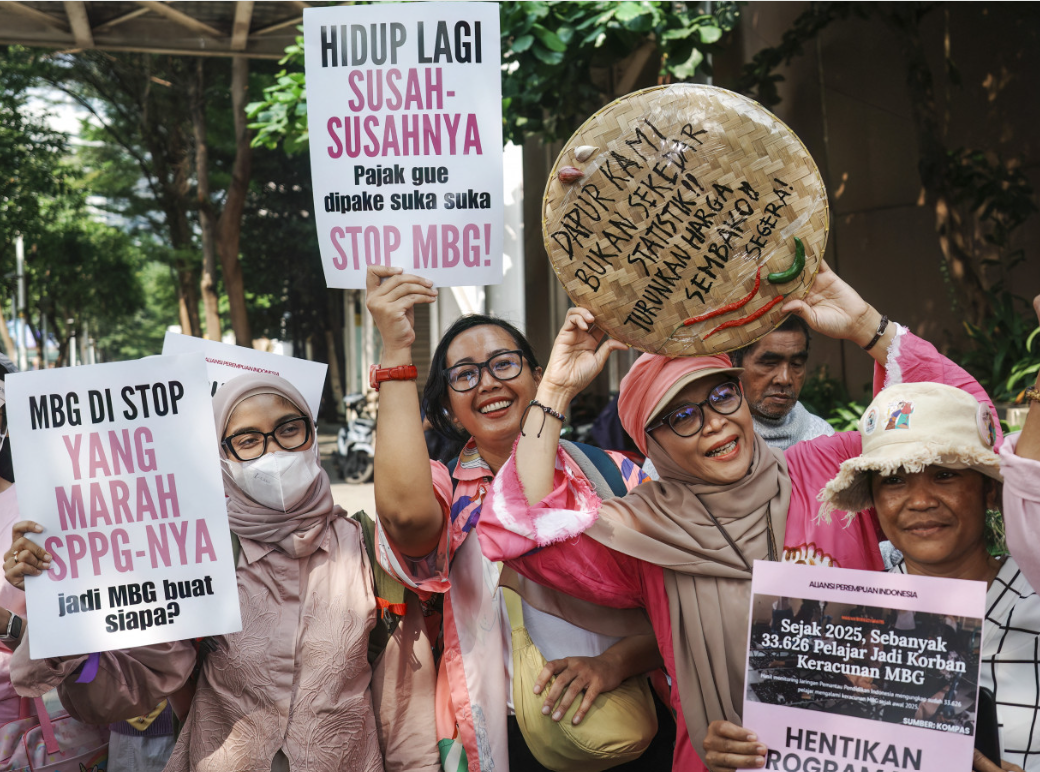
President Prabowo Subianto's ambitious free nutritious meal programme, designed to combat childhood stunting across Indonesia, is facing a credibility crisis as recipients reject the meals citing unacceptable quality, forcing policymakers to confront uncomfortable questions about whether the multi-billion-dollar initiative is actually serving those it purports to help. The controversy has moved beyond isolated complaints to become a sustained challenge to the programme's legitimacy, with beneficiaries and advocacy groups demanding a suspension and comprehensive overhaul rather than continued rollout of what was intended as a flagship social policy.
The depth of public dissatisfaction became apparent through personal testimony from mothers who had enrolled in the scheme. Nesti Nagari, a 29-year-old from Kediri in East Java, described her shock at receiving what appeared to be an unidentifiable clumped paste allegedly intended for her eight-month-old infant. Her social media post documenting the meal garnered over 11,000 likes, resonating with thousands of Indonesians who share concerns about whether their children are receiving genuinely nutritious food or simply processed material that barely meets basic definition of edible matter. Rather than continue accepting the assistance, Nagari made the striking decision to reject further meals, stating she retained capacity to prepare adequate nutrition for her child independently and would prefer the government redirect resources toward more pressing national priorities like education and healthcare infrastructure.
Similar accounts emerged from other programme participants, particularly Diah Farika, a breastfeeding mother in Semarang, Central Java, who enrolled in May but encountered persistent quality problems that went unaddressed by the nutrition fulfillment service units responsible for meal preparation. Her concerns were dismissed rather than investigated, leading her to decline further meals despite theoretically qualifying for assistance. Photographs she provided showed portions she deemed inadequate and components including unripe fruit, suggesting meals were assembled with minimal attention to nutritional appropriateness or palatability. Diah's perspective proved particularly significant because it highlighted not merely quality shortcomings but systematic unresponsiveness from implementing agencies when beneficiaries raised legitimate concerns.
The beneficiary perspective carries particular weight in Southeast Asia's context, where social safety net programmes frequently suffer from implementation gaps between central policy design and ground-level delivery. For Malaysia and neighbouring nations monitoring Indonesia's experience, the case demonstrates how even well-funded initiatives can falter without robust quality assurance and genuine responsiveness to end-user feedback. When mothers of vulnerable children feel compelled to reject government assistance rather than expose their infants to questionable meals, the programme has suffered fundamental failure in its core mission, regardless of budgetary allocation or technical specifications announced in Jakarta.
Beneficiary rejection has been joined by formal advocacy campaigns. In mid-June, the Indonesian Women's Alliance staged coordinated protests in Central Jakarta, bringing together dozens of women and rights activists to demand governmental halt and comprehensive review of the programme. These demonstrations reflected broader public concern that the initiative, despite its stated humanitarian purpose, had become mired in implementation problems suggesting either systemic mismanagement or fundamental design flaws. The protests signalled that criticism extended beyond individual mothers to encompass organised civil society groups with long experience monitoring social programmes and accountability mechanisms.
The momentum toward suspension and reform has been complicated by economic interests invested in the programme's continuation. The nutrition fulfillment service unit network comprises approximately 27,000 kitchens, many established by private investors who have committed hundreds of billions of rupiah in infrastructure development. Following recent corruption scandals involving former National Nutrition Agency leadership, the agency imposed expansion halts, creating financial jeopardy for investors who anticipated growth and recouped returns. This dynamic mirrors common challenges in Southeast Asian social programmes where government policy shifts can devastate private sector participants who invested on premises of continued expansion, creating powerful constituencies resistant to reform regardless of quality concerns.
Funding disruptions compounded implementation problems earlier in June when numerous SPPGs reported temporary closures due to delayed budget transfers, although some subsequently reopened once payments resumed. These interruptions underscored how the programme's ambition—reaching 61 million children and pregnant women across the archipelago—created complex logistical and financial management challenges. When kitchens lack certainty about payment schedules, quality deterioration follows naturally as operators prioritise survival over excellence. The scale of the initiative, while administratively impressive, may exceed the National Nutrition Agency's actual capacity to oversee quality consistently across thousands of distributed facilities.
Independent oversight by civil society groups has proven crucial in documenting systemic issues. MBG Watch, an accountability platform established by civil society organisations, determined that mounting problems had substantially eroded public confidence in the initiative's capacity to deliver genuine benefits. Research from the Center of Economic and Law Studies found that approximately 34 percent of current beneficiaries—roughly 61 million children and pregnant women—did not belong among those most requiring government assistance, including children from economically secure households with adequate nutritional access. This finding raised uncomfortable questions about whether the programme was actually targeting need effectively or had become administratively captured by different imperatives.
The budgetary dimensions add further complexity to assessment. The 2026 budget was initially set at Rp 335 trillion before being reduced to Rp 268 trillion following public pressure and scrutiny about implications for education spending. That the government felt compelled to trim an ostensibly priority social programme reflects broader fiscal tensions Indonesia faces and growing concern among policymakers that other critical investments, particularly in human capital development through education, were being crowded out by the meal initiative. For Malaysian observers, this dynamic illustrates how even substantial budget allocations cannot substitute for programmatic effectiveness, and how political commitment to a single flagship initiative can distort overall social spending priorities.
The National Nutrition Agency has responded to mounting criticism through beneficiary retrenchment rather than wholesale reform. The agency began narrowing recipient populations by removing those deemed capable of meeting nutritional needs independently. By June, 76 schools across Java were dropped from the programme, affecting over 39,000 beneficiaries. Deputy head and spokesperson Agustina Arumsari characterised this refocusing as necessary to concentrate assistance among those genuinely requiring government intervention, language that implicitly acknowledged the previous expansiveness had been excessive. The agency simultaneously implemented austerity measures including eliminating daily kitchen incentives during non-operational periods and evaluating facilities deemed underperforming.
These corrective steps, while acknowledging problems, appear insufficient to address underlying implementation architecture. Quality failures of the magnitude documented by beneficiaries suggest problems extending beyond beneficiary selection to core operational systems. The willingness of mothers to forgo assistance rather than feed it to their children indicates the programme had fundamentally breached social contract premises—that government support would genuinely enhance child welfare rather than create new forms of deprivation. Such profound legitimacy loss proves difficult to recover through marginal adjustments to beneficiary numbers or operational incentives. Comprehensive reform would likely require restructuring supply chains, substantially increasing oversight capacity, and establishing meaningful feedback mechanisms through which beneficiaries could influence service quality without dismissal.
For Southeast Asian policymakers and analysts, Indonesia's experience offers cautionary lessons about scaling social programmes without adequate implementation infrastructure. The gap between budgetary ambition and delivery reality, evident across ASEAN nations, becomes most acute when programmes target vulnerable populations dependent on government reliability. Malaysia, Thailand, and Vietnam monitor such developments closely given similar pressures to expand social protection systems amid demographic and fiscal constraints. The Indonesian case demonstrates that programme credibility depends ultimately on whether recipients perceive genuine benefit, a threshold that substantial budget allocations cannot automatically ensure. Whether the National Nutrition Agency successfully implements meaningful reform or the programme continues declining will signal important lessons for regional social policy debates.