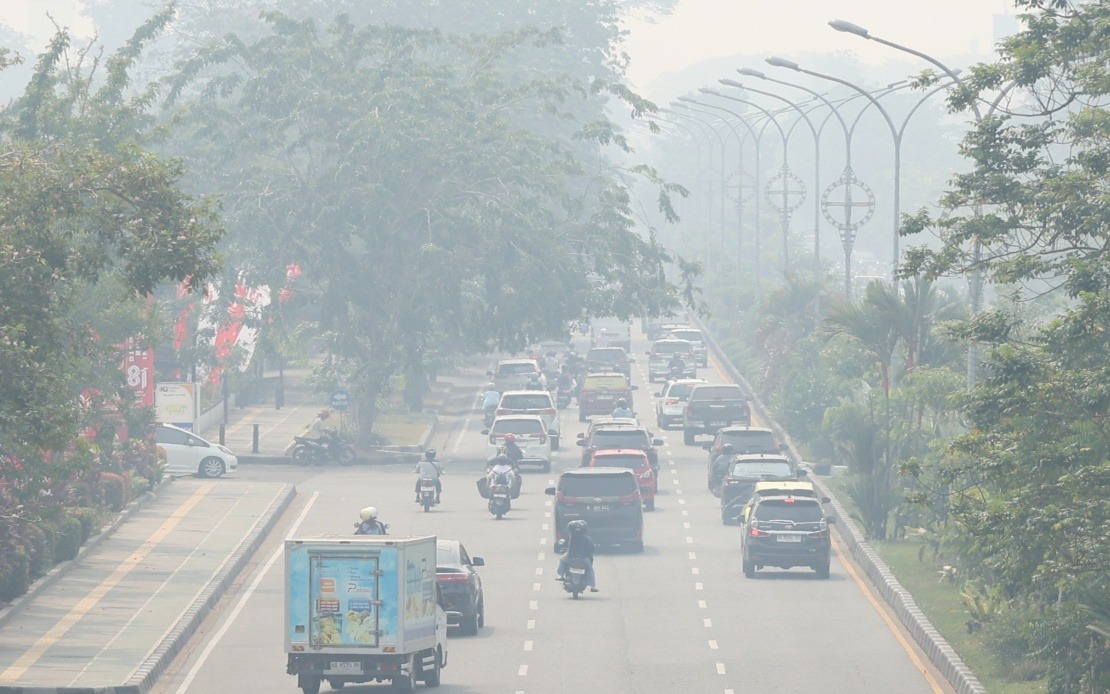
Indonesia's environmental and health authorities are grappling with a rapidly deteriorating air crisis spawned by widespread forest and land fires that have contaminated the atmosphere across multiple regions. The Air Pollutant Index has reached critically hazardous levels of 573 in Jekan Raya, a subdistrict within Palangka Raya in Central Kalimantan, according to measurements compiled from 17 monitoring stations as of early Wednesday morning. This spike underscores the severity of a pollution event that threatens millions of Indonesians and carries implications for air quality across Southeast Asia, including Malaysia's eastern regions.
The geographic scope of the crisis extends across both Sumatra and Kalimantan islands, with health officials documenting hazardous pollution levels in multiple locations. Muaro Jambi Regency in Jambi province recorded an API reading of 302, also classified as hazardous, whilst numerous other municipalities registered readings in the very unhealthy category of 201 to 300. This second tier includes Pelalawan in Riau, Penukal Abab Lematang Ilir and Ogan Ilir in South Sumatra, Southeast Pontianak in West Kalimantan, and both Gunung Mas and Katingan in Central Kalimantan. The consistent spread of readings above 200 across such a large territory signals a systemic atmospheric contamination event rather than isolated incidents.
These Pollutant Index measurements directly inform public health guidance and emergency response protocols. Environmental Health Director Then Suyanti issued stark warnings to residents of areas experiencing hazardous pollution, recommending complete avoidance of outdoor activities when API readings exceed the hazardous threshold. In regions classified as very unhealthy, the ministry advised the public to minimise time spent outdoors, particularly cautioning sensitive population groups including children, the elderly, and those with respiratory conditions. The specificity of these directives reflects the tangible health risks posed by particulate matter and other air contaminants released by the fires.
The scale of human impact extends well beyond air quality statistics. Health Crisis Centre Head Agus Jamaludin confirmed that approximately 3.4 million people across seven provinces have been affected by the smoke and haze. These provinces—Riau, Jambi, and South Sumatra on Sumatra island, together with West, Central, East, and South Kalimantan—have each formally declared an emergency alert status. Whilst authorities have not escalated to a full emergency response status, this declaration signals official recognition that the situation has transcended normal operational parameters. The distinction between alert and response status suggests confidence that current containment efforts might yet prevent further deterioration, though this assessment remains subject to how rapidly firefighting operations proceed.
Despite the severity of air pollution, direct health casualties have remained limited thus far. Medical authorities documented 42 individuals sustaining minor injuries, with two others—both burn victims in South Kalimantan—suffering serious injuries requiring hospitalisation. Notably, no deaths have been reported and no evacuations ordered, suggesting that the primary health threat stems from inhalation of pollutants rather than direct fire exposure. However, the mobilisation of 321 health personnel across affected provinces indicates that authorities are preparing for potential secondary health consequences, including respiratory complications that may emerge in vulnerable populations over coming days and weeks.
The Indonesian government has moved to implement protective measures through education and workplace adaptations. The Health Ministry is finalising a circular that may be issued within two days, establishing protocols designed to safeguard public health when air quality deteriorates. Among the proposed interventions is authorisation for schools to transition to distance learning during periods of severe pollution, effectively removing children from hazardous outdoor environments during school hours. Such measures reflect recognition that conventional operational patterns become untenable when pollution reaches levels that pose genuine health risks, particularly for young people whose lungs are still developing.
Underlying this crisis is an expansive geographic distribution of active fire danger across Indonesia's forested regions. The Forestry Ministry's satellite monitoring detected 805 high-confidence hotspots and 11,313 medium-confidence hotspots nationally as of late Tuesday evening. This data reveals a fire landscape of concerning proportions, with ignition sources scattered across vast territories. Among the six priority provinces, South Sumatra recorded the highest concentration of high-confidence hotspots with 239, followed by Central Kalimantan with 113, South Kalimantan with 89, and West Kalimantan with 86. Jambi and Riau contributed seven and one high-confidence hotspots respectively, indicating that whilst these provinces record lower readings, they remain within the crisis region.
The distribution of medium-confidence hotspots—those likely to develop into active fires—suggests continued risk across the coming period. West Kalimantan leads with 2,447 medium-confidence hotspots, trailed by Central Kalimantan with 2,168. South Sumatra recorded 1,161, whilst South Kalimantan registered 710. Riau and Jambi contributed 199 and 197 respectively. This inventory of potential fire sources indicates that current air quality crises may persist or intensify if firefighting efforts prove insufficient to contain active blazes or if additional hotspots ignite. The satellite data essentially maps the trajectory of Indonesia's environmental crisis over the coming days.
For Malaysian observers, the Indonesian fire crisis carries direct regional implications. Southeast Asian geography means that prevailing wind patterns regularly transport Indonesian haze into Malaysian territory, particularly affecting Sabah, Sarawak, and the Peninsular regions. Historical precedent demonstrates that Indonesian pollution events of this magnitude invariably produce transboundary air quality degradation in Malaysia. Beyond immediate air quality effects, Indonesia's fire crisis carries broader environmental consequences including carbon emissions from forest destruction and ecosystem degradation that affect regional climate patterns. The current crisis thus represents both an immediate humanitarian issue for Indonesian citizens and a phenomenon with ramifications extending throughout the region.
The firefighting response remains the critical variable determining whether current pollution levels stabilise, improve, or deteriorate further. Indonesian authorities have indicated hope that systematic firefighting efforts will gradually contain the fires and reduce resulting haze. However, the vast spatial distribution of hotspots and the scale of affected territory suggest that achieving this goal requires sustained effort across multiple provinces simultaneously. The declaration of emergency alert status reflects pragmatic acknowledgment that conventional firefighting resources may prove insufficient without additional mobilisation. Regional observers will monitor whether Indonesia can effectively reduce fire activity and air pollution before conditions cross further critical thresholds that might necessitate escalation to full emergency response protocols across the affected provinces.

