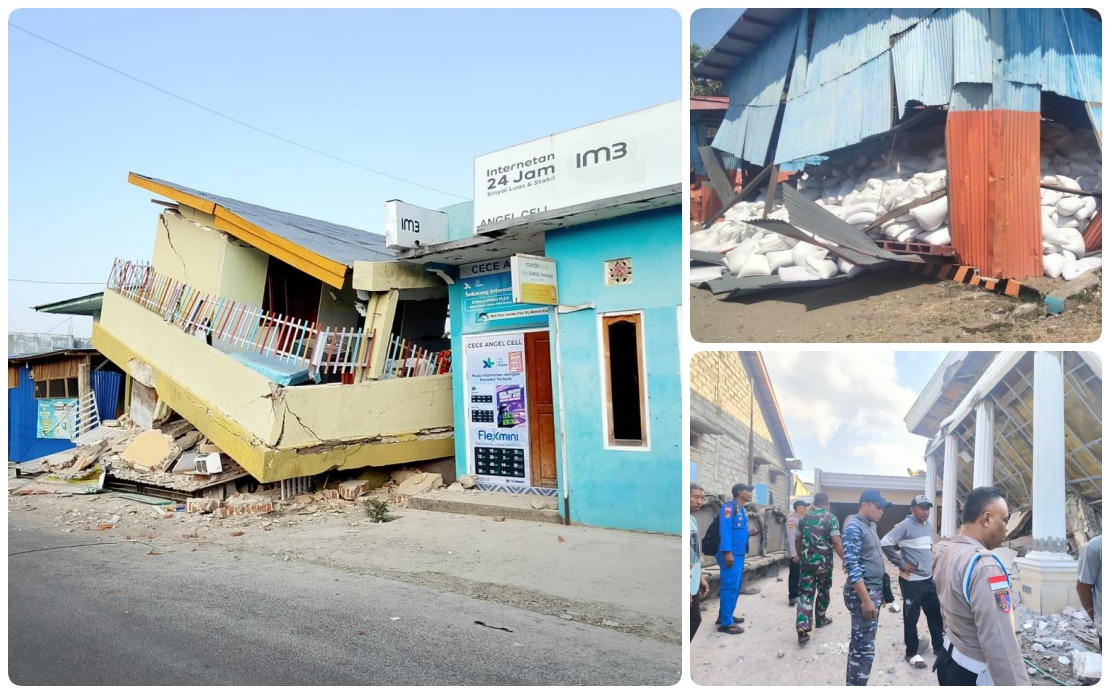
Indonesia's Flores Island faced a mounting humanitarian challenge on Sunday as seismic activity continued unabated in the wake of a powerful magnitude 7.7 earthquake that struck before dawn. Authorities reported nearly 1,000 recorded aftershocks in the days following the initial quake, with the National Disaster Management Agency confirming at least 53 deaths and 135 injuries across seven affected regencies and cities. The sheer volume of tremors—995 recorded as of Sunday afternoon alone—underscored the scale of geological disruption, though officials noted that only a fraction were perceptible to residents.
The earthquake struck at 4.58 am local time with its epicentre positioned approximately 30 kilometres from Mbay in Nagekeo district, seated at a depth of 15 kilometres beneath the ocean floor. The offshore location initially triggered tsunami warnings, prompting heightened alert status throughout the region. However, the Meteorology, Climatology and Geophysics Agency lifted the tsunami alert by 7.31 am after monitoring showed no significant rise in sea levels, providing some relief to anxious populations already dealing with the primary earthquake's destructive force.
The sustained aftershock activity created a complex psychological and practical challenge for displaced residents. According to National Disaster Management Agency Deputy for Prevention Abdul Muhari, approximately 9,290 people had sought refuge at evacuation centres by Saturday midnight, with many reluctant to return to their homes despite ongoing stabilisation efforts. The hesitation stemmed partly from legitimate structural concerns—thousands of homes had sustained damage requiring assessment and repairs—but also from deep-rooted collective memory. The 1992 Flores earthquake and subsequent tsunami remained a traumatic reference point for older residents, making the psychological barriers to resettlement as significant as the physical obstacles.
Emergency response operations entered their second critical phase with authorities pivoting toward victim assistance and infrastructure restoration. The focus shifted from immediate search and rescue toward providing essential supplies, conducting structural assessments, and repairing critical infrastructure that the earthquake had severed. Notably, officials reported no missing persons across the affected areas, a finding that suggested either thorough accounting or that fatalities had been identified rather than remaining unconfirmed. Abdul Muhari emphasised this point during a Sunday press conference, stating that across all seven impacted regencies and cities, authorities maintained no active search list for unaccounted individuals.
Logistical challenges persisted as the emergency response infrastructure mobilised across multiple fronts. A crucial road section in Reok, Manggarai, which had been blocked by landslide debris, was cleared sufficiently to allow fuel tanker trucks to pass—a necessary step for sustaining emergency operations and preventing secondary humanitarian crises from fuel shortages. Electricity restoration proceeded incrementally in several blackout-affected areas, though widespread power outages continued to hamper communications and medical services in remote communities. The distributed nature of the disaster across seven jurisdictions complicated coordination efforts, requiring the establishment of dedicated response posts in key centres.
The National Disaster Management Agency strategically positioned response and logistics hubs in Labuan Bajo and Maumere, with additional support coordination centres activated in Jakarta to streamline the flow of relief materials, specialised equipment, and rescue personnel. This multi-layered approach reflected lessons learned from previous disasters in the Indonesian archipelago, where geographic dispersion and transportation challenges frequently complicate emergency response. Aircraft and helicopters stood ready for deployment, providing contingency capacity should ground-based relief operations prove insufficient or secondary disasters—such as landslides or infrastructure failures—require aerial intervention.
The earthquake's impact rippled beyond immediate casualty figures and damaged infrastructure, exposing vulnerabilities in Indonesia's disaster preparedness systems. Flores Island's position along the Pacific Ring of Fire meant seismic activity remained an ever-present threat, yet the region's limited emergency infrastructure and evacuation capacity suggested ongoing gaps in disaster readiness. For Malaysian observers, the situation underscored broader Southeast Asian vulnerabilities to tectonic events, particularly in island communities where isolation can impede rescue efforts and complicate supply chains during emergencies.
Casuality figures continued evolving as verification processes advanced, with authorities explicitly noting that comprehensive data consolidation remained incomplete during the initial emergency phase. The 53 confirmed deaths and 135 injured represented preliminary counts subject to revision as field teams completed assessments and communicated findings to central coordination bodies. This distinction between preliminary and verified figures highlighted the operational reality of large-scale disaster response, where accurate information emerges gradually across distributed field sites rather than instantaneously.
The broader context of Indonesia's earthquake vulnerability gained renewed prominence through this incident. The nation straddles multiple tectonic boundaries, rendering earthquakes an inevitable rather than exceptional occurrence. Flores itself has experienced multiple significant seismic events, including the catastrophic 1992 earthquake that killed over 2,000 people and generated a devastating tsunami. The psychological inheritance from that disaster—manifested in residents' reluctance to leave evacuation centres despite assurances of safety—represented an underappreciated dimension of disaster recovery requiring long-term psychosocial support and community resilience-building initiatives.
As emergency operations progressed into their second day, the challenge shifted from immediate response toward sustainable recovery. Authorities faced mounting demands for temporary shelter, medical care, and reconstruction assistance, all while managing the practical complications posed by continuous aftershocks and infrastructure damage. The deployment of comprehensive relief networks and the strategic positioning of response assets demonstrated institutional learning from previous disasters, yet the scale of displacement and destruction suggested that recovery would extend well beyond the initial emergency phase. For regional partners and the international community, the situation represented both a humanitarian concern requiring potential assistance and a sobering reminder of natural disaster preparedness requirements across Southeast Asia's seismically active zones.

