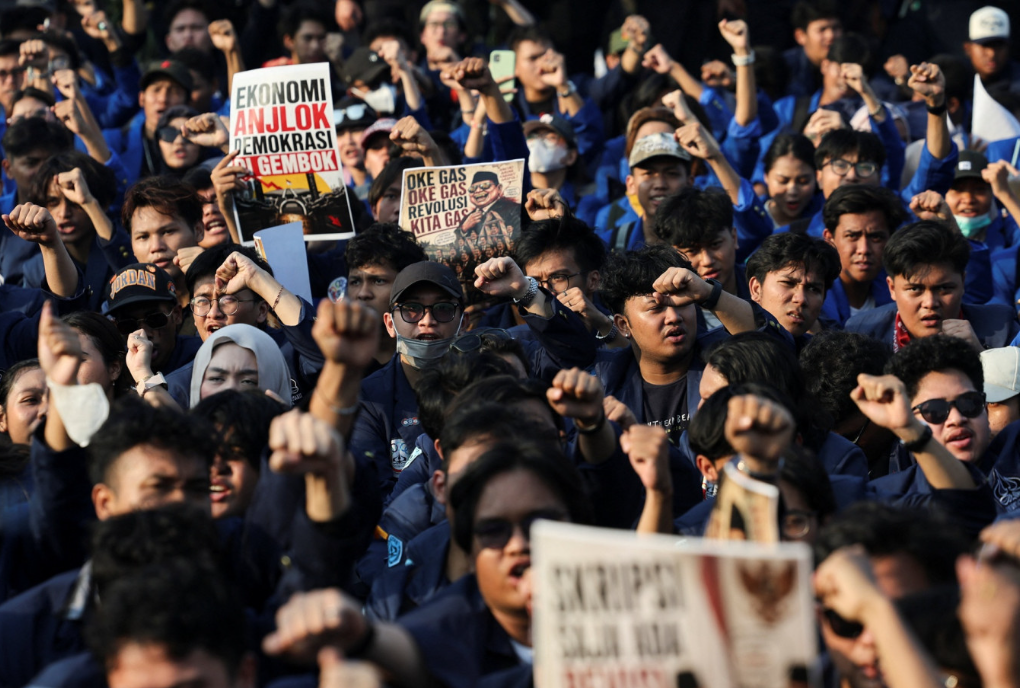
President Prabowo Subianto's flagship free nutritious meal programme has become a lightning rod for public discontent, triggering a wave of competing demonstrations across Indonesia that expose deep divisions over government spending, food safety standards, and implementation integrity. The competing rallies reveal how a single policy initiative can simultaneously alienate fiscal conservatives demanding government restraint whilst mobilising beneficiaries and workers fearful of losing livelihoods or essential support services. What began as a poverty-alleviation measure has transformed into a focal point for broader anxieties about the direction of Indonesia's economy and the credibility of public institutions.
In Bali, university students converged outside the provincial legislative building in Denpasar demanding a comprehensive audit of the meal programme alongside deeper institutional reforms. Their concerns centred on three interconnected issues: the programme's substantial budgetary footprint at a moment when government agencies face spending reductions, mounting reports of food poisoning linked to meal preparation and distribution, and escalating corruption allegations ensnaring senior officials. The student movement sought intervention from the Supreme Audit Agency to conduct forensic examination of how resources have been deployed and funds accounted for since the programme's inception last year.
Jakarta witnessed larger-scale mobilisation when thousands of students affiliated with the Indonesian Islamic Student Movement staged demonstrations at the House of Representatives complex, specifically targeting the National Nutrition Agency's leadership structure. Their demands intensified following the arrest of three top agency officials on corruption charges, creating perception that institutional mismanagement extended to the programme's operational core. The protesters framed their action not merely as opposition to a single initiative but as expression of broader frustration with what they characterised as profligate state expenditure during an economically fragile period. Parallel rallies in Batam reinforced this pattern, with student activists calling for programme suspension if audits revealed ineffectiveness or failure to reach genuinely vulnerable populations.
The Bali and Jakarta protests represent predominantly middle-class, education-aligned constituencies questioning whether Rp 335 trillion (US$15 billion) represents optimal deployment of constrained public resources. Their emphasis on fiscal discipline and institutional accountability resonates with orthodox economic thinking that Indonesia's government must prioritise debt reduction and macroeconomic stabilisation over expansionary social spending. These protesters implicitly challenge the administration's prioritisation of nutritional intervention over other competing budget demands, arguing that thoroughgoing efficiency improvements and means-testing mechanisms should precede any programme expansion.
Yet the mobilisation reveals an opposite pole of Indonesian society equally invested in the programme's continuation. Kitchen workers organised demonstrations across Batam and beyond, voicing that the proposed reduction from six-day to five-day weekly meal distribution, combined with suspension during school holidays, would directly impair their ability to meet family expenses. Approximately 1,500 kitchen workers in Batam alone face income erosion from the policy adjustments, with protest coordinator Langga Husein noting that daily wage employment leaves no buffer for anticipated income loss. This constituency perceives the efficiency measures not as technical adjustments but as threats to economic survival.
Farmers and agricultural producers have similarly mobilised in support of programme continuation, recognising that substantial demand for corn, rice, cassava, fruits and vegetables sustains commodity prices that might otherwise weaken given global supply pressures and domestic oversupply risks. Residents in Bandar Lampung highlighted that the free meal initiative functions as a demand stabiliser for agricultural products, benefiting smallholder farmers whose incomes depend upon reliable market outlets. From this perspective, programme suspension represents not merely removal of nutritional support for vulnerable populations but contraction of agricultural demand with cascading effects across rural economies.
Pregnant women, breastfeeding mothers, and toddlers represent a third beneficiary cohort whose needs extend beyond school operations, complicating the administration's effort to suspend meal distribution during extended holiday periods. Protesters accurately noted that malnutrition risk persists throughout the year regardless of school calendar, suggesting that suspension mechanisms may undermine the programme's core objective of reducing childhood stunting and maternal nutritional deficiency. This dimension reveals tension between fiscal efficiency and public health continuity, illustrating that cost-reduction measures may inadvertently compromise the epidemiological outcomes the programme ostensibly targets.
The corruption allegations surrounding National Nutrition Agency officials have substantially complicated political defence of the programme, even amongst potentially sympathetic constituencies. Allegations that senior officials diverted resources or engaged in procurement fraud create impression that programme benefits fail to reach intended recipients, eroding trust in institutional stewardship. Government Communications Agency head Muhammad Qodari and National Nutrition Agency Deputy Head Agustina Arumsari have argued that the programme warrants improvement rather than suspension, positioning themselves as advocates for reformed rather than eliminated intervention. The government has subsequently reduced budget allocation to Rp 228.4 trillion and introduced efficiency measures including targeted school exclusions and holiday suspensions.
President Prabowo's administration faces a genuine policy dilemma lacking straightforward resolution. Programme suspension would alienate beneficiary constituencies and local agricultural producers whilst demonstrating responsiveness to fiscal conservative demands. Continuation with cosmetic modifications risks perpetuating public perception of mismanagement and corruption whilst failing to address underlying concerns about resource deployment and institutional accountability. Comprehensive audit and reform might satisfy both constituencies, yet such processes require time that immediate budget pressures and political demands may not permit.
For Malaysian observers, the Indonesian experience illuminates tensions that domestic policymakers navigate when introducing universal or near-universal social programmes. The competing mobilisations reveal how single policy initiatives simultaneously satisfy material needs for vulnerable populations and provide employment for supporting workers, creating constituencies with direct economic interest in programme expansion or continuation. The corruption allegations underscore importance of institutional design, procurement transparency, and oversight mechanisms that prevent resource diversion regardless of programme merits. Indonesian student activism around fiscal restraint suggests growing generational concern across Southeast Asia regarding debt trajectories and public sector sustainability, concerns increasingly salient as regional governments confront fiscal pressures and demographic aging.
The competing protests ultimately reflect fundamental disagreement about Indonesia's fiscal priorities and institutional capacity, disagreements unlikely to be resolved through programme refinement alone. Middle-class constituencies questioning government spending discipline, worker groups defending employment opportunities, agricultural producers protecting market demand, and beneficiary populations depending upon nutritional support represent genuinely competing interests rather than variations upon common policy preference. How the Prabowo administration navigates this terrain will provide instructive lessons regarding political sustainability of ambitious social programmes when institutional credibility has been damaged and fiscal space remains constrained.