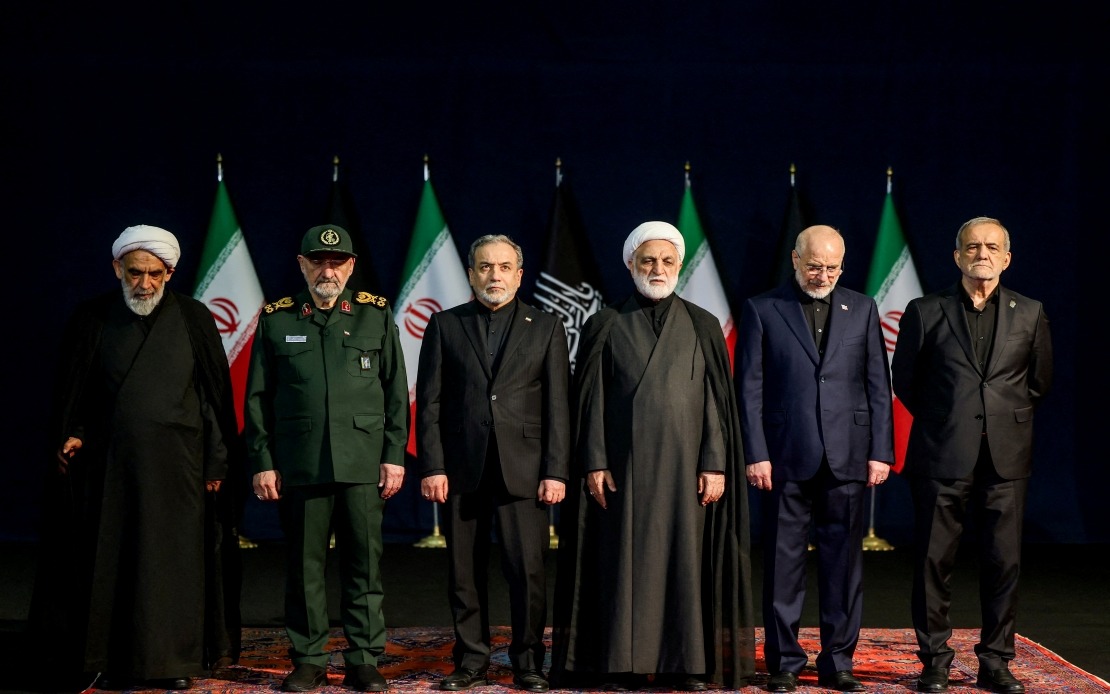
Iran's political establishment and a distinguished roster of foreign dignitaries converged on Tehran on Friday to pay formal respects to the nation's late Supreme Leader Ayatollah Ali Khamenei at a major state ceremony. The tribute took place at Imam Khomeini's Mosalla prayer hall in central Tehran, beginning in the morning hours and extending throughout the day as streams of officials and mourners filed past to honour the leader who shaped Iranian politics for decades.
The gathering reflected the significant role Khamenei held in Iran's power structure and the broader regional importance his death carries. Among those who attended were Iran's President Masoud Pezeshkian, Parliament Speaker Mohammad Baqer Qalibaf, and Judiciary Chief Gholamhossein Mohseni-Ejei, representing the three pillars of Iran's government system. Also present were Chairman of the Expediency Discernment Council Sadeq Amoli Larijani and various other government ministers and senior administrators, underlining the comprehensive nature of official acknowledgment across Iran's leadership hierarchy.
The international representation at the ceremony underscored the geopolitical weight of Khamenei's passing and Iran's standing in regional affairs. Pakistan sent Prime Minister Shehbaz Sharif alongside Chief of Army Staff Field Marshal Syed Asim Munir, signalling the importance Islamabad places on its relationship with Tehran. The presence of Armenian Prime Minister Nikol Pashinyan alongside Georgian President Mikheil Kavelashvili illustrated participation from the Caucasus region, while Iraq's representation included both President Nizar Amedi and Nechirvan Barzani, the leader of Iraq's Kurdistan Region, reflecting the intricate ties binding Iran to its western neighbour.
Asia's major powers also sent senior representatives, with delegations attending from both China and Russia, nations with which Iran has cultivated increasingly close strategic partnerships in recent years. Tajikistan's President Emomali Rahmon represented Central Asia's participation in the proceedings. Beyond government figures, the ceremony also drew Iran's religious establishment, with scholars, clerics, and tribal leaders attending to mark what many within Iran regard as a profound loss for the Islamic Republic.
Khamenei's death, which occurred on February 28 when he was killed in a combined United States and Israeli strike targeting Tehran, represented an extraordinary moment in contemporary Iranian history. The circumstances of his death—in what Iran condemned as an act of aggression by its longtime adversaries—gave the tribute ceremony added resonance as both a moment of national reflection and a demonstration of continuity amid significant instability.
The ceremonies honouring Khamenei are scheduled to extend through July 9, with major processions planned for multiple Iranian cities. Tehran will host central commemorative events, while the holy cities of Qom and Mashhad—both of profound religious significance in Iran—will hold their own processions and observances. Additionally, religious rites honouring the late leader will take place across the border in Iraq, reflecting the transnational dimensions of Shiite religious practice and Iran's religious authority in the broader Muslim world.
Iranian authorities have implemented substantial logistical measures to accommodate the scale of the mourning period. Public closures and airspace restrictions have been announced for Tehran and Mashhad on dates coinciding with major ceremonial events, reflecting security concerns and the need to manage the anticipated flow of mourners. Thursday was declared a national day of mourning across the country, signalling the official status accorded to Khamenei's death within the Iranian state system.
The succession process moved with notable speed following Khamenei's death. In March, his son Mojtaba Khamenei was selected as Iran's new Supreme Leader, a development that consolidated familial control over the Islamic Republic's highest office and raised questions about the nature of Iran's political succession for observers both within and outside the country. This transition occurred amid the ongoing tensions with Western nations and the complexities of managing a regional power with significant military capabilities and influence across the Middle East.
For Southeast Asian nations like Malaysia, which maintain diplomatic relations with Iran and have significant Shiite Muslim populations, such high-profile succession moments carry implications for bilateral ties and regional stability. The attendance of multiple heads of state from neighbouring countries at Khamenei's tribute ceremony signals that despite Western opposition to Iran, the Islamic Republic retains substantial diplomatic reach and influence throughout Asia. The rapid consolidation of power within the Khamenei family also raises questions about whether Iran's approach to regional conflicts and nuclear negotiations might shift under new leadership, developments that could indirectly affect trade relationships and security dynamics in Southeast Asia.

