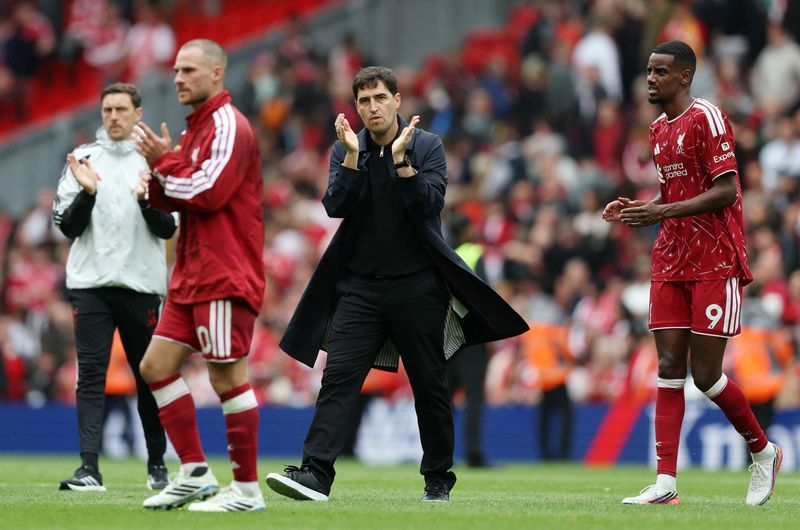
Andoni Iraola has yet to taste victory since taking charge of Liverpool this summer, but the Spanish manager is drawing encouragement from the manner of his side's response against Nottingham Forest on Saturday, which ended in a 2-2 draw. That result, coupled with an identical scoreline in the season opener at Newcastle, suggests that beneath the surface, a fundamental shift in approach is gaining traction at Anfield, even as the points tally remains modest.
The former Bournemouth boss inherited a wounded institution. Last season proved humbling for Liverpool, whose bid to defend their 2025 title ended in disappointment when the club slumped to fifth place despite a staggering investment of £446 million on fresh personnel—a sum that set a Premier League record. Restoring European football's traditional elite to the English summit represents the central challenge of Iraola's tenure, a task that demands both tactical innovation and cultural recalibration after years of contrasting managerial philosophies.
Iraola's appointment signals a deliberate choice to abandon the cautious pragmatism that characterized Arne Slot's two-year stewardship. Instead, the new manager has opted for an aggressive blueprint centred on positional pressing, rapid ball circulation, and relentless forward momentum—a style that echoes the "heavy-metal football" delivered by Juergen Klopp during his most dominant years, when Anfield commanded genuine fear among visiting sides. This departure from the defensive-minded approach of recent campaigns has obvious appeal to supporters starved of the intensity and entertainment that defined the club's peak years.
Yet the transition remains embryonic and uneven. During Saturday's first-half display against Forest, Liverpool's execution faltered noticeably. The visitors exploited Liverpool's hesitancy by striking through Dan Ndoye via a brisk counterattack, exposing the gap between Iraola's ambitions and current reality. Long stretches of sluggish, directionless play prompted visible frustration on the touchline, suggesting that embedding such a demanding system requires far more than tactical instruction alone.
The transformation after the interval, however, vindicated Iraola's conviction in his methods. Alexander Isak restored parity shortly after the hour, with new winger Victor Munoz snatching an unlikely equaliser late on. Iraola's assessment in the post-match interviews zeroed in on the difference between the two halves, drawing a direct correlation between elevated work-rate and improved outcomes. "When we improved the intensity, we won more duels and started attacking quicker and attacking better," he explained, identifying passivity without possession as the root problem underlying Liverpool's sluggish openings.
Victory in either contest would have transformed the narrative substantially, yet Iraola has adopted a measured tone regarding the twin draws. He has explicitly acknowledged that his tactical revolution cannot materialise instantaneously, a realistic assessment that reflects his experience implementing systemic changes at Bournemouth. The character demonstrated through two comebacks from losing positions supplies genuine evidence of resilience and adaptability—qualities essential for sustaining a high-octane system over a gruelling 38-match campaign.
The summer reinforcements arriving at Anfield are designed to amplify Iraola's preferred approach. Liverpool have sealed an agreement to recruit France winger Bradley Barcola from Paris Saint-Germain, with the 23-year-old's directness and explosive pace viewed as a natural complement to the manager's attacking blueprint. Such additions suggest the club's hierarchy remains convinced by the strategic direction, despite the absence of early dividends in the standings.
What emerges from Liverpool's opening fortnight is a side caught between aspiration and execution. The entertainment quotient has undoubtedly risen compared to Slot's tenure, with matches generating the kind of open, attacking football that resonates with the club's historical identity. Yet transforming improved second-half performances into consistent, match-winning football remains the fundamental test ahead. Iraola's conviction that the foundations are solidifying may yet prove prescient, but only if Liverpool can eliminate the habitual slow starts that have plagued them and maintain elevated intensity from kick-off onwards.
For Manchester and Southeast Asian observers tracking Liverpool's fortunes, the Iraola experiment represents a broader trend in modern football management: the tension between immediate results and longer-term structural change. The manager's candid acknowledgment that draws leave the squad frustrated, even when demonstrating positive traits, reflects football's unforgiving economics. Three points matter infinitely more than encouraging patterns of play, and sustained winlessness will test both Iraola's patience and the board's faith in his vision. The coming weeks will reveal whether his optimistic assessments about emerging foundations translate into the victories that ultimately define managerial success at elite institutions.

