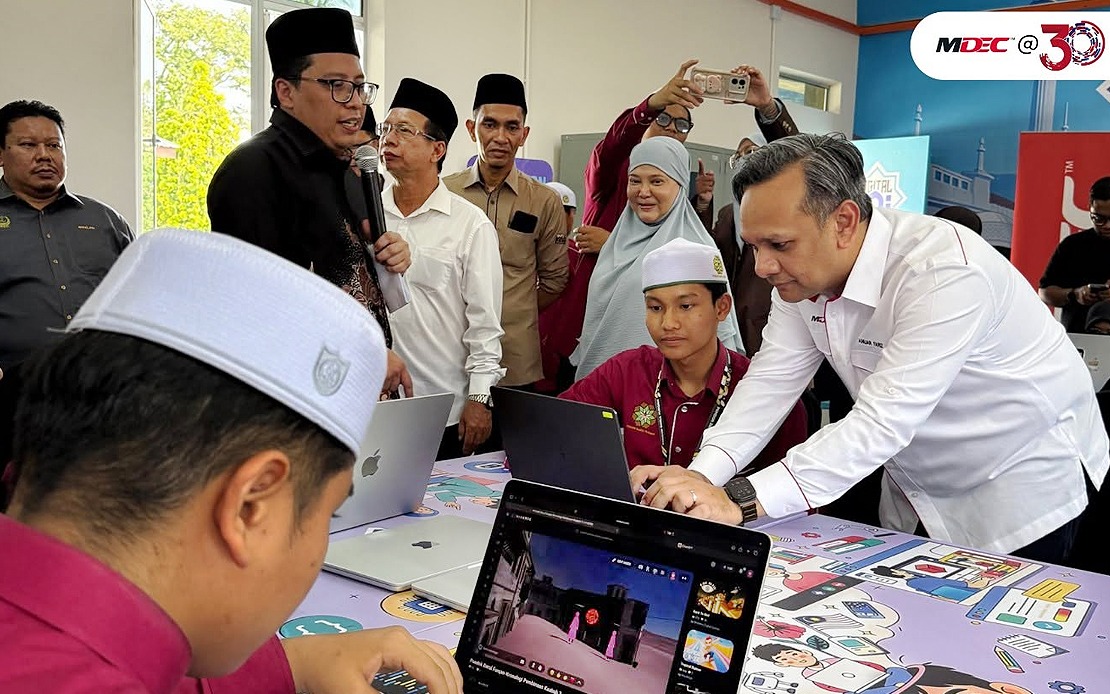
The Malaysia Digital Economy Corporation (MDEC) has launched a Digital Maker Hub at Pondok Darul Furqan in Tambun, Ipoh, marking a significant step in broadening access to technology and digital competencies within Malaysia's Islamic education sector. The facility, unveiled on July 13, represents a tangible investment in equipping students and teachers with the practical tools and knowledge needed to participate in the country's digital economy.
The hub functions as an interactive learning environment, stocked with laptops, high-speed internet connectivity, smartboards, robotics kits and microcontroller units—essentially a physical space where abstract digital concepts can be tested, built and experimented with in real time. This hands-on approach addresses a critical gap in many traditional educational settings, where exposure to emerging technologies remains limited or purely theoretical. MDEC chief executive Anuar Fariz Fadzil emphasised that such infrastructure is essential for nurturing a generation capable of working with artificial intelligence and other advanced technologies.
The initiative operates under the banner of the Digital IPI (Islamic Education Institution Digital Transformation Programme), a coordinated national undertaking developed jointly by MDEC and the Department of Islamic Development Malaysia (JAKIM). Since its launch by Prime Minister Datuk Seri Anwar Ibrahim in March, the programme has been positioned as a direct response to Malaysia's stated ambition to become an AI Nation by 2030—a goal that cannot be realised if large segments of the student population lack foundational digital literacy.
The scale of ambition underlying this effort is considerable. Over its lifetime, Digital IPI is projected to reach more than 3,000 students and 50 teachers through structured training modules spanning digital literacy and artificial intelligence, digital creativity, immersive learning environments, metaverse technology and digital content development. The breadth of this curriculum reflects an understanding that digital skills now encompass far more than basic computer use; they touch on design thinking, problem-solving, content creation and navigation of emerging virtual spaces.
Pondok Darul Furqan itself became a testing ground for one element of this ecosystem when 30 of its students and five teachers participated in a two-day MetaSkool Metaverse Programme shortly after the hub's opening. Rather than lecturing students about virtual worlds, the programme used experiential and interactive activities to introduce how metaverse technologies function and might be applied. This pedagogical approach—learning by doing rather than passively absorbing information—aligns with broader trends in technology education globally, where engagement and hands-on exploration drive deeper understanding.
The pilot phase encompasses five other Islamic education institutions distributed across Kedah, Kelantan, Negeri Sembilan, Pahang and Penang. This geographic spread suggests a deliberate effort to ensure that digital opportunity is not concentrated in any single state or region, though the rollout remains selective at this stage. Each of these institutions will receive an identical Digital Maker Hub, allowing comparative assessment of how such facilities perform in different environments and with diverse student populations.
From a Malaysian policy perspective, the integration of technology into Islamic education institutions carries particular significance. For decades, digital transformation has been framed primarily as an urban, secular concern—the domain of tech parks and multinational corporations. By deliberately extending these programmes into Islamic schools, the government signals that technological literacy is not incompatible with religious education, nor is it the exclusive preserve of any single community. This positioning may help counter perceptions that technology adoption creates a false choice between tradition and modernity.
The broader context matters here as well. Malaysia faces stiff regional competition in the technology sector from Singapore, Vietnam and Indonesia. Developing a talent pipeline that includes graduates from all educational traditions—not just secular schools—represents a pragmatic approach to building sufficient human capital for the digital economy. When Islamic education serves roughly 20 percent of Malaysia's school-age population, excluding this cohort from technology training would needlessly constrain the country's competitive position.
MDEC's framing of Digital IPI also emphasises values integration, seeking to weave religious principles such as trustworthiness into technology education. While the source material on this aspect remains incomplete, the intent appears to be moving beyond a purely technical skills model toward one where ethical frameworks rooted in Islamic teaching inform how students approach technology, innovation and digital citizenship. This resonates with growing international interest in responsible AI and ethical technology design.
The practical implications for students at institutions like Pondok Darul Furqan are tangible. Exposure to robotics kits and microcontroller units during schooling years can spark interest in engineering, computer science or emerging fields like AI development. Teachers gain capacity to deliver modern curriculum content more effectively, shifting from purely verbal instruction to demonstrations and projects. Both groups gain familiarity with tools and concepts they will encounter in university or the workplace, reducing the adjustment burden later.
However, the success of such initiatives ultimately depends on factors beyond infrastructure. Teacher training quality, curriculum design, sustained funding and integration with national qualification frameworks all matter enormously. A Digital Maker Hub sits idle if educators lack training to facilitate its use effectively. The programme's inclusion of teacher training suggests this logic has been considered, though implementation fidelity will determine outcomes.
For Malaysia's broader digital economy agenda, efforts like Digital IPI represent a recognition that inclusive growth matters. An AI Nation cannot be built on a narrowly defined talent pool; it requires capabilities distributed across the population. By investing in Islamic education institutions today, the country is planting seeds that may yield dividends in innovation, entrepreneurship and digital competitiveness over the coming decade.

