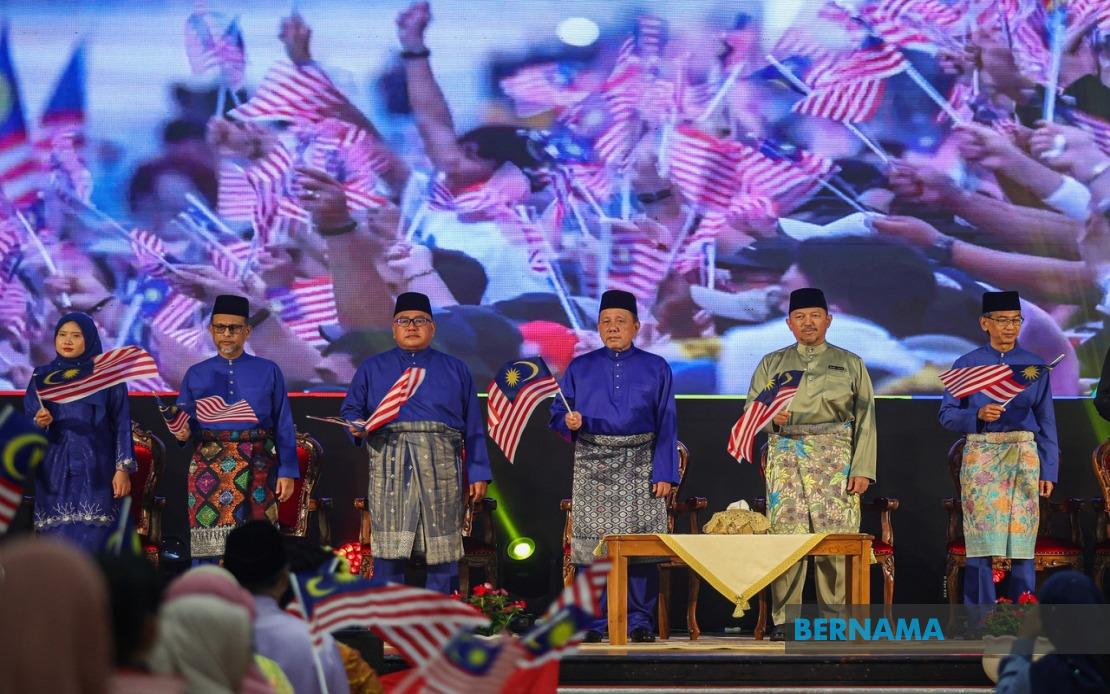
Negeri Sembilan Menteri Besar Datuk Ismail Lasim has mapped out an administrative roadmap built on three foundational pillars—stability, progress and prosperity—intended to anchor the state government's approach to public service delivery and economic management. Speaking at the Negeri Sembilan State-Level Public Servants Assembly and the launch of the Kibar Jalur Gemilang campaign in Seremban, Ismail positioned these principles not merely as political rhetoric but as operational frameworks designed to reshape how the state tackles governance challenges, expedites bureaucratic processes and raises living standards across its 1.2 million residents.
The emphasis on stability carries particular significance in Ismail's articulation of governance priorities. Rather than defining the administration by its numerical strength in the State Legislative Assembly, he has reframed institutional resilience as the cornerstone of state management. This distinction matters because it signals an intent to entrench democratic norms, protect constitutional mechanisms and preserve the formal structures that underpin Negeri Sembilan's system of government, including the Constitutional Monarchy. By placing institutional durability alongside political stability and administrative coherence, Ismail appears to acknowledge that governments commanding legislative majorities must still invest in the legitimacy and functionality of state institutions to command public and investor confidence.
The second pillar, progress, extends beyond conventional economic metrics. Ismail has explicitly decoupled progress from GDP growth alone, instead proposing a multifaceted approach that encompasses job creation, capital attraction and spatially balanced development. The state recorded a gross domestic product of RM55.8 billion last year, representing a 2.6 per cent increase from RM54.3 billion the previous year, with the services and manufacturing sectors driving expansion. Yet Ismail's framing suggests that headline growth figures insufficiently capture what matters to ordinary citizens—namely, whether economic opportunities are accessible to them personally and whether development reaches beyond urban centres into countryside and agricultural zones.
This geographical dimension of progress reflects a deliberate counter-narrative to concentration of investment and infrastructure in major population centres. Ismail has singled out rural communities and Felda settlements as areas requiring parallel advancement, implying that equitable development across diverse localities constitutes a measure of administrative success. For Malaysian readers familiar with persistent urban-rural economic divides, this language acknowledges a chronic tension within regional development policy and positions the Negeri Sembilan administration as committed, at least rhetorically, to bridging that gap.
Prosperity, the third pillar, is framed as the natural outcome of stability and progress working in tandem. Critically, Ismail has defined prosperity as something to be distributed rather than concentrated, emphasising that economic gains must translate into improved living conditions for the majority rather than enriching a narrow segment. This inclusive framing aligns with contemporary political expectations across Southeast Asia, where governments increasingly face pressure to demonstrate tangible improvements in household incomes, access to services and economic mobility, particularly among younger demographics.
Financial figures disclosed during his address provide concrete context for these aspirations. Negeri Sembilan's state revenue reached RM522.4 million to date, with Ismail expressing confidence that the state can achieve a RM1 billion revenue target by 2030. This tenfold expansion over roughly a decade signals ambition, though observers may question whether macroeconomic conditions, investment flows and commodity prices will cooperate with such projections. Nonetheless, the target itself communicates a commitment to fiscal expansion that could theoretically fund expanded public services, infrastructure development and social programmes if achieved.
Ismail has attributed much of the administrative capability needed to execute this vision to the diversity of experience, expertise and energy within the newly constituted State Executive Council. This emphasis on the Exco's composition suggests that the administration views its leadership team as fundamentally different from its predecessor, though the operational implications of this freshness remain to be demonstrated through concrete policy implementation. The ability of state government to function effectively depends substantially on whether the Exco can translate ideological frameworks into actionable programmes and whether coordination with the public service translates into faster, more efficient administration.
The relationship between government leadership and the civil service emerges as crucial to Ismail's stated agenda. His appeal for cooperation between the Exco and public servants indicates recognition that even well-intentioned policy directives depend on bureaucratic competence and commitment for realisation. In the Malaysian context, where state-level administration often grapples with capacity constraints, staff retention challenges and coordination difficulties between federal and state agencies, this emphasis on partnership suggests Ismail understands that governance quality hinges on more than political leadership alone.
Ismail has positioned Negeri Sembilan as increasingly competitive in attracting investment and business activity, though this claim requires validation through subsequent foreign and domestic capital inflows. He has also identified youth employment and agricultural sector strengthening as priority areas, recognising that rural economies dependent on declining sectors require strategic reorientation to remain viable across coming decades. These priorities align broadly with national development concerns, particularly as Malaysia navigates post-pandemic economic adjustment and labour market shifts.
The simultaneous launch of the Kibar Jalur Gemilang campaign during Ismail's address illustrates a parallel emphasis on national patriotic sentiment and flag-flying in conjunction with National Day celebrations. While this represents routine observance, the timing underscores how state administrations in Malaysia frequently interweave local governance narratives with expressions of national pride and unity, signalling that Negeri Sembilan's development aspirations occur within the framework of broader Malaysian nation-building.
For Malaysian observers, Ismail's three-pillar framework offers a governance template that attempts to synthesise institutional rigour, inclusive economic development and shared prosperity—outcomes that most state governments rhetorically endorse but struggle to deliver simultaneously. Whether this administration can translate its stated priorities into measurable improvements in public service quality, investment climate outcomes and household living standards will determine whether its foundational principles constitute genuine operational guides or merely aspirational rhetoric. The coming years will test whether Negeri Sembilan's new leadership can narrow the gap between ideals and implementation.

