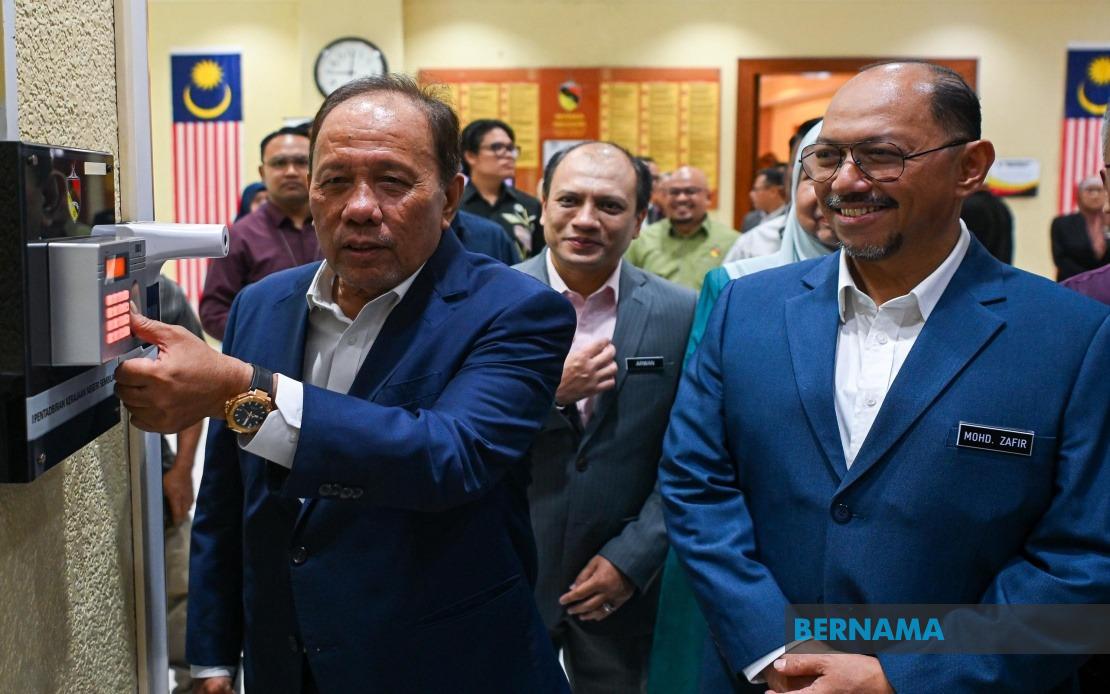
Negeri Sembilan's newly installed Menteri Besar Ismail Lasim has moved swiftly to address criticism surrounding his appointment to the position, insisting that the entire process adhered rigorously to established constitutional and procedural guidelines. Speaking at Wisma Negeri in Seremban on August 4, Lasim stated that the appointment mechanisms were executed correctly and transparently, pushing back against allegations of irregularities that have surfaced in recent days.
The defence comes in response to public questioning by Tan Sri Rais Yatim, the chairman of Wawasan, who has raised concerns about how the Menteri Besar selection transpired. Rais Yatim's criticism extended beyond procedural matters to encompass broader questions about the sanctity of Negeri Sembilan's constitutional framework, suggesting that external actors may have wielded inappropriate influence over decisions that should have remained purely within the state's governance sphere. These allegations have touched on sensitive ground given the federal structure of Malaysian governance and the delicate balance between state and national authority.
Lasim's appointment followed the Negeri Sembilan state election, in which he secured the Juasseh state seat. The electoral contest produced a clear outcome that simplified coalition arrangements for government formation. Barisan Nasional emerged as the dominant coalition partner, capturing 18 of the 36 available seats and substantially outpacing its nearest rival. Perikatan Nasional, which represents the second major grouping in Negeri Sembilan's political landscape, secured seven seats. This distribution meant that both BN and PN together commanded well over two-thirds of the assembly, providing multiple pathways to form a functioning state administration.
The formal investiture ceremony occurred at Istana Besar Seri Menanti, where Lasim took the oath of office before Yang Dipertuan Besar of Negeri Sembilan Tuanku Muhriz Tuanku Munawir. This constitutional procedure represents the culmination of a process that begins with political negotiation and coalition-building but culminates in the traditional ceremony that historically legitimises executive authority in Malaysian states. The involvement of the state ruler in the swearing-in carries particular significance, as the position of Menteri Besar derives its authority partly from the confidence of both the assembly majority and the reigning monarch.
For Malaysian observers, the Negeri Sembilan situation illustrates the continuing complexity of state-level politics within the nation's federal architecture. Unlike the federal government, where the Prime Minister operates within a purely parliamentary framework, state governments maintain a dual legitimacy structure. The Menteri Besar requires not only the support of an assembly majority but also the formal approval and ceremonial endorsement of the state's hereditary ruler. This framework can occasionally generate friction when questions arise about whether the assembly's will and the ruler's constitutional prerogative have been properly balanced.
The timing of this controversy also reflects broader shifts in Malaysian politics following recent electoral contests. Multiple states have experienced coalition realignments and leadership changes, creating scrutiny around appointment processes and governance transitions. Each state government formation receives examination from rival coalitions and political observers seeking evidence of either transparency or irregularity. In Negeri Sembilan's case, the critical eye has fallen on whether established procedures were followed and whether the outcome reflected genuine coalition mathematics or instead represented external pressure applied to circumvent normal processes.
Lasim's statement that the appointment process was "followed correctly" represents a direct rebuttal to the more elaborate allegations made by Rais Yatim. The distinction matters significantly in Malaysian political discourse, where accusations of procedural impropriety carry substantial weight even when specific evidence remains unclear. By emphasizing compliance with prescribed procedures, Lasim attempts to anchor the legitimacy of his position in the constitutional framework rather than in contested narratives about backroom negotiations or interference. This framing moves the debate away from allegations about his personal suitability or the political motivations behind his selection toward a more technical question about administrative correctness.
The controversy underscores an important reality about Malaysian governance: the constitutional apparatus for appointing chief executives in states, while clearly outlined in each state constitution, can still become contested when political circumstances make certain appointments contentious. The Negeri Sembilan case demonstrates how electoral outcomes, though seemingly decisive, do not automatically resolve all questions about who should lead the resulting government or how that leadership should be constituted.
For Negeri Sembilan's citizens and the broader Malaysian public, this episode carries implications extending beyond one state's internal affairs. How political coalitions form and how state leaders are selected influences public confidence in democratic institutions and constitutional processes. Criticism that these processes operate opaquely or subject to external pressure, even when ultimately unsubstantiated, can erode the legitimacy of the resulting government. Conversely, transparent adherence to established procedures, even when leading to outcomes that some find disappointing, strengthens the democratic framework's perceived integrity.
Moving forward, Lasim faces the task of converting procedural legitimacy into effective governance that wins broader public acceptance. His emphasis on proper procedure represents a necessary but insufficient foundation for a stable tenure. The real test will involve how well his administration manages state affairs and responds to the needs of Negeri Sembilan's citizens. The controversy surrounding his appointment, though now addressed at least in formal terms, may require ongoing demonstration through effective administration that the process, whatever its particulars, produced a capable and legitimate state leader.

