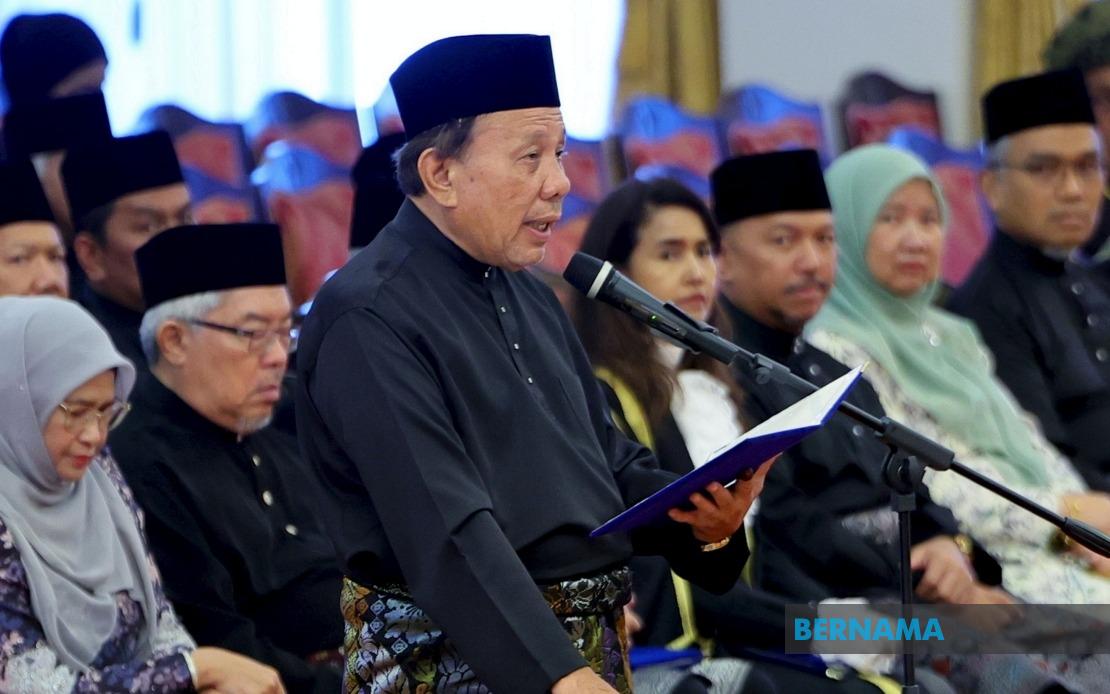
Datuk Ismail Lasim took his oath of office as Negeri Sembilan Menteri Besar at Istana Besar Seri Menanti in Kuala Pilah on August 2, marking the beginning of his leadership following the state's recent electoral mandate. The swearing-in ceremony, witnessed by Yang Dipertuan Besar Tuanku Muhriz Tuanku Munawir, represented a significant transition in the state's administration as Ismail embarked on his new role with commitments spanning governance, development, and institutional respect.
In his oath of allegiance speech, Ismail framed his appointment not merely as political advancement but as a profound responsibility to vindicate public confidence. He articulated that the electoral mandate bestowed upon him in the 16th Negeri Sembilan State Election demanded demonstrated commitment to rigorous, accountable administration. The incoming Menteri Besar emphasised that voter trust transcends ceremonial recognition, instead functioning as a mandate requiring consistent demonstration through dedicated service, attentive leadership, and equitable policy implementation across all state affairs.
A cornerstone of Ismail's vision centres on governance architecture grounded in transparency and public responsiveness. He committed to establishing administrative structures that genuinely absorb citizen aspirations, translate them into actionable governance, and execute programmes with measurable accountability. This pledge extends to the entire state leadership apparatus, signalling expectations that his cabinet and senior officials will embody similar principles of openness and diligent service throughout their tenure.
Ismail's remarks underscored deep respect for Negeri Sembilan's constitutional monarchy framework and the Yang Dipertuan Besar's institutional role. He pledged unwavering deference to the royal ruler's guidance, views, and decrees, positioning the relationship between executive authority and the monarchy as symbiotic rather than hierarchical. This commitment reflects Malaysia's constitutional framework, wherein menteri besars operate within parameters defined by both written constitutions and the counselling influence of traditional rulers.
A distinctive dimension of Ismail's platform involves preserving and advancing Adat Perpatih, Negeri Sembilan's uniquely matrilineal customary system. He recognised that this heritage system, founded on principles of consensus-building, equitable distribution, collective wisdom, and harmonious dispute resolution, requires active institutional stewardship to transmit to succeeding generations. By grounding state policies within Adat Perpatih's philosophical foundations, Ismail signalled intention to balance contemporary governance with cultural continuity, ensuring development initiatives respect traditional institutional frameworks deeply embedded in Negeri Sembilan society.
Economic rejuvenation emerged as another critical pillar in Ismail's inaugural platform. He outlined intentions to fortify the state's productive base through strategic investment attraction, employment generation, and sectoral diversification encompassing agriculture, education, healthcare, and housing. This multi-sector approach recognises that sustainable prosperity requires simultaneous advancement across economic and social dimensions rather than singular focus on infrastructure or GDP metrics. The commitment acknowledges Malaysian regional competition, wherein states must offer compelling investment environments whilst maintaining social cohesion.
Ismail articulated a sophisticated definition of societal advancement extending beyond conventional development metrics. Rather than measuring progress exclusively through infrastructure expansion or economic growth rates, he advocated evaluating success through improved living standards, reinforced social harmony, strengthened institutional integrity, and restored public confidence in governmental systems. This reframing suggests awareness that technical development divorced from equitable distribution or institutional trust generates citizen dissatisfaction despite numerical economic gains.
The incoming Menteri Besar placed considerable emphasis on administrative integrity and civil service standards. He pledged to cultivate workplace cultures emphasising professional dedication, personal accountability, and conscientious service delivery throughout the Negeri Sembilan bureaucracy. Such commitments carry particular weight in Malaysian state administration, where civil service morale and corruption perceptions substantially influence public satisfaction and investor confidence in governance quality.
Ismail's governance philosophy incorporates constructive disagreement and institutional consensus-building. Rather than characterising opposition or critical feedback as obstruction, he positioned diverse viewpoints as essential inputs enhancing policy quality and long-term state interests. This approach reflects Adat Perpatih's consensual traditions whilst acknowledging contemporary governance requirements for stakeholder consultation and evidence-based decision-making. The emphasis on listening to varied perspectives whilst maintaining administrative direction suggests recognition that sustainable governance requires legitimacy extending beyond electoral cycles.
Relational architecture featured prominently in Ismail's vision for state administration. He committed to cultivating harmonious partnerships spanning the royal institution, federal authorities, provincial bureaucracy, commercial enterprises, community leaders, and ordinary citizens. This multi-layered relational commitment recognises that state-level governance within Malaysia's federal system requires productive coordination with national authorities, whilst simultaneously necessitating strong local institutional networks binding government to constituent communities.
Ismail acknowledged his predecessor Datuk Seri Aminuddin Harun's contributions whilst positioning his tenure as building upon rather than abandoning established developmental foundations. This transitional rhetoric demonstrates commitment to policy continuity in productive areas whilst signalling scope for strategic reorientation. For Malaysian observers, such gestures indicate Ismail's recognition that abrupt administrative reversals damage institutional credibility and investor confidence, even when new political leadership brings electoral change.
The swearing-in ceremony culminated with Ismail requesting divine guidance, popular prayer support, and the Yang Dipertuan Besar's continued counselling. These closing appeals reinforced his positioning of leadership as collective endeavour rather than individual achievement, dependent upon institutional cooperation, public goodwill, and traditional authority partnership. For Negeri Sembilan citizens and Malaysian observers broadly, Ismail's inaugural statements established baseline commitments against which subsequent administrative performance will be evaluated.

