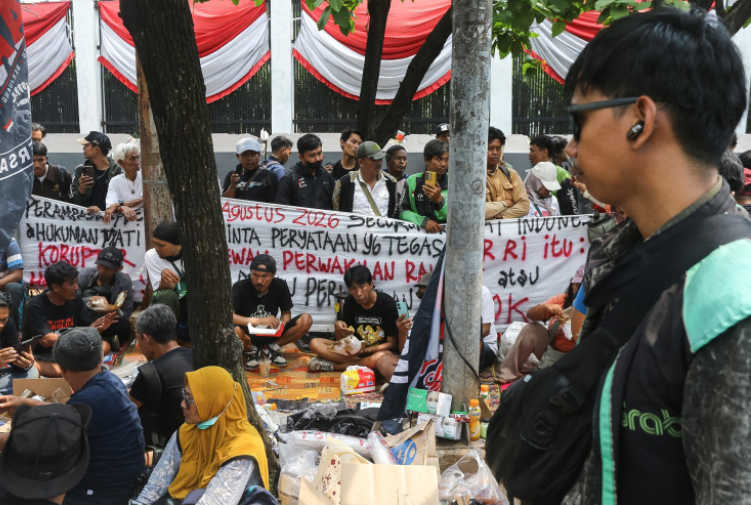
Thousands of anti-corruption protesters surrounded Indonesia's parliamentary complex in Senayan, Central Jakarta, on Thursday, escalating public pressure for sweeping legislative action against official misconduct. The demonstration, which organisers estimated would attract at least 500 participants, reflected growing civilian frustration with delays in enacting asset forfeiture legislation—a measure that has languished in legislative limbo for more than a decade and promises to fundamentally reshape how Indonesia tackles organised wrongdoing.
The United Pati People's Alliance, a coalition of residents from the Central Java municipality of Pati, orchestrated the rally as part of a coordinated campaign that began the previous week. AMPB coordinator Supriyono revealed that the group had mobilised supporters across multiple provinces, demonstrating the nationwide resonance of anti-corruption sentiment among ordinary Indonesians. The movement's capacity to maintain momentum despite official obstruction underscored the depth of public anger over persistent graft in government ranks.
Authorities made multiple attempts to impede the demonstration before it commenced. Police intercepted several buses transporting protesters bound for the capital, whilst Bank Mandiri, a state-owned financial institution, froze the personal account of AMPB coordinator Supriyono—a move that triggered public outcry and sparked calls for consumers to withdraw their patronage. Such actions typically backfire in the court of public opinion, transforming protest organisers into symbols of resistance and amplifying their message. Undeterred, Supriyono announced that five additional coach loads would proceed to Jakarta, underwritten entirely by voluntary contributions from sympathetic citizens.
The government response revealed the scale of concern about maintaining order in the capital. Jakarta Police spokesperson Sr. Comr. Budi Hermanto acknowledged that authorities expected crowds potentially exceeding initial estimates, as metropolitan-based civil society organisations signalled their intention to join the rally. Traffic diversions encompassed major arterial roads, including both directions of Jl. Gatot Subroto from the Senayan Park vicinity through to the parliamentary forecourt. Hundreds of uniformed officers established a security perimeter, signalling official seriousness about preventing disruption whilst respecting constitutional rights to assembly.
The asset forfeiture bill lies at the heart of the grievance articulated by Thursday's demonstrators. Originally introduced in 2008, the legislation has stalled repeatedly during its fourteen-year passage through Indonesia's byzantine parliamentary procedures. The measure would grant authorities unprecedented powers to seize properties, bank accounts, and moveable assets suspected of originating from criminal activity—crucially, prior to formal judicial conviction. Such confiscatory powers represent a significant departure from conventional criminal procedure, which typically demands proof of wrongdoing and formal sentencing before asset appropriation.
Proponents argue the bill addresses a critical loophole that allows corrupt officials to shield illicitly accumulated wealth behind complex corporate structures and offshore arrangements. Indonesia's anti-corruption agencies, chronically understaffed and under-resourced, have repeatedly watched wealthy defendants use legal technicalities and procedural delays to preserve stolen fortunes even following criminal conviction. Asset forfeiture legislation would theoretically allow preventive action before criminal proceedings conclude, disrupting the financial pipelines that sustain systems of organised graft throughout the bureaucracy.
Yet legal scholars have raised substantial concerns about potential misuse. The absence of prior conviction before asset seizure creates opportunities for authoritarian application, permitting politically motivated administrators to target rivals and opponents by freezing their assets under vague suspicion. Several Asian democracies have experienced precisely this trajectory, where nominally anti-corruption measures metastasize into instruments of political persecution. The law's language must therefore incorporate robust protections against weaponisation—including strict judicial oversight, transparency requirements, and compensation mechanisms for wrongfully targeted individuals.
Parliamentary leadership has signalled receptiveness to expedited consideration. Gerindra Party lawmaker Habiburokhman, who chairs House Commission III responsible for legal affairs portfolio, publicly committed to completing deliberations within eight weeks, targeting December completion. This accelerated timeline responds directly to street-level mobilisation and reflects political calculation that failure to deliver on anti-corruption promises could catalyse broader public disaffection. The Pabowo Subianto administration's communications apparatus separately stated that the executive branch supports swift legislative passage, positioning presidential authority behind parliamentary action.
The convergence of executive enthusiasm, legislative commitment to compressed timelines, and sustained popular pressure creates genuine momentum for passage. However, implementation will determine whether this legislation becomes an effective anti-corruption instrument or merely symbolic gesture. Transitional democracies throughout Southeast Asia have enacted ambitious anti-graft statutes only to discover that enforcement mechanisms, institutional capacity, and political will remained inadequate. Malaysia's own experience with anti-corruption reform offers instructive parallels: legislative architecture means little without institutional independence, prosecutorial resources, and political insulation from interference.
Thursday's demonstration underscored that ordinary Indonesians increasingly expect concrete action rather than rhetorical commitment to transparency and accountability. The willingness of Pati residents to undertake expensive coach journeys despite police interception attempts suggests grassroots exasperation with perpetual parliamentary inertia. Whether this legislative session finally concludes fifteen years of deliberation remains uncertain, but the political cost of further delay has demonstrably risen.
The broader implications extend throughout Southeast Asia, where endemic corruption undermines institutional legitimacy and perpetuates public cynicism toward governance structures. Indonesia's asset forfeiture initiative, if enacted with sufficient safeguards and enforcement provisions, could establish regional precedent for confronting the financial architecture enabling systematic misconduct. Conversely, botched implementation or political capture of enforcement mechanisms would reinforce the prevailing pattern where anti-corruption measures become theatrical gestures masking continued elite impunity. For Malaysian observers, the trajectory of Indonesian legislative and institutional development merits close attention, as regional approaches to graft containment increasingly influence domestic policy debates.

