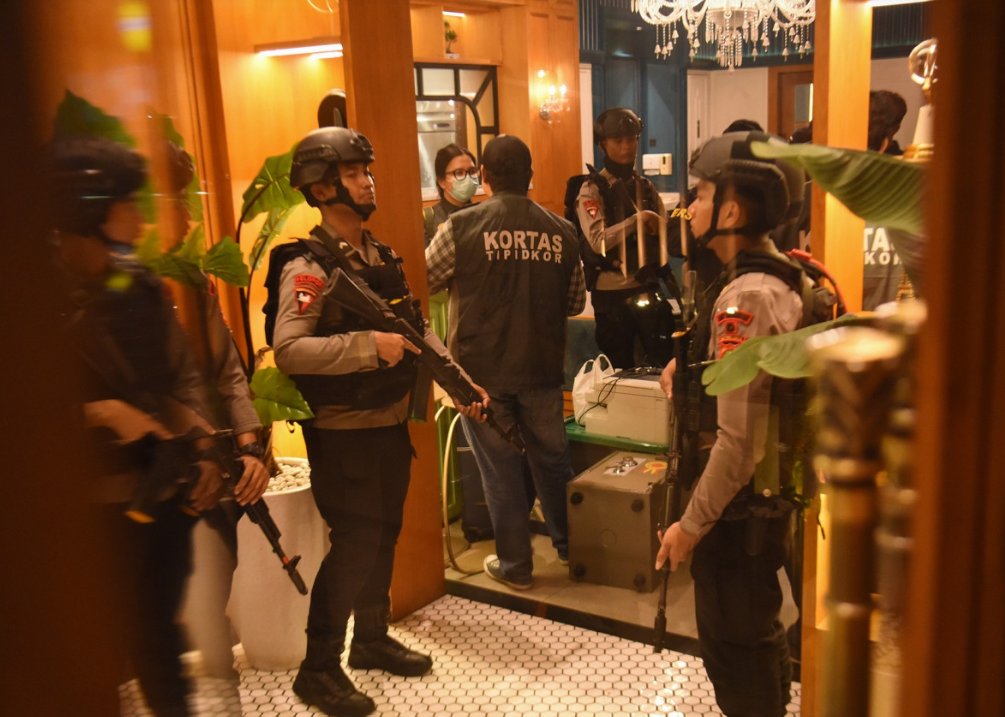
A coordinated police operation across Jakarta on July 8 has exposed one of Indonesia's law-enforcement establishment's most significant scandals in recent memory, with heavily armed officers discovering millions of dollars in gold bars and foreign currency stashed in residential safes and commercial premises. The dramatic raids, which unfolded over more than 24 hours spanning Wednesday afternoon into Thursday morning, targeted at least a dozen locations throughout the capital, painting a stark picture of alleged financial misconduct at the highest levels of the nation's justice system.
The operation commenced at de'Clan Signature, an upscale restaurant in the Cipete neighbourhood of South Jakarta, where armed personnel from the Jakarta Police and the National Police's corruption crime unit, flanked by Mobile Brigade officers in tactical gear, forced entry to access a concealed safe standing roughly two metres high behind a cabinet. What emerged was documentation and millions of dollars in cash denominated in multiple currencies. The dramatic seizures continued immediately next door at Koin Money Changer, where investigators opened another vault revealing hundreds of thousands of additional dollars in Indonesian rupiah.
Yet these discoveries paled in comparison to what authorities found during a search of a luxury residential property in Sentul, a verdant hillside enclave approximately one hour's drive south of Jakarta. Police uncovered seven suitcases containing 74 kilogrammes of gold bars alongside cash in various currencies, with investigators valuing the entire discovery at US$26.3 million. The images of gleaming bullion arranged in rows and stacks of colourful banknotes secured with rubber bands quickly became the dominant visual narrative of the unfolding scandal, broadcast repeatedly across Indonesian media outlets and social media platforms.
The property in Sentul belongs to Febrie Adriansyah, who had occupied the position of deputy attorney general for special crimes for just over four years before tendering his resignation following the raids. Investigators named Febrie a suspect in both corruption and money-laundering cases, though he has not been detained. In response to the seizures, Febrie acknowledged ownership of the Sentul residence but contended that the recovered assets did not belong to him, claiming that their true ownership would emerge through the legal process. This assertion has drawn considerable scepticism from both media observers and legal commentators given the scale and specificity of the discoveries.
The investigative net extended considerably beyond the initial locations, with police systematically searching residences and office spaces throughout metropolitan Jakarta. Among the additional targets was an apartment at the exclusive Pacific Place towers situated near the city's financial district, as well as multiple commercial offices dispersed across Jakarta's business zones. Investigators also conducted searches at properties in the Gandaria neighbourhood of South Jakarta, including a residence connected to Don Ritto, a lawyer who has similarly been named a suspect in the investigation. Unlike Febrie, Ritto was taken into police custody, according to reports from local news sources. Corporate records suggest that Ritto maintained business interests in entities associated with both the raided restaurant and the money changer establishment.
The scale and nature of the discoveries have triggered intense debate within Jakarta's political and legal circles regarding what the revelations signify about Indonesia's institutional capacity to combat high-level corruption. Some observers interpret the successful raid operation as evidence that anti-corruption mechanisms are functioning effectively, demonstrating that even senior officials remain subject to investigation and prosecution. Others, however, view the incident as merely one episode in an expanding pattern of scandals that suggests deeper, more systemic corruption problems embedded within Indonesia's law-enforcement and judicial institutions. The discovery that such substantial sums could be accumulated, concealed, and apparently maintained without detection raises uncomfortable questions about oversight and accountability mechanisms.
A prominent constitutional law scholar and former authority figure has publicly raised procedural concerns about how the investigation is being handled. Mahfud MD, who previously served as chief justice of Indonesia's Constitutional Court and as coordinating minister for political, legal and security affairs, questioned the legality of transferring investigative authority from the police to the Attorney General's Office. Speaking on his YouTube channel while wearing formal Batik attire, Mahfud argued that such a transfer lacks statutory foundation under Indonesia's criminal procedure code and could establish grounds for a pretrial challenge that might jeopardise the prosecution's case.
Mahfud's intervention adds a technical but potentially crucial layer to the developing controversy. His suggestion that the Corruption Eradication Commission, an independent state body, should assume control of the investigation represents a call for greater institutional distance and independence in how the case proceeds. This recommendation reflects broader concerns within Indonesia's legal community about whether investigations involving senior justice officials can maintain sufficient credibility and procedural integrity when handled through conventional police and prosecutorial channels that may themselves harbour conflicts of interest. The question of which institution ultimately leads the investigation could substantially influence public confidence in eventual outcomes.
For Malaysian readers and Southeast Asian observers more broadly, the Jakarta scandal carries significant implications regarding regional judicial integrity and the vulnerability of high-level officials to financial corruption. Indonesia's situation demonstrates that even nations with dedicated anti-corruption institutions and constitutional protections remain susceptible to large-scale, sophisticated schemes involving senior law-enforcement personnel. The incident underscores the importance of maintaining truly independent investigative bodies insulated from political and institutional pressure, a principle equally relevant across the region as various nations grapple with similar challenges to institutional integrity and public trust in judicial systems.

