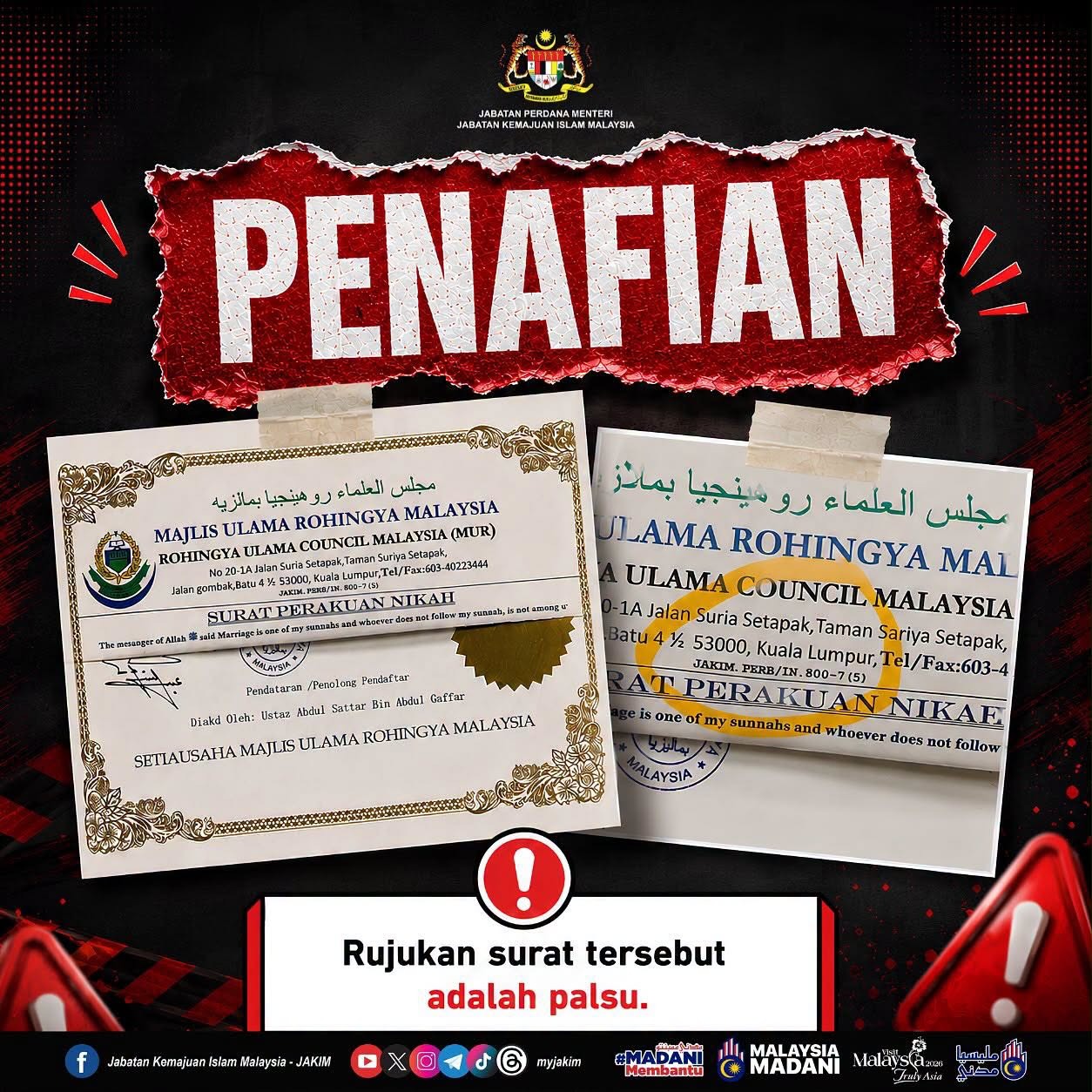
The Department of Islamic Development Malaysia (JAKIM) has moved swiftly to counter widespread misinformation after a fraudulent letter claiming organisational recognition circulated rapidly across social media platforms. In a statement released through its official Facebook channel on July 15, the department explicitly confirmed that the document in question bears a fabricated reference number and has no legitimate connection to any Malaysian Islamic authority.
The controversy centres on a marriage declaration letter purportedly issued by the Malaysia Rohingya Ulama Council, which displayed the reference number "JAKIM.PERH/LN.800-7(5)" on its face. This ostensible reference to JAKIM lent apparent credibility to the document, prompting numerous social media users to accept it as genuine. However, JAKIM's investigation definitively established that neither the reference number nor the letter itself originated from the department or any legitimate Islamic religious body in the country.
In its formal clarification, JAKIM emphasised the critical distinction between authentic and fraudulent religious documentation. The department stressed that it, alongside all state-level Islamic religious councils and departments operating throughout Malaysia, has never granted any organisation—including the Malaysia Rohingya Ulama Council—any mandate to manage, certify, or oversee marriage-related matters on their behalf. This authoritative statement serves as an unambiguous warning against accepting such documents without proper verification.
The circulation of counterfeit religious documents presents serious risks to public trust in legitimate Islamic institutions and processes. Individuals relying on fake marriage letters could face significant legal complications, as such documents may be presented to civil authorities or used in matrimonial disputes. The ease with which fraudulent material spreads through social media amplifies these concerns, particularly among populations less familiar with official government documentation formats and procedures.
JAKIM's response reflects growing institutional awareness of how misinformation exploits religious contexts to gain traction. The department has now issued direct guidance to the Malaysian public, urging citizens to adopt a verification protocol before accepting any religious documents claiming official recognition. Individuals encountering dubious certificates, letters, or declarations should contact JAKIM directly or liaise with the appropriate state Islamic religious authority before treating such materials as legitimate.
The incident also highlights vulnerabilities within systems designed to manage religious affairs at the federal and state levels. The ease with which a fake reference number matching JAKIM's apparent format circulated suggests broader questions about document authentication and public awareness of how legitimate Islamic authorities operate. This points to an ongoing need for public education campaigns that help Malaysians recognise authentic official communications.
Minister in the Prime Minister's Department (Religious Affairs) Dr Zulkifli Hasan has indicated that a formal investigation into the matter would proceed once complete information became available. This investigation will likely examine not only the origins of the fraudulent letter but also the mechanisms by which such documents gained credibility and spread so rapidly through digital channels. Understanding these pathways could inform future prevention strategies.
For Malaysian citizens navigating matters related to Islamic law and registration, distinguishing between authentic and counterfeit documentation remains crucial. The state Islamic religious councils in each Malaysian state maintain direct responsibility for validating marriage-related matters within their jurisdictions, and these bodies alone can issue legitimate certificates or recognition letters. Any organisation claiming to act as an intermediary or agent for such councils without explicit written authorisation from those councils should be treated with considerable scepticism.
The broader regional context adds another dimension to this incident. Malaysia's diverse demographic composition means that various communities and organisations operate within Islamic frameworks, and the involvement of the Malaysia Rohingya Ulama Council in the fraudulent letter points to how trust gaps and communication barriers can be exploited. Clear institutional messaging and accessible verification procedures become essential safeguards.
Moving forward, JAKIM's emphasis on proactive verification by the public represents a pragmatic response to the digital information landscape. Rather than relying solely on institutional outreach, encouraging citizens to independently confirm the authenticity of religious documents shifts responsibility toward individual critical evaluation. This approach acknowledges that digital misinformation travels faster than official corrections, making public scepticism and verification habits valuable protective mechanisms.
The incident underscores the vulnerability of religious and governmental institutions to document fraud in an increasingly digital environment. As social media continues to serve as a primary information distribution channel, particularly among younger demographics, the potential for carefully crafted fraudulent documents to achieve viral status remains significant. Institutions must balance reactive crisis management with proactive strategies that build public literacy around document authentication.

