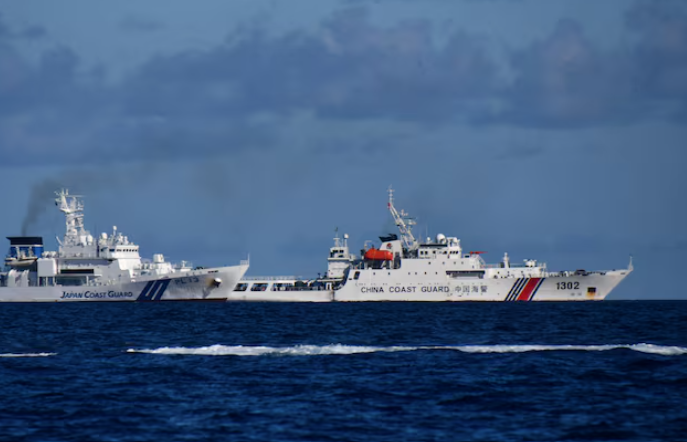
Japan's coast guard forcibly removed two Chinese coast guard vessels from waters surrounding the disputed Senkaku Islands on Tuesday, marking an escalation in the long-standing maritime contest between Asia's two largest economies. The Chinese ships had been heading toward a Japanese fishing boat operating in the contested zone when Japanese authorities intervened, ordering the vessels to depart and successfully clearing them from Japanese territorial waters by around 9.20am local time.
The incident underscores the persistent friction over the Senkaku Islands—called the Diaoyu by China—an uninhabited archipelago positioned strategically between Taiwan and Japan's Okinawa prefecture. Both nations maintain competing sovereignty claims over the territory, a dispute that has simmered for decades but grown considerably more volatile in recent months. The appearance of Chinese coast guard ships approaching Japanese commercial fishing operations represents a notable shift in the character of these confrontations, suggesting Beijing is willing to directly challenge Japanese economic activity in the region rather than merely asserting presence through routine patrols.
While Chinese maritime assets had last intruded into Japan-claimed waters on June 10, direct approaches to Japanese fishing vessels remain comparatively uncommon. This development signals a potential hardening of Beijing's posture, possibly reflecting frustration over Tokyo's increasingly assertive stance on regional security matters. The coast guard's deployment of protective assets around the Japanese fishing boat demonstrates that Tokyo is prepared to physically defend its nationals and claimed territorial interests, even at the risk of dangerous maritime confrontations that could spiral unpredictably.
Japan's coast guard characterised the Chinese actions as a violation of international law, a standard rhetorical position but one that carries weight given the framework of maritime dispute resolution under the United Nations Convention on the Law of the Sea. The statement emphasised that Tokyo would persist in responding "calmly and resolutely" whilst safeguarding its territorial waters through all available lawful means—language that hints at the delicate balance Japan must maintain between deterrence and restraint in these encounters.
The broader context for this Tuesday confrontation traces back to November, when Japanese Prime Minister Sanae Takaichi made comments asserting Tokyo's readiness to intervene militarily should Taiwan face attack from China. Beijing regarded this statement as provocative interference in what it considers an internal matter, viewing Taiwan as an integral part of Chinese territory that remains subject to potential military reunification. The remarks have poisoned the diplomatic atmosphere considerably, with China subsequently discouraging its citizens from travelling to Japan and implementing targeted trade restrictions against select Japanese companies as punitive measures.
China's deployment pattern around the Senkaku Islands has become increasingly routine, with coast guard vessels regularly operating in the disputed zone in what observers interpret as an attempt to normalise Chinese presence and gradually shift effective control. These operations have generated numerous tense maritime standoffs between Chinese and Japanese coast guards, creating genuine risks of miscalculation or accident that could trigger broader conflict. The East China Sea remains economically significant beyond its territorial dimensions; the seabed is believed to contain substantial reserves of oil and natural gas, amplifying the stakes beyond mere symbolic sovereignty.
For Malaysian and Southeast Asian observers, these dynamics carry particular relevance. The Senkaku dispute exemplifies how unresolved territorial claims in the region can generate recurring friction and unpredictable escalation, mirroring similar disputes elsewhere in the South China Sea. If Japan and China cannot manage their contested waters through stable mechanisms, the implications extend throughout the region's maritime stability and the broader regional order that underpins trade and security.
Japan's willingness to physically expel Chinese vessels suggests Tokyo is moving beyond diplomatic protest toward active enforcement of its claimed boundaries. This represents a meaningful evolution from earlier periods when Japan sometimes tolerated Chinese coast guard presence to avoid further deterioration. The shift reflects both domestic political pressure and strategic recalibration in response to what Tokyo perceives as Beijing's increasingly assertive approach to territorial matters. Prime Minister Takaichi's November comments on Taiwan indicate that Japan is consciously elevating its profile as a security actor willing to engage with controversial regional issues.
China's perspective on these incidents differs fundamentally. Beijing disputes Japan's territorial claims entirely, viewing the entire operation as Japanese intrusion into Chinese waters and Japanese obstruction of legitimate Chinese coast guard activities. From Beijing's standpoint, Japanese fishing vessels represent economic extraction from what China considers its own maritime zone, making Chinese coast guard interceptions a reasonable assertion of sovereignty rather than aggressive encroachment. This collision of competing narratives makes each incident a potential flashpoint where both sides feel they are defending rightful interests against the other's provocation.
The incident also reflects deeper strategic competition between Japan and China over regional influence and the emerging security architecture of East Asia. As China's military capabilities expand and Japan responds by strengthening defence ties with the United States and allied nations, maritime disputes take on added weight as indicators of shifting power dynamics. For countries throughout Southeast Asia, including Malaysia, these developments matter because they influence the broader geopolitical environment, affect shipping lanes and resource access, and shape the credibility of security guarantees from external powers.
Going forward, observers should monitor whether this Tuesday expulsion represents an isolated incident or signals a new pattern of more aggressive Chinese operations combined with more forceful Japanese responses. The presence of four Chinese vessels in the area, with only two entering disputed waters, suggests possible coordination or testing of Japanese resolve. Such probing operations could continue as Beijing seeks to understand the parameters of Tokyo's willingness to respond and the degree of international support Japan can mobilise for its position.
The sustainability of the current equilibrium remains uncertain. Without higher-level diplomatic engagement or agreed protocols for managing these encounters safely, the mathematical probability of serious accident increases with each incident. Both nations possess sophisticated maritime capabilities and well-trained personnel, yet accidents and miscommunications can occur in high-tension situations. The international community, including regional powers with stakes in East China Sea stability, has limited leverage to influence these two major powers toward restraint, making the internal calculus of Japanese and Chinese decision-makers the critical variable determining whether tensions remain manageable or cross into dangerous escalation.

