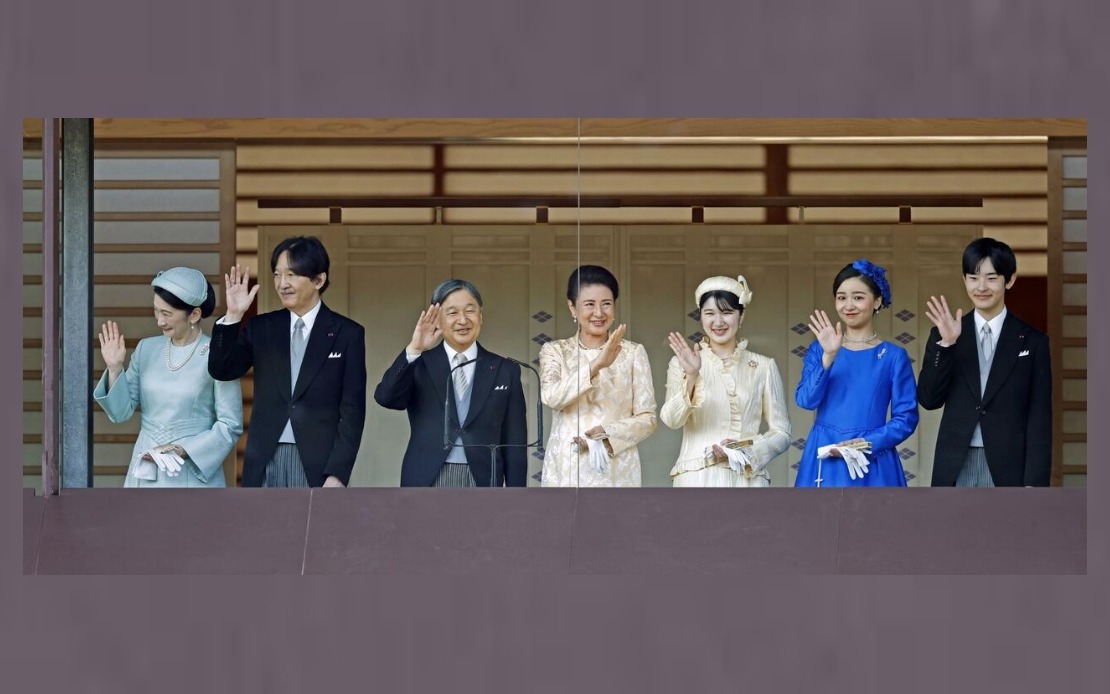
Japan's legislative body has greenlit substantial amendments to its 1947 Imperial House Law, marking the first meaningful overhaul to succession rules governing the world's oldest continuous monarchy. The passage of these reforms by the House of Councillors represents an attempt by Prime Minister Sanae Takaichi's administration to shore up the dwindling imperial household, which currently counts only three male heirs to Emperor Naruhito and faces mounting questions about its long-term viability. Yet despite the historic nature of these changes, the government has resisted the most transformative option—permitting women to ascend the Chrysanthemum Throne—a position sharply at odds with overwhelming public sentiment.
The revised law introduces two principal modifications to imperial protocol. First, it opens the door for unmarried male descendants of former imperial branch families, specifically males aged 15 and older, to be formally adopted into the current imperial household. Second, it permits female imperial family members to maintain their status and title even after marrying individuals outside the imperial lineage, a significant departure from past practice that effectively confined women to the role of producing heirs rather than exercising authority in their own right. These concessions reflect acknowledgment within government circles that the existing system cannot sustain itself without intervention, yet they represent a careful calibration designed to preserve rather than fundamentally alter the patrilineal succession structure that has governed the imperial throne for generations.
The scale of the adoption provision becomes apparent when examining which families qualify. Following the post-World War II American occupation, Japan's 1947 constitution stripped 51 individuals from 11 former imperial branch families of their royal status, a sweeping disenfranchisement meant to consolidate the imperial institution under a slimmed-down framework. The revised law now potentially permits unmarried male descendants of these 11 families to rejoin the imperial household, dramatically expanding the pool of potential successors beyond the current 16-member imperial family. Under the new regulations, any males adopted through this mechanism could theoretically ascend to the throne, provided they maintain the required male-line connection to historical emperors—a technicality that opens pathways closed for decades.
Opposition lawmakers and progressive politicians have mounted sustained criticism of both the substance and process of these reforms. They contend that the Diet's deliberations proved insufficiently thorough, with parliamentary debate falling short of the depth required for modifications to constitutional succession. More pointedly, critics argue that Prime Minister Takaichi and her coalition partners—the long-dominant Liberal Democratic Party and its junior ally, the Japan Innovation Party—have prioritized preserving tradition over addressing the practical crisis facing the imperial succession. The government's apparent resistance to even discussing female or maternal-line emperors signals, from this perspective, an unwillingness to consider genuinely transformative solutions despite the severity of Japan's demographic and succession challenges.
Cross-party negotiations spanning months culminated in a legislative "consensus" drawing on input from 13 parliamentary parties and groups, yet this consensus deliberately sidestepped the core succession question. Rather than resolving the fundamental debate about whether women should rule, the compromise focused narrowly on the adoption provisions and female status retention, treating these as sufficient remedies without addressing the elephant in the room. The Takaichi government has subsequently maintained that the revised law adequately addresses succession concerns by enabling male descendants of adopted branch family members to assume the throne, yet this argument rings hollow to observers who recognize the precariousness of banking on future male births within an expanding pool of potential heirs.
The historical context underscores the radicalism of the 1947 framework. The original Imperial House Law, drafted during American occupation and reflecting post-war constitutional principles, enshrined the doctrine that the throne "shall be succeeded to by a male offspring in the male line belonging to the Imperial Lineage." This formulation crystallized a patrilineal succession principle extending back centuries, transforming customary practice into written constitutional law. The 1947 revision itself represented a dramatic rupture from the imperial institution's pre-war configuration, yet subsequent governments have treated the male-line stipulation as sacrosanct, resisting modification despite altered demographic and social realities. The latest amendments, therefore, function as minor adjustments within a constitutional framework that remains fundamentally unchanged in its core principle.
Public opinion diverges markedly from government caution. A Kyodo News poll conducted in May revealed that 83.0 percent of Japanese respondents support permitting female emperors, while only 13.1 percent oppose this notion. This overwhelming majority sentiment reflects not merely abstract support for gender equality but pragmatic recognition that Japan faces a succession crisis requiring bold solutions. The gap between public preference and legislative outcomes illustrates the phenomenon of conservative institutional interests overriding democratic sentiment—a pattern observable across many established democracies but particularly pronounced in Japan's hierarchical, tradition-conscious political culture. The fact that Sanae Takaichi herself, as the nation's first female prime minister, presides over a government declining to enable female imperial succession underscores the compartmentalization between supporting women's advancement in routine governance and their eligibility for the ultimate constitutional role.
For Southeast Asian observers, Japan's imperial succession debate carries instructive implications regarding the relationship between tradition, constitutional law, and democratic legitimacy. Many regional monarchies face analogous succession pressures, yet Japan's experience demonstrates how institutional conservatism can produce half-measures satisfying neither reformers nor traditionalists. The adoption solution, while enlarging the potential successor pool, remains contingent on future male births and introduces complexities regarding legitimacy and line continuity that female succession would bypass entirely. Thailand, Malaysia, Brunei, and Cambodia—all monarchies with varying female succession provisions—represent alternative models that Japan has essentially rejected despite evidence of workability elsewhere in Asia.
The Takaichi government's emphasis on male-line preservation, even while acknowledging the need for reform, reflects deeper anxiety within Japan's conservative establishment about the imperial institution's cultural meaning and constitutional status. Rather than viewing female succession as potentially strengthening the monarchy by expanding the talent pool and modernizing its image, the ruling coalition appears to view it as fundamentally threatening to the institution's identity. This defensive posture, combined with the technical complexity of the adoption provisions, may ultimately create more problems than it resolves—if future adoptions fail to produce sufficient male heirs, Japan may face renewed succession crises within a decade or two, forcing another contentious round of constitutional revision under even more fraught circumstances.
The passage of these reforms also reflects the degree to which Japanese political leadership remains insulated from public opinion on constitutional matters. While 83 percent of citizens favor female emperors, parliamentary procedures and institutional conservatism enabled legislators to approve measures explicitly rejecting this preference. This disconnect suggests that future succession crises, rather than being definitively resolved, may instead generate renewed political tension and public frustration. Whether the adoption provisions ultimately stabilize the imperial house or merely postpone confrontation with the underlying succession question remains uncertain, but the Takaichi government has clearly wagered that preserving patrilineal tradition takes precedence over either public sentiment or long-term institutional stability.

