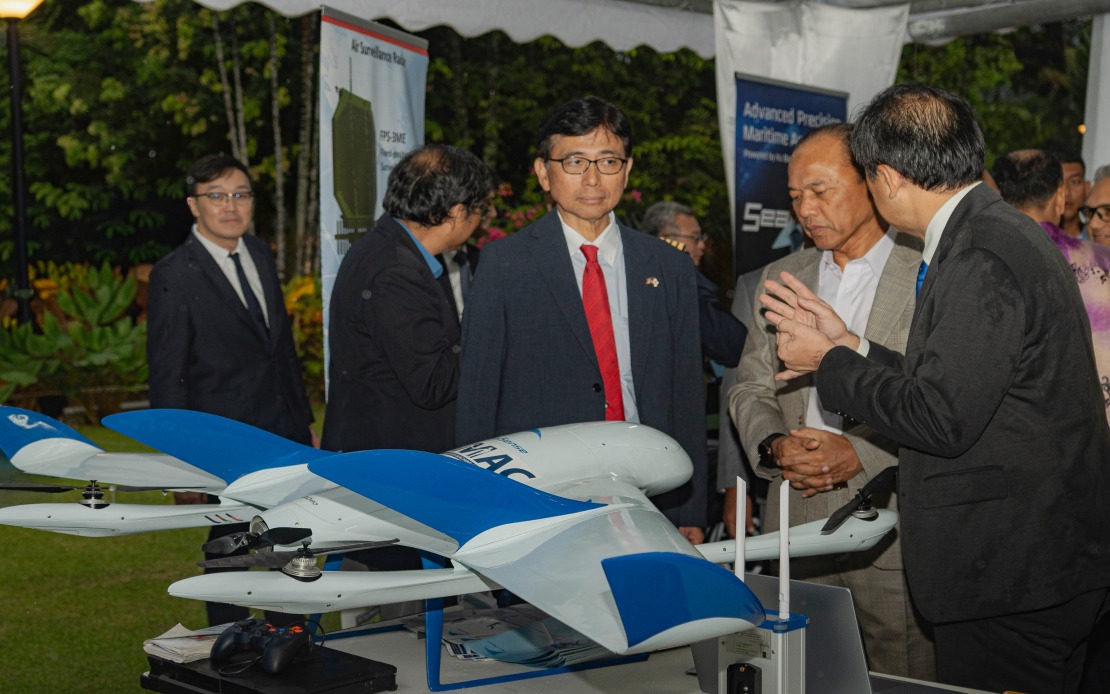
Japan is prepared to significantly deepen its security partnership with Malaysia as both nations navigate an increasingly unstable Indo-Pacific region, according to Japanese Ambassador Noriyuki Shikata. Speaking at the 72nd Japan Self-Defence Forces Day Reception in Kuala Lumpur on Wednesday, Shikata underscored the commitment made by Prime Minister Sanae Takaichi and Malaysian Prime Minister Datuk Seri Anwar Ibrahim during the latter's recent visit to Tokyo, where the two leaders reaffirmed their shared vision for enhanced defence and security cooperation.
The bilateral relationship has already reached a significant milestone. Japan and Malaysia formally elevated their ties to a Comprehensive Strategic Partnership in 2023, a designation that reflects the depth of their engagement across political, economic, and security domains. As the two countries approach the 70th anniversary of their diplomatic relationship in 2025, Shikata emphasised his commitment to advancing cooperation even further, particularly in defence and security matters where shared interests and regional stability concerns align closely.
Central to this strengthened partnership is the alignment of Japan's Free and Open Indo-Pacific strategy with ASEAN's own outlook on the region. Both frameworks prioritise maintaining freedom of navigation, upholding international law, and preventing unilateral actions that could destabilise the delicate balance of power in Southeast Asia. By synchronising these visions, Japan and Malaysia are positioning themselves as anchors of stability in a region where geopolitical tensions continue to simmer. This coordination is particularly significant for Malaysia, which sits at the intersection of global maritime trade routes and faces its own security challenges in territorial waters.
Practical military cooperation between Tokyo and Kuala Lumpur has become increasingly concrete through regular joint exercises. The bilateral MALPAN exercise, conducted routinely in the South China Sea and the Strait of Malacca, has become a cornerstone of their defence partnership. This exercise programme expanded significantly in April when the Royal Malaysian Air Force joined naval operations for the first time, broadening the scope beyond maritime operations into the air domain. Such exercises serve multiple purposes: they build mutual trust and understanding between armed forces, enhance interoperability for potential crisis situations, and reinforce commitment to maintaining secure sea lanes that remain vital to regional commerce and stability.
Beyond exercises, Japan has initiated substantial material support to Malaysia through its Official Security Assistance programme, launched in 2023. This mechanism allows Japan to provide military equipment and technology to regional partners in ways that strengthen their defence capabilities while reinforcing strategic relationships. Malaysia was among the first recipients of this assistance. In 2024, Japan provided unmanned aerial vehicles and rescue boats to enhance Malaysia's operational capacity. The OSA 2025 programme commitment is even more ambitious, with Japan planning to furnish equipment specifically designed for ceasefire monitoring operations, reflecting Malaysia's role in ASEAN peace initiatives. Most significantly, Japan has pledged to provide a dedicated diving support vessel to the Royal Malaysian Navy, a substantial capability enhancement that speaks to Japan's seriousness in the partnership.
The defence industry dialogue represents another dimension of deepening ties. During Defence Services Asia 2026 in Kuala Lumpur, ten Japanese defence companies participated in the exhibition, demonstrating cutting-edge military technologies and equipment to Malaysian defence officials and industry representatives. More importantly, Japan and Malaysia formalised their intention to establish a bilateral defence industry dialogue through a Terms of Reference signed at the event. This framework will facilitate sustained engagement between defence manufacturers and government procurement bodies, potentially opening pathways for technology transfer, joint development projects, and deeper industrial cooperation in the years ahead.
For Malaysia, this expanding security partnership with Japan offers several strategic advantages. Japan brings advanced technological capabilities, substantial financial resources, and a proven commitment to regional stability without the baggage of Cold War-era alliances or contested territorial claims in Southeast Asia. Japanese defence equipment and expertise can meaningfully enhance Malaysian capabilities while Japan's diplomatic weight and strategic partnerships provide backing for ASEAN's efforts to maintain regional order. The equipment transfers, particularly the diving support vessel and ceasefire monitoring technology, directly support Malaysia's diplomatic leadership within ASEAN and its commitment to conflict resolution mechanisms.
The timing of this security deepening is significant given the current regional environment. Rising great power competition, tensions over maritime boundaries, and concerns about de-escalation have made regional partners increasingly attentive to balance-of-power considerations. Malaysia's engagement with Japan signals its intent to strengthen ties with a security-conscious democratic ally while maintaining its own non-aligned positioning. This balancing act has become increasingly delicate, and Japan's emphasis on supporting de-escalation and international law aligns well with Malaysia's preference for multilateral solutions and respect for the rules-based international order.
Armed Forces chief General Tan Sri Malek Razak Sulaiman's attendance at the reception underscored the significance of the security dialogue at the highest military levels. The presence of senior Malaysian defence leadership alongside the Japanese ambassador reflected mutual recognition of the partnership's importance. As regional security challenges continue to evolve, with maritime security, counter-terrorism, and cyber threats demanding sustained attention, the depth of institutional relationships between defence establishments becomes increasingly valuable.
Looking beyond the immediate bilateral context, Japan's deepening engagement with Malaysia also reflects broader Tokyo strategy in Southeast Asia. Japan recognises that maintaining stability in the region depends on building strong relationships with individual ASEAN members while respecting ASEAN's centrality in regional architecture. By strengthening its partnership with Malaysia—a significant ASEAN member with considerable influence—Japan advances its strategic objectives while contributing to regional resilience. The focus on enhancing Malaysia's defence capabilities, particularly in maritime and air domains, addresses genuine capability gaps while supporting ASEAN's collective security interests.
The Japanese ambassador's emphasis on keeping sea lanes open and secure carries particular resonance for Malaysia, whose economy and strategic position depend fundamentally on unimpeded maritime commerce. The South China Sea and Strait of Malacca represent not merely military domains but economic lifelines for Malaysia and the broader region. Japan's commitment to working with Malaysia to maintain the security of these waterways, through both operational exercises and diplomatic support for international law, directly serves Malaysian interests. As Ambassador Shikata noted, these are not merely symbolic gestures but practical steps that build institutional trust and operational readiness.
Moving toward 2025 and the 70th anniversary of diplomatic relations, the trajectory of Japan-Malaysia security cooperation appears poised for continued expansion. The mechanisms now in place—joint exercises, equipment transfers, industry dialogue, and aligned strategic visions—provide a solid foundation for deepening engagement. Malaysia's leaders, including Prime Minister Anwar Ibrahim, have demonstrated their willingness to embrace this partnership while maintaining broader regional balance. For Japan, Malaysia represents a crucial pillar in its Indo-Pacific strategy, offering reliable partnership, geographic significance, and shared commitment to regional stability based on international law and free navigation.

