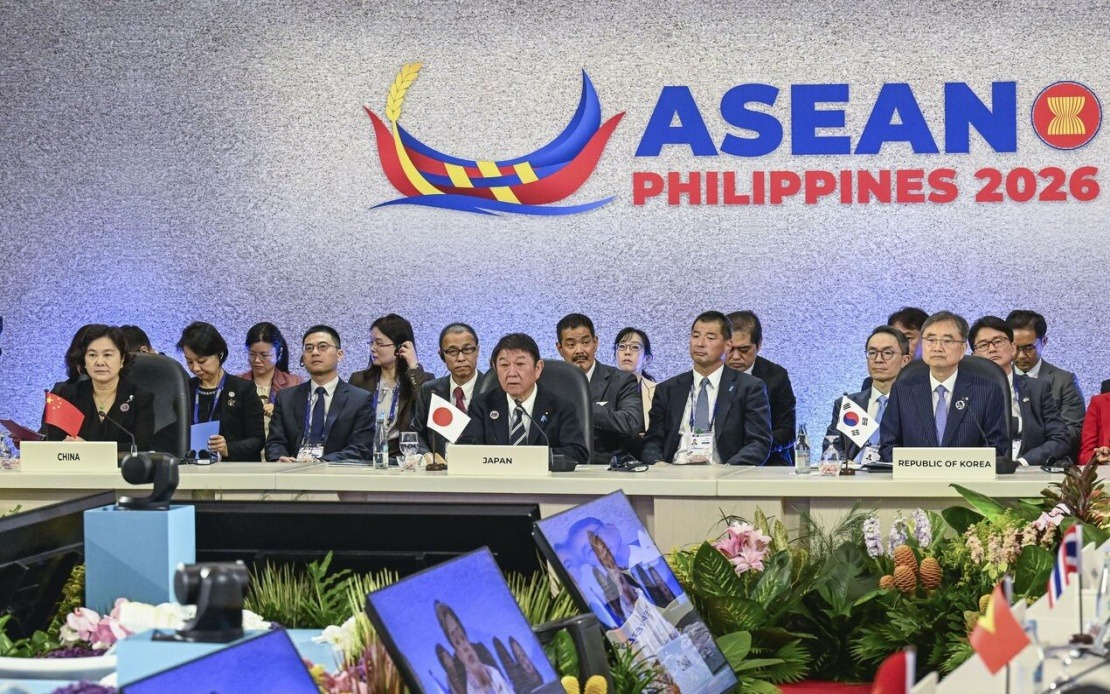
Japan has pledged to deepen its engagement with Southeast Asia, China, and South Korea across critical sectors including energy infrastructure and digital security, signalling Tokyo's determination to maintain influence in an increasingly complex regional landscape. The commitment emerged from a ministerial gathering in Manila that brought together foreign ministers from the ASEAN-plus-three grouping, underlining Japan's strategic interest in maintaining cooperative frameworks with its neighbors even as geopolitical tensions persist across the Indo-Pacific.
Japanese Foreign Minister Toshimitsu Motegi used the platform to articulate Japan's vision for the region, emphasizing that the combined economies of ASEAN-plus-three countries now represent more than a quarter of global economic output. This observation carries particular weight for Malaysia and other Southeast Asian nations, as it underscores how the region's collective economic strength has grown substantially since the framework's establishment following the 1997 Asian financial crisis. The scale of this economic bloc creates both opportunities for coordinated action on shared challenges and potential friction points if member states pursue divergent policies.
One of Motegi's principal focuses was energy security, an issue that has gained urgency across the region in light of recent geopolitical developments in West Asia. The ministers highlighted the necessity of reinforcing energy supply networks to ensure stability and resilience in Southeast Asia, a region heavily dependent on imports of fossil fuels and increasingly invested in diversifying its energy sources. For Malaysia, which has energy export interests alongside growing renewable energy ambitions, this discussion directly influences how the country positions itself within regional energy markets and supply chains.
The second pillar of Japan's proposed cooperation concerns online scams and digital crime, a mounting concern across Southeast Asia where sophisticated fraud schemes have targeted both businesses and individual consumers. Malaysia has witnessed particularly high incidences of online fraud and investment scams in recent years, making this commitment from Japan relevant to domestic law enforcement and financial sector stability. Cross-border coordination on identifying and disrupting criminal networks operating through digital channels requires the kind of trilateral and multilateral cooperation that frameworks like ASEAN-plus-three can facilitate.
Motegi also reiterated Tokyo's unwavering support for ASEAN centrality, a diplomatic principle that emphasizes the bloc's role as the primary driver of regional architecture and decision-making. Japan's backing for the ASEAN Outlook on the Indo-Pacific, an initiative crafted to preserve freedom of navigation, rules-based order, and prosperity across maritime spaces, reflects Tokyo's strategic alignment with Southeast Asian preferences. The Japanese minister further indicated that his government intends to coordinate with China and South Korea to promote this ASEAN-led initiative through the ASEAN-plus-three mechanism, suggesting that even amid great-power competition, consensus exists around certain foundational principles.
China's representation at the meeting through Vice Foreign Minister Hua Chunying, rather than Foreign Minister Wang Yi, signalled a diplomatic message in itself, though such attendance patterns can reflect scheduling rather than political significance. Nonetheless, the presence of a senior Chinese official demonstrated Beijing's continued participation in multilateral forums that ASEAN anchors, despite broader tensions between China and various Southeast Asian nations over territorial and maritime disputes.
The ASEAN-plus-three framework, which incorporates Japan, China, and South Korea alongside the ten ASEAN member states, has functioned since the late 1990s as a practical mechanism for addressing transnational issues that transcend bilateral relationships. The last summit-level gathering occurred in Malaysia in October, indicating that high-level engagement within the grouping remains active even when broader regional tensions fluctuate. This continuity matters for Malaysian policymakers, as the framework offers channels for advancing national interests within a structured diplomatic environment.
Motegi's subsequent engagement with British Foreign Secretary Ed Miliband illustrated how Japan simultaneously maintains robust partnerships beyond Asia, leveraging its diplomatic relationships to address global challenges. The conversation underscored Tokyo's interest in coordination with like-minded democracies, even as Japan pursues Asia-focused regional cooperation. For Malaysia and other ASEAN members, this dual engagement by Japan reflects a broader regional pattern where major powers balance their commitment to Asian regional frameworks with deeper ties to partners in Europe, the Americas, and beyond.
The pledges announced in Manila reveal Japan's strategy of using multilateral mechanisms to promote its vision of a stable, rules-based regional order while maintaining practical cooperation on issues where clear mutual interest exists. Energy security and cybercrime represent domains where sovereignty concerns remain manageable compared to sensitive geopolitical questions, allowing for productive collaboration even between nations with competing strategic interests. For Malaysia, Japan's proactive engagement suggests opportunities to advance shared economic and security interests through platforms where ASEAN's centrality is respected and Southeast Asian voices carry weight in decision-making processes.

