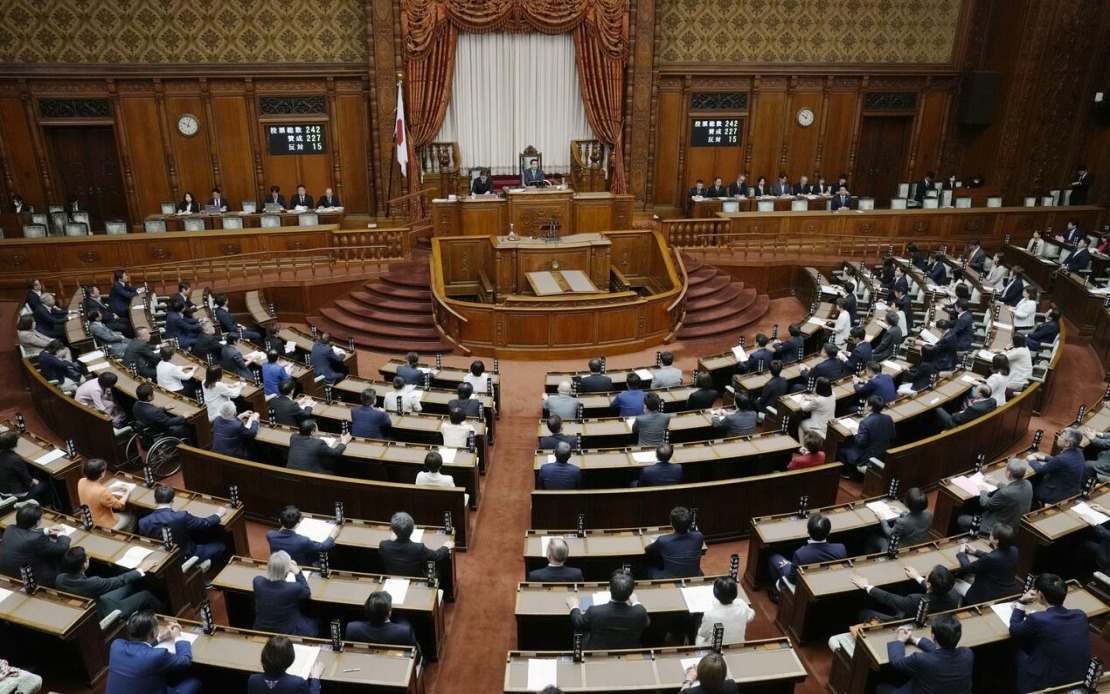
Japan's lawmakers have approved comprehensive defence legislation that fundamentally restructures the nation's military framework to prioritise space domain operations, marking a significant strategic pivot in how Tokyo addresses contemporary security threats. The Japanese parliament's House of Councillors passed the measure on Friday, authorising sweeping changes to the Air Self-Defence Force's organisational structure and introducing a new space-focused command hierarchy that will become operational during the fiscal year ending March 2027. This legislative overhaul signals Japan's recognition that modern conflict scenarios increasingly depend on control of orbital assets and satellite-based communications, surveillance systems and navigation infrastructure that underpin both military operations and civilian infrastructure across the archipelago.
The restructured military apparatus will establish a dedicated space operations group operating under a lieutenant general's command, fundamentally elevating space defence from an ancillary function to a core strategic pillar. This newly created unit will concentrate institutional resources on enhancing Japan's space domain awareness capabilities and bolstering surveillance operations via satellite networks. The reorganisation reflects a deliberate strategic calculation that Japan's existing military structures, while effective for traditional air and ground operations, lack the specialised command infrastructure necessary to operate effectively in the contested space environment where China and Russia are rapidly advancing their own capabilities. By establishing a dedicated command hierarchy, Japan aims to develop coherent doctrine, training protocols and operational procedures specifically adapted to space warfare scenarios.
Defence Minister Shinjiro Koizumi emphasised that space defence extends far beyond military applications, underscoring how Japan's economic and social systems depend fundamentally on uninterrupted access to orbital infrastructure. Koizumi pointed to satellite navigation systems that guide everything from commercial logistics networks to agricultural operations, smartphone-based mapping applications that organise daily civilian mobility, and weather forecasting systems that inform disaster preparation and response across the island nation. This framing demonstrates Japan's holistic understanding that space control directly affects national resilience, economic competitiveness and public welfare. The defence minister pledged that his government would systematically establish the administrative and institutional frameworks necessary to enable the Self-Defence Forces to fulfil their operational missions effectively within this expanded strategic domain.
Beyond space operations, the legislation addresses mounting recruitment and retention challenges facing Japan's military establishment by enhancing post-service financial security for retiring personnel. The Self-Defence Forces confront demographic headwinds and competing employment opportunities that have made attracting qualified candidates increasingly difficult. By raising retirement benefits for SDF members whose mandatory exit ages vary according to rank and typically occur earlier than standard civil service employment, the government aims to make military service more financially attractive to potential recruits and career personnel. This personnel-focused reform recognises that technological sophistication and operational effectiveness require retaining experienced military professionals who otherwise might transition to civilian employment offering superior long-term financial security.
The parliament also authorised the appointment of a second senior vice defence minister, a structural innovation designed to distribute workload across Japan's defence leadership during emergencies and major natural disasters that frequently affect the archipelago. This additional ministerial position will expand capacity for conducting high-level defence dialogues with the United States and other security partners, facilitating more frequent and substantive strategic coordination. The second vice minister position, expected to be filled as early as summer, reflects Japan's commitment to deepening defence integration with allied nations while managing the expanding complexity of contemporary security affairs. This staffing enhancement acknowledges that Japan's defence challenges now span multiple domains simultaneously—conventional military deterrence, space operations, cyber security, disaster response—requiring distributed administrative capacity that a single vice minister cannot adequately manage.
Significantly, the legislation simultaneously upgrades Japan's Ground Self-Defence Force 15th Brigade, stationed in Naha within Okinawa Prefecture, to full divisional status. This ground force restructuring directly responds to China's assertive maritime activities in the surrounding waters and reflects Japan's determination to strengthen military installations defending its geographically dispersed southwestern island chain. The elevation to divisional status increases command authority, resource allocation and operational independence for the Naha-based unit, signalling that Japan considers its southwestern maritime frontier a priority theatre requiring enhanced defensive capacity. The timing of this upgrade alongside space operations reorganisation demonstrates Tokyo's multidimensional approach to security challenges, addressing both orbital domains and territorially contested waters simultaneously.
For Southeast Asian observers and Malaysian strategic planners, Japan's defence reorganisation carries significant implications for regional stability and military modernisation patterns. Japan's emphasis on space capabilities reflects broader Indo-Pacific trends where middle powers seek asymmetric advantages through technological specialisation rather than matching adversary capabilities across all domains. Malaysia and regional partners increasingly depend on satellite-based communications, navigation and surveillance infrastructure for both civilian and defence purposes, yet typically lack dedicated space command structures comparable to those Japan is now establishing. Japan's experience reorganising military institutions to accommodate space operations may offer instructive models for how smaller regional powers can develop space-oriented defence capabilities without requiring comprehensive military overhauls.
The strategic context underpinning Japan's defence legislation reflects intensifying great power competition in the Asia-Pacific region, where China's rapid military modernisation and demonstrated willingness to use coercive maritime pressure have prompted Tokyo to accelerate its own force development timelines. By establishing space operations capability before potential contingencies emerge, Japan positions itself to maintain technological advantage in orbital domains that increasingly determine military outcomes. This preemptive approach to capability development contrasts with reactive modernisation patterns and suggests Japan's defence planners view the next decade as a critical window for establishing advantageous military balances before adversary capabilities mature further. Malaysian defence policy makers observing Japan's strategic calculations might recognise parallel imperatives to develop advanced capabilities during periods when regional military competitions remain less formalised.
Japan's legislative approach to defence modernisation also demonstrates how democratic nations integrate military reform through parliamentary processes requiring broad political consensus. Unlike authoritarian competitors, Japan must persuade elected representatives that defence investments serve legitimate national interests and justify resource allocation. This institutional requirement for transparency and consensus building may slow the pace of Japanese military modernisation relative to competitors operating without such constraints, yet it ensures that defence policies reflect genuine democratic deliberation rather than narrow elite preferences. For Southeast Asian democracies, Japan's experience illustrates both advantages and constraints inherent in pursuing military modernisation through democratic institutions while competing against less constrained rivals.
The space operations reorganisation ultimately reflects Japan's strategic assessment that future security challenges cannot be addressed effectively using exclusively traditional military capabilities and organisational structures. By establishing dedicated space command institutions, elevating space operations to strategic prominence, enhancing personnel retention through improved benefits, and augmenting defence ministry staffing capacity, Japan signals that contemporary security demands multidimensional institutional innovation. These reforms will require sustained budgetary support, ongoing technological investment and careful coordination across Japan's military branches to achieve intended operational effectiveness. Success will depend on whether Japan can translate institutional restructuring into genuine operational capabilities that enhance national deterrence and resilience across space, maritime and conventional domains simultaneously.

