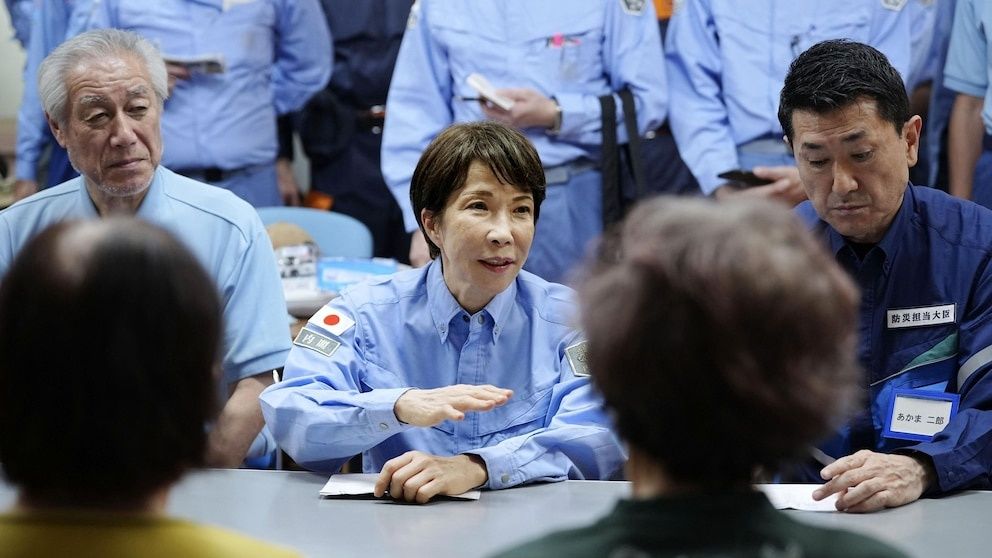
Prime Minister Sanae Takaichi visited Kumamoto Prefecture on Monday for the first time since a powerful magnitude 7.1 earthquake devastated Japan's southwestern region on Tuesday, August 4. The catastrophic quake has claimed 38 lives, with authorities investigating circumstances surrounding several deaths, including one victim who succumbed to apparent heat stroke whilst sheltering in a vehicle. The scale of destruction remains staggering, with approximately 700 homes completely destroyed and more than 11,300 buildings sustaining damage across the prefecture.
The aftermath of the disaster has been compounded by a brutal combination of environmental and logistical challenges that are hampering relief efforts and endangering survivors. More than 46,000 households across the region lack access to water supplies, whilst widespread fuel shortages have created additional hardship as temperatures soar. The Japan Meteorological Agency forecasted peak temperatures approaching 40 degrees Celsius, intensifying fears of heat-related casualties among the displaced population and emergency responders working in demanding conditions.
Conditions in evacuation shelters have become increasingly dire as the crisis persists. Over 8,500 residents remain crowded into converted community centres, school gymnasiums and classroom spaces, many of which are not equipped with air-conditioning systems. The situation reflects longstanding concerns raised by disaster management experts, who have consistently highlighted how inadequate shelter infrastructure leads to overcrowding, poor sanitation standards, and compromised personal privacy for displaced populations. Beyond formal shelters, thousands of desperate residents have resorted to sleeping in vehicles parked at municipal lots and in makeshift outdoor arrangements near their damaged homes.
Governor Takashi Kimura used his meeting with Takaichi to emphasize the extraordinary hardships facing residents attempting to survive under "abnormal heat" conditions whilst managing the trauma and displacement of losing their homes and livelihoods. The governor presented specific requests for enhanced government support aimed at improving conditions within evacuation centres, particularly regarding access to clean drinking water and adequate medical care. Takaichi responded by committing the government to rapidly assess assistance options and pursue proactive measures to support affected communities, though her statement remained general in scope.
Meanwhile, a separate tragedy emerging from the disaster has exposed employer negligence and raised serious questions about workplace safety protocols during emergencies. Habita, a local general store operator with a shop inside the collapsed Aeon Mall in Kashima town, instructed two employees to remain in the building to secure sales proceeds in a company safe after the initial earthquake. The two workers were subsequently killed in an explosion that occurred inside the mall, which the operator believes resulted from a gas leak. Two company executives attended the funeral of 22-year-old Kurumi Otake, one of the victims, to apologize to her bereaved parents. "I wish someone had stopped her," Otake's mother said tearfully during the wake. "My daughter is not coming back."
The incident has sparked broader reflection on emergency decision-making protocols and the protection of workers during natural disasters. The mall's operator confirmed that approximately 3,000 shoppers had been successfully evacuated to a nearby parking lot following the initial quake, yet certain staff members remained inside the building pursuing routine duties. Rescue operations ultimately recovered five survivors from the collapsed structure, but seven additional victims were found deceased within the rubble, underlining the lethal consequences of decisions made in the chaotic hours immediately following the earthquake.
Takaichi's initial visit to the disaster zone included an aerial survey of affected areas by military helicopter, followed by an inspection of one of the region's best-equipped shelters featuring cardboard partition beds and air-conditioning systems. The choice of venue prompted criticism on social media platforms, with observers noting that the carefully selected shelter represented conditions significantly better than those experienced by the vast majority of evacuees. This selectivity in the prime minister's tour itinerary raised questions about whether official visits were accurately reflecting the genuine hardship endured across the broader evacuee population, particularly in the overcrowded, poorly equipped facilities housing the majority of displaced residents.
The scale of infrastructure damage documented by Kumamoto prefecture officials underscores the earthquake's destructive power and the monumental reconstruction challenge ahead. Beyond the 700 completely destroyed structures, the 11,300 damaged buildings represent disrupted commercial activity, displaced workers, and disrupted supply chains affecting the regional economy. Local authorities have begun constructing temporary housing in towns including Uki and Hikawa, whilst hotels and inns across the prefecture are offering accommodation to evacuees, demonstrating community solidarity alongside government response measures.
For Malaysian and Southeast Asian observers, the Kumamoto disaster offers sobering lessons relevant to earthquake-prone regions throughout the broader Asia-Pacific area. Malaysia's exposure to seismic activity, particularly in Sabah and Sarawak, alongside the nation's experience with flooding and other natural disasters, underscores the critical importance of maintaining robust emergency shelter infrastructure, adequate water and sanitation systems within evacuation centres, and clear workplace safety protocols during crises. The Kumamoto experience demonstrates how secondary hazards such as extreme heat can transform already challenging post-disaster situations into life-threatening emergencies, particularly for vulnerable populations including the elderly and those with pre-existing health conditions.

