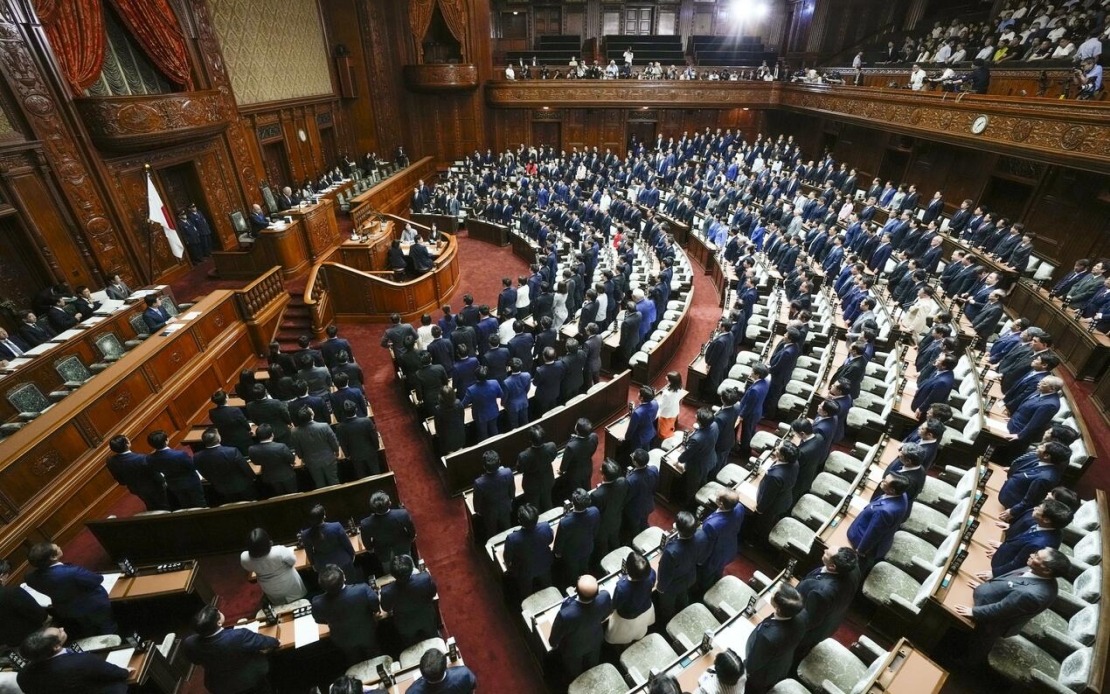
Japan's House of Representatives approved sweeping changes to the Imperial House Law on Friday, moving forward a contentious legislative package that marks the most substantial overhaul of imperial succession rules in more than seven decades. The vote, which took place after compressed deliberations that began earlier the same day, represents a significant victory for Prime Minister Sanae Takaichi's coalition government following weeks of parliamentary gridlock that had prevented meaningful debate on the controversial measures.
The ruling Liberal Democratic Party and its coalition partner, the Japan Innovation Party, secured the necessary supermajority to pass the legislation in the lower chamber, holding more than two-thirds of the available seats. With this milestone achieved, lawmakers from both ruling parties now aim to shepherd the bill through the House of Councillors before the current parliamentary session concludes on July 17, clearing the final hurdle toward enactment. The accelerated timeline underscores the administration's determination to resolve a succession crisis that has accumulated over generations.
At the heart of the reform lie two transformative provisions that fundamentally reshape how Japan manages its imperial lineage. First, the legislation permits the imperial family to adopt male descendants of emperors from eleven defunct branch families, provided they are at least fifteen years of age and trace their lineage exclusively through the male line. Second, the bill allows female imperial family members to retain their status and titles even after marrying non-imperial Japanese citizens, reversing a centuries-old convention that has stripped women of imperial rank upon matrimonial union with commoners.
The succession implications of these changes extend beyond the immediate expansion of the eligible pool. While the law explicitly prohibits adopted individuals themselves from ascending the Chrysanthemum Throne, it permits their male children and male descendants to be considered for succession. This distinction preserves certain ceremonial purity around direct imperial bloodline while simultaneously creating new pathways for securing the continuity of the institution. However, notably absent from the final legislation is any provision addressing the broader debate over female emperors or succession through maternal lines, concepts that have gained considerable traction among the Japanese public and within certain political circles.
The current legal framework restricts the throne exclusively to males possessing an emperor in their patrilineal ancestry, a restriction that has created cascading problems for institutional stability. The imperial family has experienced a dramatic contraction in recent decades, with eligible male heirs dwindling to dangerously low numbers. Female members have traditionally been removed from the succession equation entirely upon marriage, further constraining the dynasty's practical options. This demographic erosion has prompted policymakers to act before the succession itself faces genuine constitutional jeopardy.
The bill's development reflected extensive cross-party consultation, having been drafted in response to proposals compiled by the lower and upper house speakers and vice speakers after canvassing all thirteen parliamentary parties and caucuses. This collaborative genesis suggested the legislation might enjoy broader legitimacy than typical partisan measures. However, during the final legislative stage, the government incorporated provisions beyond the original cross-party framework, particularly the permission for male children of adoptees to become emperor. These additions have drawn sharp criticism from opposition legislators, who contend the ruling camp exceeded the mandate of interparty consensus.
The parliamentary approval comes as part of a broader coalition arrangement negotiated between Takaichi and the Japan Innovation Party on October 20 of the previous year. The imperial law revision figured prominently in those negotiations, establishing it as a foundational commitment of their governing partnership. When Takaichi ascended to the premiership shortly after that agreement, updating the Imperial House Law became one of her administration's principal legislative ambitions.
Reaching this Friday's vote required surmounting a substantial political hurdle. Parliament had ground nearly to a standstill from late June when opposition parties refused to engage substantively with two other major ruling bloc initiatives: legislation to reduce lower house representation and measures establishing a secondary capital facility to provide institutional redundancy for Tokyo's governmental functions. Opposition leaders characterized the ruling camp's approach to parliamentary management as heavy-handed and demanded intensive debate sessions with Takaichi to address allegations that her political organization had commissioned online content attacking rival politicians. These confrontations threatened to derail the entire legislative agenda.
The breakthrough arrived when the ruling coalition made significant concessions on Tuesday. Most notably, the government abandoned plans to force the lower house seat-reduction bill through parliament before the session's end, defusing the most volatile point of contention. This concession signaled flexibility and created sufficient political opening for opposition parties to resume substantive engagement with pending legislation, including the imperial law measure. Additionally, the ruling camp agreed to schedule intensive one-on-one debate sessions between Takaichi and opposition leaders for Wednesday afternoon, the first such sessions since May, thereby addressing opposition demands for direct accountability forums.
The imperial succession question carries profound significance for Japan's constitutional order and national identity. The institution of the Chrysanthemum Throne represents one of the world's oldest continuous hereditary institutions, carrying enormous cultural weight and ceremonial importance in Japanese society. A succession crisis would reverberate through the nation's sense of historical continuity and constitutional stability. The decision to permit adoptions from former branch families represents a pragmatic acknowledgment that maintaining institutional viability may sometimes require deviation from strict biological succession principles, while still preserving the male-line requirement that many traditionalists consider fundamental to the institution's integrity.
For Malaysia and other Southeast Asian nations observing Japan's political and constitutional developments, this legislative achievement demonstrates both the capacity for cross-party coordination on matters of national institutional importance and the genuine tensions that can emerge between ruling coalitions and opposition forces over governance procedures. The eventual expansion of the imperial succession base through adoption provisions offers comparative insights into how established institutions adapt to demographic and social pressures while attempting to maintain core constitutional principles and public legitimacy.
The rapid passage following weeks of deadlock reflects broader dynamics within Japan's parliamentary system, where coalition management and opposition cooperation prove essential for major constitutional changes. The government's willingness to compromise on unrelated legislation in exchange for opposition acquiescence on the imperial reform suggests that even in polarized political environments, elite consensus on institutional preservation can sometimes override partisan divisions. Whether the modifications to imperial succession will ultimately prove sufficient to resolve the dynasty's long-term demographic challenges remains to be seen, particularly given the continuing absence of provisions addressing female succession, a matter likely to resurface in future political debates.

