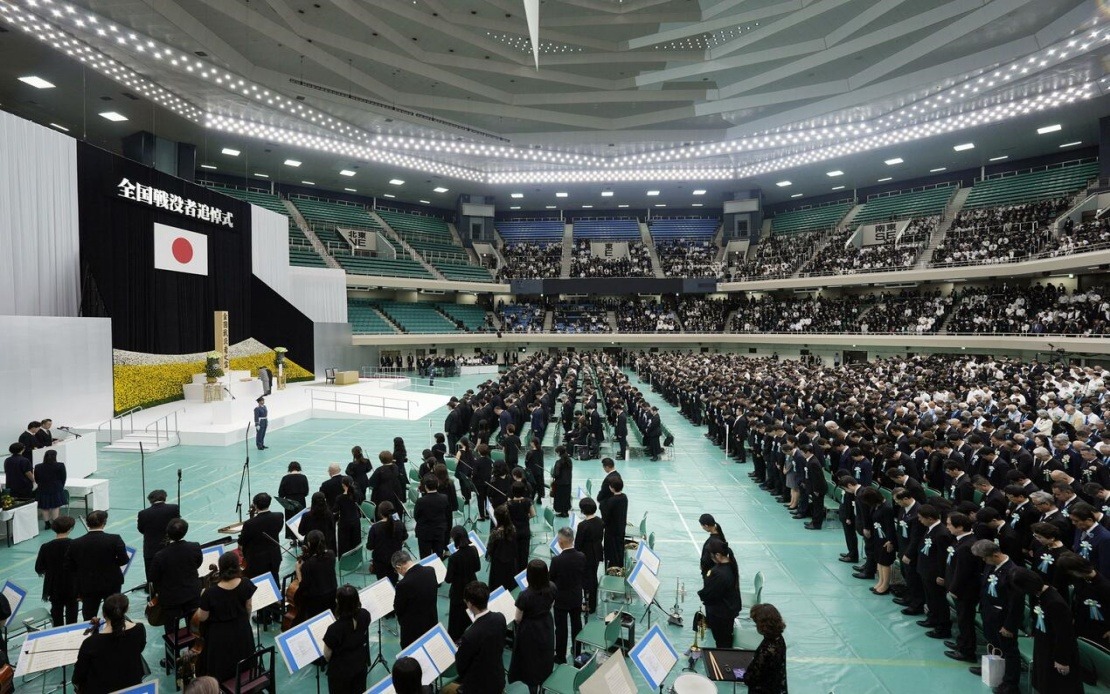
Japan observed the 81st anniversary of its World War II surrender on Saturday with a government-sponsored ceremony in Tokyo honouring approximately 2.3 million military personnel and around 800,000 civilians who perished in the conflict. Prime Minister Sanae Takaichi presided over the memorial event, pledging Japan's enduring commitment to peace, yet her remarks departed significantly from her predecessor's language in ways that underscore a subtle but consequential shift in how the nation's political leadership frames its wartime past.
Takaichi, who took office last October, attended the annual commemoration for the first time as prime minister. Her speech centred on Japan having "consistently walked the path of a nation that values peace and made all possible efforts for world peace and prosperity." The emphasis on forward-looking commitments to peace reflected a careful rhetorical choice, one that notably avoided the more explicit language her predecessor Shigeru Ishiba deployed at last year's ceremony. Ishiba had invoked Japan's "remorse" over the war and articulated a "resolute pledge to renounce war"—language that marked the first time in 13 years a sitting Japanese prime minister had formally acknowledged remorse at the August 15 ceremony.
The divergence between Takaichi and Ishiba's speeches carries symbolic weight beyond the ceremonial setting. As a prominent figure associated with Japan's hawkish faction on national security matters, Takaichi's omission of the word "remorse" signals a wider trajectory in how conservative Japanese leadership has gradually recalibrated its official commemorative language. Before Shinzo Abe, Takaichi's political mentor, commenced his second term as prime minister in December 2012, successive Japanese leaders had routinely acknowledged the nation's wartime aggression across Asia, including towards China and the Korean Peninsula, and explicitly expressed contrition. That consistency has eroded markedly over the past decade.
Takaichi's approach mirrors the pattern established during Abe's tenure, when references to aggression and remorse became increasingly minimised at state ceremonies. By sidestepping direct acknowledgement of wartime conduct while simultaneously invoking generational responsibility, Takaichi navigated a delicate political path. She stated: "Although 81 years have now passed, no matter how time flows, we will remain committed to this resolute pledge, passing it down across generations." The rhetoric emphasises continuity and forward momentum rather than historical accounting, allowing her to reaffirm peace commitments without the language of contrition that previous leaders had deemed necessary.
Contrasting sharply with the prime minister's measured tone, Emperor Naruhito maintained the imperial tradition of explicitly expressing "deep remorse" during the ceremony, as he does annually. The emperor further called upon citizens to preserve and transmit memories of wartime suffering to future generations, language he has consistently employed. This distinction between the imperial and prime ministerial positions reflects an enduring tension within Japanese political culture between formal acknowledgement of historical wounds and the rhetorical preferences of elected leaders increasingly drawn from nationalist political currents.
The timing of this year's anniversary carries particular geopolitical significance. Japan faces heightened regional tensions and has undergone substantial shifts in its defence posture, including substantially elevated national security expenditures and relaxed restrictions on defence equipment exports. These policy adjustments represent departures from Japan's postwar security architecture and reflect a recalibration of strategic priorities. Takaichi's rhetoric, by emphasising Japan's contemporary commitment to peace without dwelling on historical transgressions, aligns the anniversary commemoration with the administration's broader strategic messaging about national renewal and security adaptation.
For Southeast Asian nations and regional observers, the language choices at such ceremonies matter considerably. Malaysia and other ASEAN members, many of which experienced Japanese occupation during World War II, have historically monitored how Tokyo's leadership frames its wartime history. The gradual softening of remorse language and the avoidance of direct reference to aggression can register as concerning indicators of historical revisionism or as signals about how Japan might approach contemporary regional relationships and historical disputes. Taiwan and South Korea have similarly scrutinised such official statements as barometers of Japan's stance on longstanding grievances.
The ceremony proceeded with a noon moment of silence, the exact time when then Emperor Hirohito announced Japan's surrender via radio broadcast in 1945. This annual ritual maintains a direct temporal and symbolic connection to the moment of capitulation, grounding the modern commemoration in the historical facts of defeat and surrender. Yet the words chosen by contemporary leaders to frame that historical moment increasingly diverge from those used by their immediate predecessors, suggesting that debates over how Japan should remember and present its wartime past remain contentious and actively contested among political elites.
Takaichi's calculated omission reflects broader patterns within Japanese conservatism, where certain factions have persistently challenged the narrative of imperial aggression enshrined in postwar orthodoxy. By avoiding the explicit language of remorse, she neither endorses revisionist positions that deny wartime wrongdoing nor does she alienate constituencies sceptical of what they characterise as excessive historical self-flagellation. This rhetorical middle ground, however, disappoints those who view sustained acknowledgement of historical responsibility as integral to Japan's democratic maturity and regional credibility.
The ceremony's bifurcated messaging—with the emperor maintaining traditional language while the prime minister charts a modified course—creates ambiguity about the official Japanese position. International observers and neighbouring nations face interpretive challenges in determining whether shifts in prime ministerial rhetoric signal genuine policy reorientation or merely reflect the particular ideological preferences of individual leaders. For Malaysia and Southeast Asia, monitoring such signals remains diplomatically important, particularly as Japan navigates an increasingly complex regional security environment where historical trust and contemporary strategic interests intersect.

