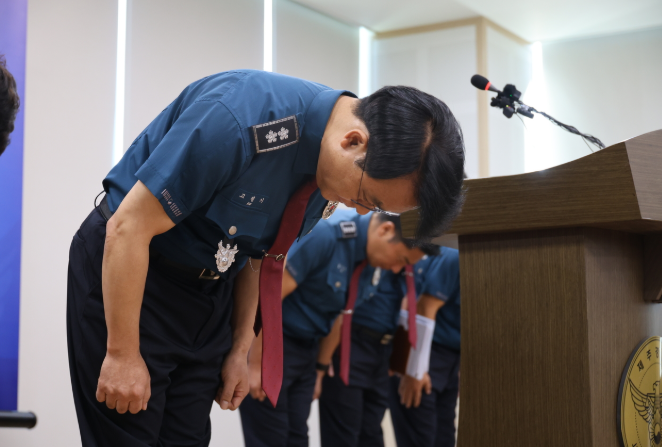
Jeju Police Commissioner Ko Pyeong-gi issued a formal public apology on Thursday following the discovery that a subordinate officer had improperly handled two missing person investigations, resulting in the deaths of both individuals going unaddressed during critical periods. The commissioner appeared at the Jeju Provincial Police Agency to publicly acknowledge the gravity of the failures and their devastating impact on bereaved families.
The controversy centres on a police officer identified only as Bu, who stands accused of using fabricated grounds to prematurely close the missing person file of Jang Mi-ran, a 37-year-old woman who vanished in May. Jang's remains were discovered on Monday, more than three months into her disappearance. Investigators allege that Bu falsely documented having made direct contact with Jang to justify case closure, thereby terminating active search efforts and removing the investigation from official priority status.
The same officer employed an identical approach in a separate case involving a man in his 60s, whose body was recovered on Saturday. The parallel methodology suggests either systemic negligence in case management protocols or deliberate misconduct designed to artificially reduce the police agency's pending caseload. The timing of both discoveries within days of one another has intensified scrutiny of police procedures across Jeju's jurisdiction.
In his statement, Commissioner Ko expressed profound remorse for the families' suffering and acknowledged the fundamental breach of duty. "I bow my head in apology to the two deceased people who never made it back to their families, and to the bereaved families suffering grief beyond description," the commissioner stated. He further recognised that the incident had inflicted lasting psychological damage on the victims' relatives and had undermined public confidence in local law enforcement.
Ko emphasised that police officers occupy a position of public trust that demands absolute integrity in executing their responsibilities. "A police officer has a responsibility to protect the safety and lives of the people, yet he disregarded that duty and lied, leaving permanent scars on the families," he said, extending his apologies beyond the immediate families to the broader Jeju resident population whose safety depends on reliable police work.
The commissioner committed Jeju police to conducting a thorough and transparent investigation into both cases, signalling that accountability measures would follow the apology. This represents an acknowledgment that the police department itself must participate in uncovering the full scope of what occurred, rather than relegating the matter entirely to external prosecutors or oversight bodies. The transparency commitment is particularly significant given historical concerns in South Korea regarding police institutional accountability.
More broadly, Ko announced that Jeju police would undertake a comprehensive audit of all missing person cases handled within the island's jurisdiction to identify whether similar patterns of mismanagement or misconduct exist elsewhere in their records. This systematic review addresses fears that Bu's actions may represent isolated incidents or instead point to deeper organisational dysfunction affecting case prioritisation and officer accountability mechanisms. The decision to conduct such an audit effectively acknowledges that the problem may be wider than the two cases that triggered the public apology.
The incident raises important questions about police management structures and oversight mechanisms in South Korean law enforcement. Missing person investigations require sustained attention and resources, particularly during critical early phases when investigative leads remain fresh and public visibility matters most. Falsely closing cases removes investigative momentum and can significantly delay recovery efforts, as the three-month gap in Jang's case illustrates.
For regional observers and policymakers, the Jeju situation underscores the importance of institutional checks on front-line police discretion, particularly in cases where officers control documentation and case status determinations. Without adequate supervision and verification protocols, individual officers retain considerable power to misrepresent investigative progress or deliberately suppress ongoing investigations. The incident demonstrates that professional training and recruitment standards alone cannot guarantee ethical conduct without supporting accountability infrastructure.
The public apology by a senior police official also reflects shifting expectations regarding institutional responsibility in South Korean governance. Rather than deflecting blame or minimising misconduct, the police hierarchy has chosen to accept collective responsibility and commit to systemic improvements. This approach differs markedly from responses in some jurisdictions where institutional reputation takes priority over acknowledgment of failures.
For families of missing persons across South Korea and the broader region, the Jeju incident carries sobering implications. It highlights the vulnerability of cases that depend on police resource allocation and individual officer decisions, particularly when missing persons lack prominent public profiles or high-profile circumstances that generate media attention. The outcome also emphasises the importance of family persistence in pursuing investigations when institutional responses seem inadequate.
The review of all Jeju missing person cases will likely require substantial police resources and may uncover additional problems requiring remedial action or further investigation. The scale of such an audit, if conducted thoroughly, could occupy the department's investigative capacity for an extended period and may result in criminal referrals beyond the officer currently implicated. The broader implications for police management culture and performance metrics on Jeju will likely emerge as the review progresses.

