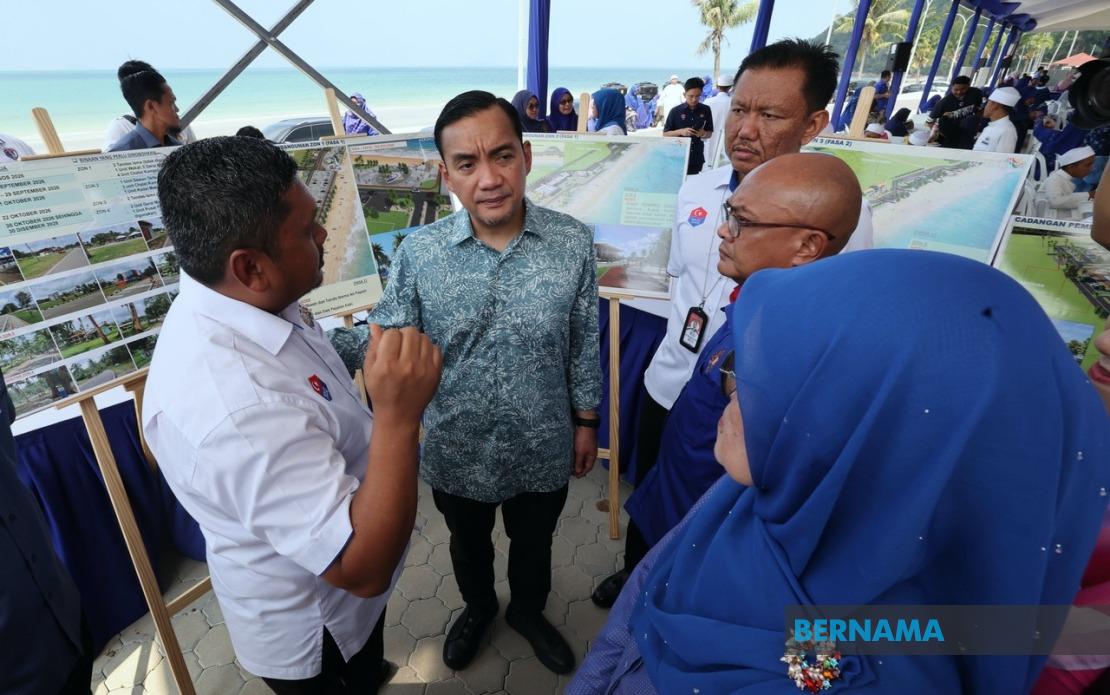
Johor's state government has earmarked RM1.5 million to fund a comprehensive suite of development initiatives in Mersing, spanning infrastructure modernisation, sporting facilities, healthcare enhancements, and essential public utilities. The allocation represents part of a broader commitment by Menteri Besar Datuk Onn Hafiz Ghazi to ensure that economic prosperity—particularly the gains emerging from tourism and commercial activity—translates directly into tangible improvements for the district's 80,000 residents.
The financial package underscores a strategic pivot within Johor's governance framework, one that recognises a critical governance challenge: rapid economic expansion in major urban centres can inadvertently leave peripheral districts without commensurate development. Onn Hafiz indicated during his address in Mersing that the state intends to replicate the development template that has proven effective in Johor Bahru, adapting proven methodologies to suit the distinct needs and circumstances of more rural and semi-developed areas. This approach reflects a recognition that sustainable prosperity requires geographic equity alongside headline economic growth rates.
Central to this initiative is the Johor Economic Transformation Plan (JETP), a multi-phased roadmap that articulates short-term, medium-term, and long-term objectives for the state's economic advancement. Rather than positioning the plan solely as a mechanism for capital generation or sectoral expansion, state leadership has framed it explicitly as a vehicle for livelihood enhancement and employment creation. The emphasis on youth employment is particularly significant in Malaysian context, where demographic trends and emigration patterns have raised concerns about whether domestic job markets can absorb and retain young talent with appropriate remuneration and career progression.
The healthcare allocation illustrates the government's recognition that development extends beyond tourism infrastructure and commercial zones. Of the total RM1.5 million, RM500,000 has been designated for upgrading facilities at Mersing Hospital's Haemodialysis Unit. This investment reflects an understanding that peripheral districts often lag in specialised medical provision, and that residents requiring regular dialysis treatment frequently must travel considerable distances to urban centres. Improving renal care capacity locally reduces both patient hardship and strain on family finances, particularly among lower-income households that comprise a significant portion of Mersing's demographic.
Sporting and community infrastructure comprises a substantial portion of the funding envelope. The allocation includes RM200,000 each for carpet replacement at Kampung Sri Lalang Mosque, construction of a futsal court at Taman Sri Mersing, and repair of an existing futsal court in Felda Nitar. An additional RM80,000 has been designated for a sepak takraw court in Felda Tenggaroh 6. These investments reflect a holistic understanding that community wellbeing encompasses not merely income generation but also recreational opportunity and cultural activity. The emphasis on futsal and sepak takraw—sports deeply embedded in Malaysian popular culture—suggests a commitment to supporting activities that resonate with local communities rather than imposing externally determined priorities.
Rural electrification emerges as another priority, with RM100,000 each allocated for solar-powered streetlighting installations in the Orang Asli villages of Kampung Peta and Kampung Tanjung Tuan. This investment category carries particular significance in a Southeast Asian context where indigenous communities often occupy the margins of national development indices. Solar technology deployment represents not merely infrastructure provision but also a pragmatic acknowledgment of geographic and logistical constraints that can render conventional grid extension uneconomical. The choice of renewable energy sources additionally signals alignment with environmental sustainability principles.
Onn Hafiz announced several ancillary strategic initiatives that extend beyond the immediate RM1.5 million allocation. Plans to establish a Religious Affairs Office in Mersing address administrative gaps that have likely created inconvenience for residents navigating Islamic affairs bureaucracy. More significantly, a commitment to establish a Technical and Vocational Education and Training campus represents a medium-term investment in human capital development. TVET provision has become increasingly critical within Malaysia's economic diversification strategy, offering pathways for young people who may not pursue traditional university education but require marketable technical competencies.
The proposal to construct a petrol station specifically servicing the Special Forces Group at Camp Iskandar represents a more specialised military and civilian infrastructure initiative. While ostensibly a logistics provision, such facilities often generate ancillary employment and supply chain opportunities within local economies. The coordination mechanism outlined—involving both the local assemblyman and the Mersing District Officer—suggests recognition that implementation success depends on functional inter-agency cooperation and community-level advocacy.
The broader policy architecture reflected in this allocation deserves analytical attention. Rather than pursuing a zero-sum approach where development resources concentrate in high-return urban corridors, Johor's leadership appears to embrace a distributive model that acknowledges political legitimacy and social cohesion require equitable geographic development. This philosophy gains urgency in Malaysian context where regional disparities have historically fuelled both migration pressures and political grievances. The messaging that development benefits should reach all residents, not merely tourism operators and commercial enterprises, represents an implicit acknowledgment of equity concerns within the state's own population.
Implementation fidelity will ultimately determine whether this allocation generates the intended outcomes. Johor's track record in infrastructure delivery and project management suggests reasonable confidence in successful execution, though delays and cost escalations have plagued certain initiatives across Malaysian states. The involvement of local assemblymen—Tenggaroh assemblyman Mohd Youzaimi Yusof and Endau assemblywoman Alwiyah Talib—in the announcement underscores a deliberate effort to embed constituency representatives in project governance, potentially enhancing accountability and responsiveness to local priorities.
For Southeast Asian observers, this Mersing initiative reflects broader regional trends in development governance. As tourism revenue becomes increasingly important to district and state economies across the region, jurisdictions face pressure to ensure such growth translates into widely distributed benefits rather than concentrated wealth capture. Malaysia's federal structure and relative administrative capacity provide advantages over some neighbours in implementing distributive development strategies, yet challenges in translating policy allocations into on-ground impact remain formidable. Mersing will serve as an instructive case study in whether peripheral Malaysian districts can achieve genuine economic inclusion within a high-growth regional context.

