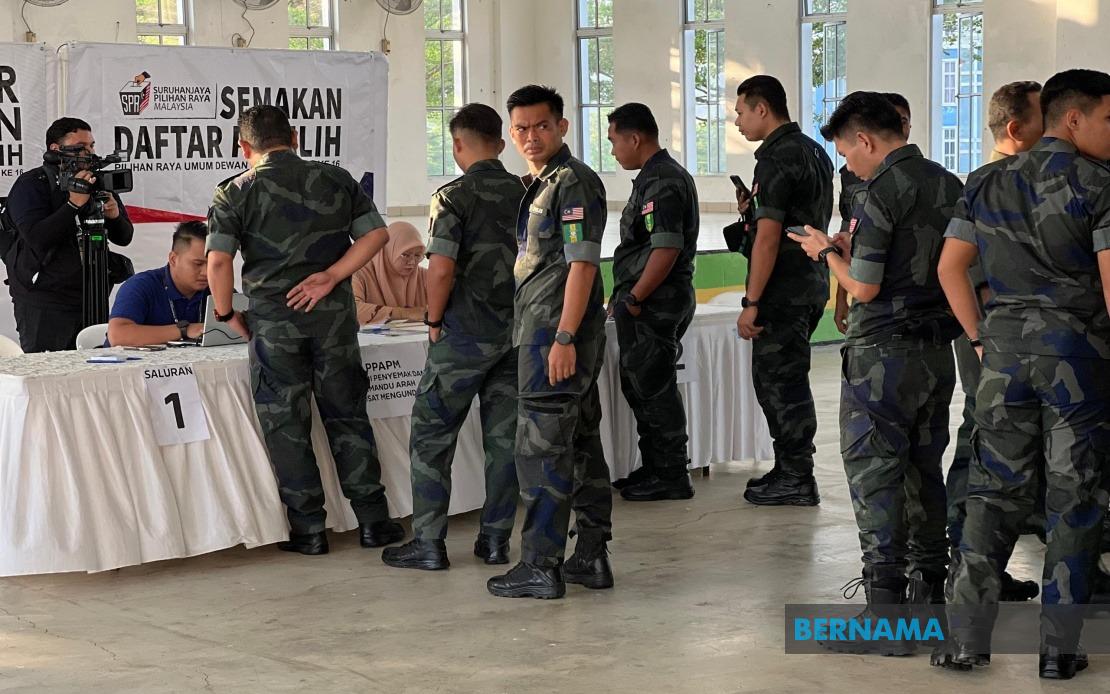
Malaysia's 16th Johor state election entered a crucial preparatory phase on Friday as security forces and their families exercised their voting rights at 64 dedicated early polling stations throughout the state. A total of 24,751 eligible voters from the Malaysian Armed Forces, Royal Malaysia Police, and General Operations Force participated in the advance ballot, taking place the day before the general polling day scheduled for Saturday.
The Election Commission designated separate voting infrastructure to accommodate the security sector's unique requirements. The Malaysian Armed Forces and their spouses utilised 11 dedicated polling centres to cast their ballots, with 12,041 personnel expected to vote across these venues. This parallel arrangement reflects the constitutional recognition that military and police personnel require distinct voting procedures to ensure operational readiness and maintain public order during electoral periods.
The Police and paramilitary forces accessed a considerably larger network of polling stations. A total of 53 centres across Johor catered to approximately 12,710 voters from the Royal Malaysia Police and General Operations Force, alongside their eligible spouses. The disparity in the number of polling stations reflects the different geographic distribution and strength of these security agencies across the state, ensuring that no personnel faced undue travel burdens when fulfilling their democratic duty.
Operational logistics demonstrated careful planning by election authorities. All 64 early voting centres commenced operations at 8 am, with staggered closing times designed to prevent congestion while maintaining the integrity of the electoral process. The Election Commission implemented a phased closure schedule, with voting stations shutting down progressively between noon and 6 pm, allowing flexibility for security personnel whose operational duties may not permit simultaneous voting periods.
The timing of early polling for security forces is not arbitrary. In Malaysia's constitutional framework, members of the armed forces and police require advance voting arrangements because their deployment schedules during general polling days could prevent them from exercising their franchise. This practice, adopted in elections across the nation, ensures that those serving in uniform maintain equal democratic participation despite their professional obligations to maintain order and security during the election itself.
Saturday's main polling day would involve a substantially larger electorate spread across 56 state seats. Approximately 2.7 million ordinary voters were expected to participate in the general ballot, determining the composition of the Johor state assembly and ultimately the state government. The magnitude of this turnout underscores Johor's significance as Malaysia's second-largest state by population and its consistent role as a bellwether for broader political trends affecting the nation.
Weather conditions reported across several Johor districts suggested favourable polling conditions. Batu Pahat, Muar, Pontian, and Tangkak experienced sunny weather on Friday, which typically facilitates voter turnout by reducing the inconvenience of weather-related delays or travel difficulties. Meteorological stability in these constituencies, covering diverse geographic zones from coastal to inland areas, indicated that Saturday's polling day would likely not face weather-related disruptions.
The early voting mechanism for security personnel represents a practical accommodation within Malaysia's democratic system, balancing electoral accessibility with operational necessity. By completing security forces' voting on Friday, the Election Commission ensured that Saturday could proceed with full police and military deployment focused entirely on securing polling stations, maintaining order, and facilitating the voting process for the general population. This separation of the security vote from the main election day reduces logistical complications and potential conflicts of interest.
For Malaysian observers and regional political analysts, Johor state elections carry significance beyond the state itself. Johor has historically demonstrated voting patterns reflective of broader national sentiment, and the composition of its state assembly influences federal political calculations. The state's economic importance—anchored by its port facilities, manufacturing base, and strategic location adjacent to Singapore—ensures that electoral outcomes in Johor command attention from investors, policymakers, and political strategists across Southeast Asia.
The Election Commission's administration of the early polling phase showcased the institutional capacity of Malaysia's electoral body to manage complex logistics across multiple security agencies. Coordinating voting arrangements for military, police, and paramilitary personnel, while maintaining security protocols and ensuring that all eligible family members could participate, required substantial organisational effort and interagency cooperation. The successful opening of 64 centres without reported incidents suggested that preparatory work had proceeded methodically.
Saturday's broader polling day would determine not only the composition of the state assembly but also provide early indicators of voter mood regarding political performance and governance. As the second major state election since the 2022 federal election that brought the Pakatan Harapan-Barisan Nasional coalition to federal power, Johor's results would offer insights into whether the federal coalition maintained public confidence or faced challenges that regional elections might amplify.

