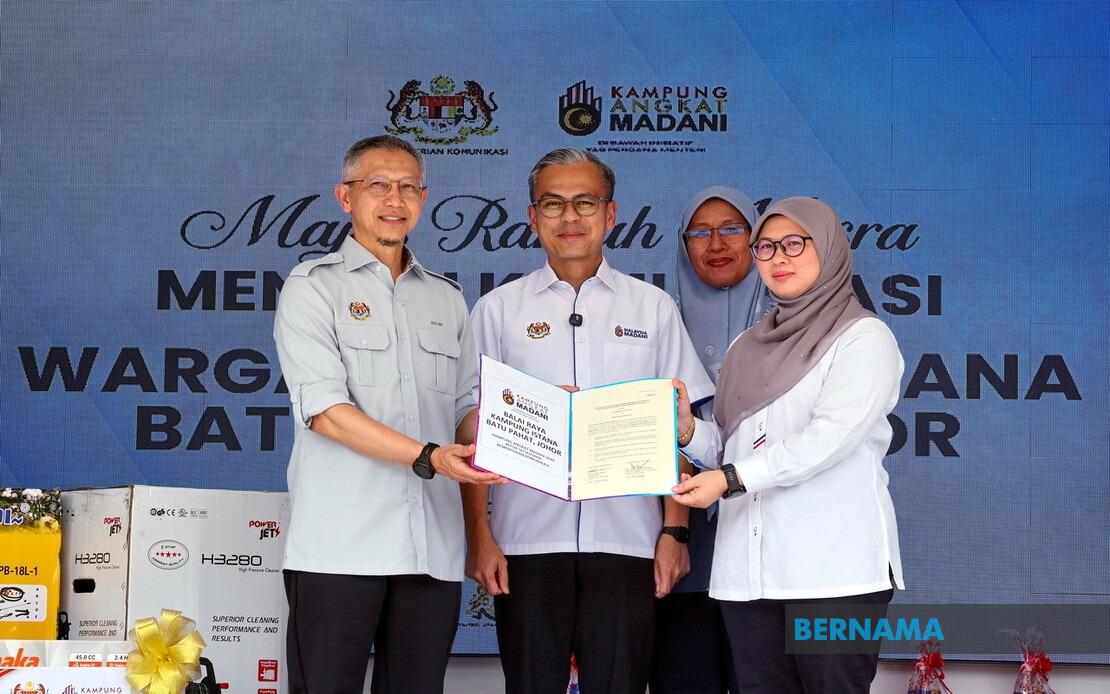
The upcoming Johor state election represents a pivotal moment for voters to assess which leadership team can deliver tangible progress for the state, rather than serving as a personal endorsement for any individual politician, according to Pakatan Harapan (PH) Communications Director Datuk Fahmi Fadzil. Speaking during a campaign visit to Kampung Istana in Batu Pahat, Fahmi sought to redirect public discourse away from what he characterised as distracting narratives that conflate electoral support with backing for specific personalities or causes unrelated to governance.
The comments came in direct response to claims made by Datuk Nazifuddin Mohd Najib, who had suggested that a Barisan Nasional (BN) victory in the Johor election would demonstrate public support for granting a pardon to his father, former Prime Minister Datuk Seri Najib Razak. This assertion appears designed to link state-level electoral performance to federal-level political rehabilitation—a framing that Fahmi argued should alarm voters. By presenting a state election as a proxy vote on an individual's legal status rather than on local governance priorities, Fahmi contended that such messaging fundamentally misrepresents what is at stake for Johor residents.
Fahmi's intervention reflects broader concerns within PH that opposition messaging is attempting to mobilise support through personal loyalty rather than policy substance. The strategy of decoupling the election from individual political figures allows PH to maintain focus on substantive governance issues—economic development, service delivery, and state management—rather than becoming entangled in narratives about pardons or personal vindication. This repositioning is particularly significant given Johor's historical status as a political stronghold for UMNO, the dominant component of the BN coalition.
The communications minister also addressed shifting voter behaviour, particularly regarding the notion of "fixed deposits"—populations assumed to vote predictably for particular parties. Fahmi emphasised that no political party can assume permanent voter support in contemporary Malaysian politics. This observation carries particular weight in Johor, where UMNO has long treated the state as a bastion of reliable backing. The emergence of public statements from UMNO-aligned figures such as former Rengit assemblyman Datuk Dr Mohd Puad Zarkashi, who has signalled openness to PH candidates, suggests that traditional partisan alignments are becoming more fluid.
PH's strategy appears to centre on demonstrating that support traditionally locked behind UMNO and BN cannot be taken for granted, particularly when state-level performance becomes a salient issue for voters. The defection of statements from opposition-aligned individuals represents an attempt to normalise cross-coalition political movement and signal that Johor voters have genuine alternatives worth considering. These endorsements, even when coming from figures not formally switching allegiance, serve as public permission structures for other voters to consider voting outside established patterns.
Fahmi highlighted the growing appeal of PH across diverse constituencies by referencing support from Bersatu members for the coalition's Sri Medan candidate, Hishamuddin @ Misrin Ishak, and backing from former opposition figures for the Rengit seat. These developments suggest that PH believes it is assembling a broader coalition than it may have historically enjoyed in Johor. For a state that has been considered UMNO's electoral fortress, the ability to attract defections and cross-party endorsements, even at the margins, represents a significant tactical achievement.
The polling for the 16th Johor State Election, scheduled for July 11 with early voting on July 7, will see 172 candidates contest 56 seats across the state. The scale of the contest means that voter behaviour at the margins—swing voters, first-time voters, and those willing to consider alternatives to traditional choices—could determine the overall outcome. Fahmi's framing of the election as a choice about future direction rather than personal politics is designed to activate precisely these marginal voters who may be ambivalent about established political relationships.
For Malaysian observers and regional political analysts, the Johor election carries significance beyond the state itself. Johor's political trajectory influences the broader national political balance, particularly in relation to UMNO's capacity to maintain control within the BN framework and within national politics more broadly. A result that substantially challenges BN dominance in Johor would signal that the traditional structure of Malaysian electoral politics—where certain regions were considered safely controlled by particular coalitions—is undergoing fundamental transformation.
Fahmi's messaging also addresses a more subtle but important concern: the risk that electoral participation becomes distorted by external narratives disconnected from local governance. By insisting that voters focus on leadership quality and capacity to deliver for Johor specifically, PH is attempting to frame the election on terrain where it believes its candidates and campaign have competitive advantage. The party's emphasis on economic recovery and governance competence positions PH to compete more effectively than if the contest becomes dominated by discussions of pardons, personal rehabilitation, or factional disputes within the national political establishment.
The invocation of Prime Minister's leadership in strengthening economic recovery, including Johor's economic prospects, connects the state election to broader themes of national governance and prosperity. This strategy seeks to make PH's federal-level stewardship relevant to state-level voting decisions, suggesting that choosing PH in Johor represents alignment with a leadership team that has demonstrated economic competence at the national level. Such messaging aims to create cognitive coherence between state and federal voting choices, potentially benefiting PH if voters perceive a connection between Putrajaya's economic management and their personal prosperity.
As the campaign intensifies toward polling day, the competing narratives about what the Johor election represents will continue to shape voter perception and behaviour. PH's insistence that the election concerns governance and future development rather than individual politicians represents a deliberate choice to contest on grounds where it believes it has sufficient message discipline and candidate quality to be competitive. Whether voters ultimately accept this framing or instead permit themselves to be mobilised by alternative narratives—whether related to pardons, factional loyalties, or other concerns—will significantly influence both the election outcome and what that result means for Malaysian politics more broadly.

