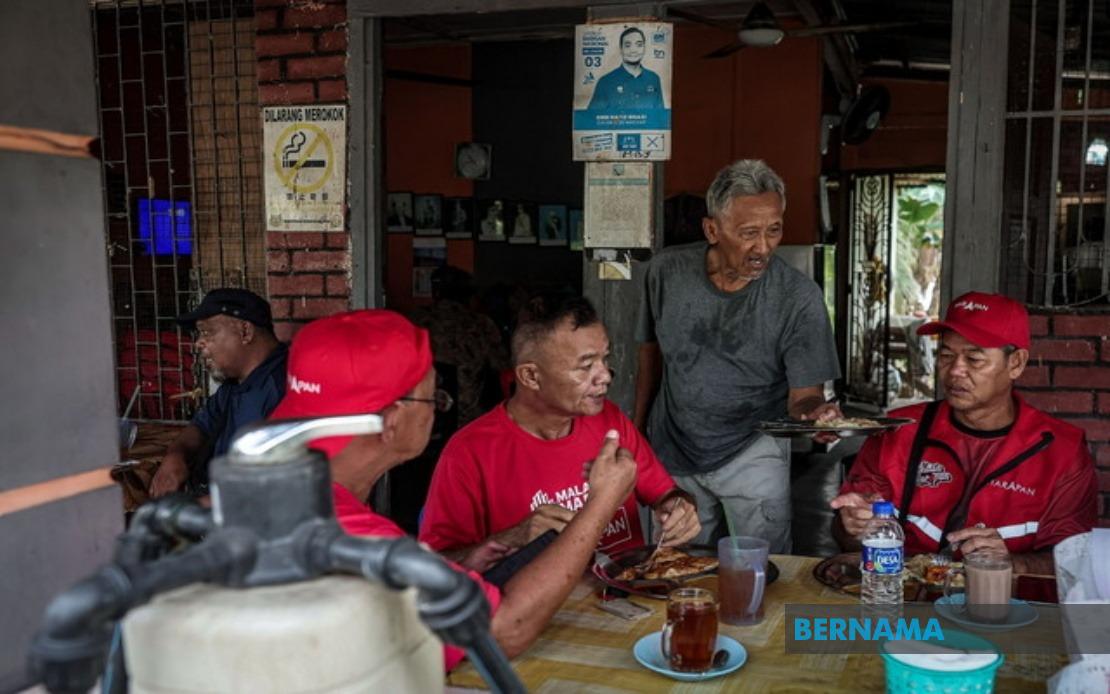
The ongoing Johor state election campaign has delivered an unexpected economic dividend to petty traders and street food vendors operating across key constituencies, particularly in the Layang-Layang and Simpang Renggam areas. Beyond its role as a democratic exercise, the polling season has functioned as a substantial income generator for hawkers whose daily takings have surged well beyond their typical earnings, suggesting that election periods create distinct but temporary opportunities for grassroots economic activity in rural and semi-urban Malaysian communities.
In Felda Layang-Layang, Noorma Zafmeeden, a 70-year-old stall operator, has witnessed a dramatic transformation in her morning service since the campaign intensified. Her roti canai and nasi lemak establishment ordinarily shifts less than RM400 in morning sales, a modest figure for a breakfast service operating since the late 1980s. However, the arrival of campaign teams and their accompanying entourages has fundamentally altered her customer flow, with revenues climbing substantially above her historical baseline. The timing of such booms matters considerably for vendors like Noorma, whose margins in the food service sector are typically tight, making seasonal income fluctuations a significant factor in household financial planning.
Operating alongside her husband Bahari Madiran, 76, Noorma has maintained their established practice of commencing preparations in the pre-dawn hours to serve breakfast dishes, then transitioning to evening fried food service. Their long tenure in the Felda settlement—spanning since 1987—positions them as fixtures in the local community, their warung functioning as a gathering space where customers from diverse ethnic and religious backgrounds converge. For Bahari, the election season's influx represents more than commercial opportunity; it reflects a deeper social phenomenon wherein campaign activity generates cross-community interaction and cultural exchange at ground level, far removed from the political speeches and strategic announcements dominating media coverage.
The economic benefits flowing to food vendors extend well beyond individual stall operators. Ahmad Ridzuan Awang, a 45-year-old nasi campur trader operating in Simpang Renggam, has documented a doubling of his daily sales during the campaign period. His experience illustrates a critical threshold effect: whereas his diverse selection of side dishes would typically exhaust only by evening, the campaign period has compressed his selling cycle dramatically, with bulk orders from various political teams and supporters clearing his inventory by early afternoon, sometimes as soon as 1:30 pm. This acceleration in turnover carries implications for supply chain logistics and ingredient procurement, forcing vendors to recalibrate their purchasing patterns to meet demand spikes that would be uneconomical to sustain year-round.
The phenomenon Ahmad Ridzuan describes as an influx of "political tourists" encompasses campaign workers, party representatives, candidate entourages, and supporters converging on constituencies from across Malaysia's regions. These external actors inject spending power into local economies that would otherwise remain confined to established residential populations. The phenomenon functions as a form of temporary economic stimulus, though one that depends entirely on electoral calendars and campaign intensity rather than sustained demand fundamentals. For constituencies like Simpang Renggam and Layang-Layang, the predictability of election-driven booms provides planning opportunities that other seasonal industries—such as tourism or agricultural production—might struggle to establish with similar reliability.
Beyond direct food sales, the ripple effects of campaign activity benefit the broader supplier ecosystem and adjacent service providers. Ahmad Ridzuan explicitly identifies secondary beneficiaries in local procurement networks, noting that enhanced foot traffic and increased ingredient consumption for his operation necessarily drive corresponding demand among his suppliers—from rice merchants to vegetable wholesalers to cooking oil distributors. This multiplier effect, though temporary, demonstrates how political activity can function as an economic stimulus mechanism when concentrated in specific geographic areas. However, this benefit structure reveals an underlying fragility: when campaign activity concludes, the supporting economic activity terminates abruptly, potentially creating a deflationary shock for vendors who have expanded capacity to meet temporary demand.
The 16th Johor state election, scheduled for polling day on July 11 with early voting on July 7, encompasses 172 candidates competing across 56 seats. The competitive intensity of such contests necessarily translates into sustained campaign presence across all constituencies, creating the conditions for the demand surges documented among Layang-Layang and Simpang Renggam vendors. The campaign window between nomination and polling day provides a measurable period during which election-related economic activity concentrates investment and foot traffic in ways that urban areas with established tourist infrastructure might experience during festival seasons or public holidays.
For Malaysian policymakers and development economists, the election economy presents an interesting case study in localized economic stimulus. The phenomenon raises questions about whether similar demand-generation mechanisms could be engineered during non-election periods, or whether the concentration of visitors during campaigns represents a unique opportunity window that policy intervention could extend or institutionalize. Rural areas and Felda settlements, which have historically experienced income volatility and limited service sector development, might benefit from sustained economic activity rather than episodic surges tied to electoral calendars.
The vendors' experiences also illustrate the resilience of Malaysia's informal economy and the capacity of street-level food services to respond to demand fluctuations. Both Noorma and Ahmad Ridzuan managed to expand service delivery without formal expansion of their operations, suggesting that capacity constraints in informal sector enterprises are often less binding than might be assumed. This flexibility has implications for understanding how grassroots traders could potentially sustain higher activity levels year-round if demand were more consistent.
For consumers and campaign participants, the proliferation of accessible food services during electoral periods reflects the integration of local vendors into campaign logistics and community mobilization. Rather than campaign teams importing food services or relying on chain establishments, they patronize existing neighborhood hawkers, generating reciprocal benefits that strengthen local economic linkages. This pattern contrasts with more urbanized campaign models that might rely on centralized catering or retail dining establishments.
The temporary nature of election-driven economic booms suggests that while vendors like Noorma and Ahmad Ridzuan benefit substantially during campaign periods, sustainable income growth for informal sector traders ultimately requires structural interventions—improved access to credit, formalized supply chains, or expanded tourist infrastructure—rather than reliance on episodic political activity. Nevertheless, the current election season demonstrates the latent demand for food services in these constituencies and the capacity of local vendors to meet it when circumstances generate sufficient customer traffic.

