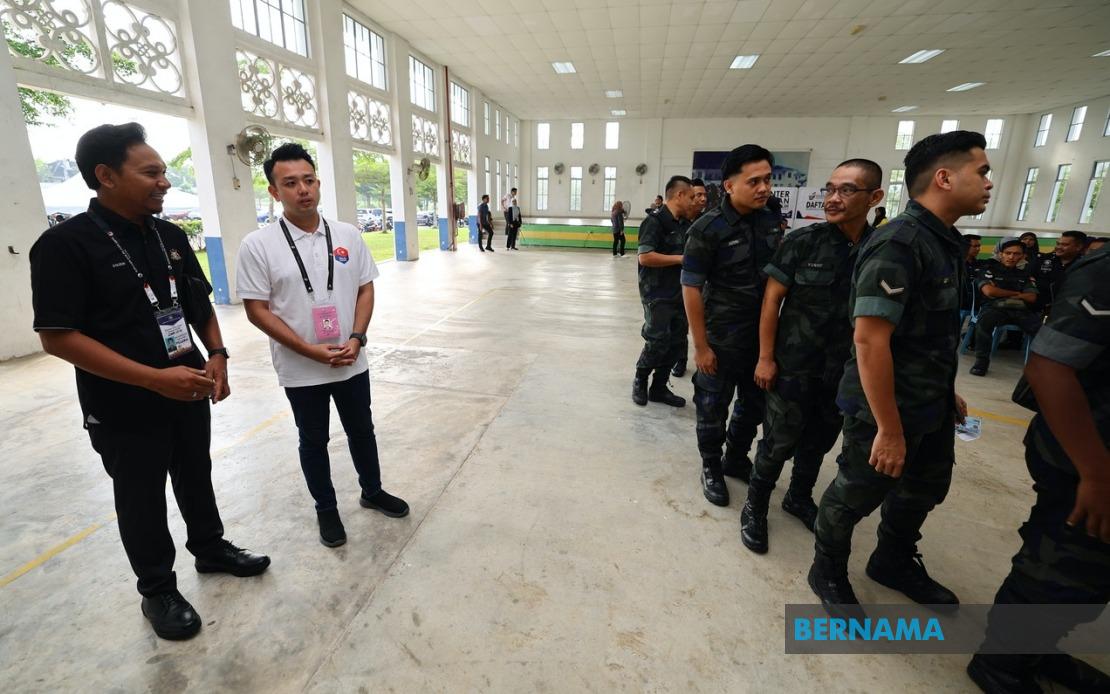
The Johor state election campaign entered its final stretch on Thursday as candidates paused their ground activities to observe early voting procedures at military and police installations across the state. Despite maintaining intense campaign schedules with polling day set for Saturday, representatives from the three main political coalitions made their presence felt at designated early voting centres, underscoring the competitive nature of the 16th Johor State Election.
At the GOF Camp in Simpang Renggam, all three contenders for the Layang-Layang seat witnessed the voting process unfold. Guna Balakrishnan representing Pakatan Harapan, Chua Jian Boon fielding the Barisan Nasional ticket, and Abd Mutalip Abd Rahim from Perikatan Nasional gathered to observe how security personnel exercised their franchise. Similarly, the trio contesting the Tenggaroh seat — Muhamad Amerul Muhamad of PN, Mohd Youzaimi Yusof of BN, and Md Yusof Dawam of PH — observed proceedings at Iskandar Camp in Mersing. These coordinated appearances demonstrated the candidates' commitment to ensuring transparency and fairness in the electoral process, a critical concern in Malaysian elections where public confidence in institutional integrity remains paramount.
The early voting exercise involved a cross-section of security personnel eligible to vote ahead of the main polling day. Military and police officers, along with their spouses, represented a concentrated voting bloc that historically exhibits high turnout rates due to their institutional discipline and sense of civic duty. A total of 20,607 voters participated in the early voting process, comprising 8,544 members of the Malaysian Armed Forces and their families alongside 12,063 police personnel and their dependents. For electoral purposes, this represented a significant portion of the total electorate that would determine the composition of the Johor State Legislative Assembly.
Senior government officials and military leaders also made their presence known at voting centres. Army Chief General Tan Sri Azhan Md Othman, accompanied by 21st Special Service Group commander Major General Datuk Ahmad Shuhaimi Mat Wajab, visited Iskandar Camp in Mersing to observe the process. Johor police chief Datuk Ab Rahaman Arsad cast his vote at Dewan Dato Onn at Johor police headquarters, signalling the inclusive nature of the early voting arrangement that applied across rank and seniority levels. These visits by senior officials served dual purposes: monitoring compliance with electoral procedures and demonstrating leadership commitment to the integrity of the democratic process.
The voting experience proceeded smoothly throughout the morning and early afternoon despite weather challenges. Security personnel arrived in organised batches beginning from 8 am, adhering strictly to protocols established by Election Commission officers. Brief rainfall at several locations posed no significant disruptions to the flow of voters, with participants maintaining orderly queues and demonstrating the professional discipline characteristic of the uniformed services. The systematic approach to managing voter traffic reflected months of electoral planning by the Election Commission to accommodate this large cohort while maintaining security and procedural integrity.
Fifty-six seats across the Johor State Legislative Assembly attracted 172 candidates representing various political entities and independent aspirants, making the contest notably competitive. The early voting mechanism served to facilitate participation among security personnel whose professional commitments might otherwise complicate their ability to vote on the main polling date. The establishment of 64 early voting centres operating from 8 am and closing in stages between noon and 6 pm demonstrated the Election Commission's determination to maximise accessibility while maintaining operational efficiency. This approach provided valuable logistical experience for managing voting procedures across geographically dispersed locations with varying numbers of registered voters.
The observation of early voting by candidates from all major political coalitions reflected the increasingly sophisticated and transparent nature of Malaysian electoral practices. Rather than treating security personnel as a monolithic bloc, candidates recognised the importance of understanding how this demographic exercised electoral choices. The presence of rival candidates at the same venues underscored competitive civility, where political opponents acknowledged mutual interests in ensuring democratic standards. This conduct contrasted with concerns occasionally raised about electoral fairness and candidate behaviour during campaign periods, demonstrating that Malaysian politics could accommodate healthy institutional practices when political actors prioritised process integrity.
For Pakatan Harapan, Barisan Nasional, and Perikatan Nasional, the early voting process provided crucial indicators of campaign effectiveness and organisational reach. Each coalition's candidates were strategically positioned across different constituencies, reflecting their respective assessments of competitive terrain. The Layang-Layang, Tenggaroh, Kempas, and Bukit Permai seats represented focal points where the contest appeared sufficiently tight to warrant candidate attention during the early voting phase. These decisions about where senior or prominent candidates positioned themselves offered observers insight into internal campaign calculations about winnable constituencies and areas requiring intensive effort.
The participation rate among eligible security personnel would eventually become relevant data for post-election analysis. Malaysian elections have historically seen strong turnout among uniformed services, reflecting both institutional expectations and genuine civic engagement. Whether the early voting process would accelerate or merely facilitate participation among this cohort remained a question that would be answered only after Saturday's main polling. The data gathered during early voting sessions would inform Election Commission assessments of overall electoral efficiency and participation patterns, contributing to ongoing refinements in Malaysian democratic practice.
The Johor election represented a significant electoral exercise within Malaysia's federal context, as state elections in any Peninsular state carried implications for national political dynamics. The composition of the Johor State Legislative Assembly could influence broader coalition calculations and power balances within Putrajaya. The comprehensive candidate observation of early voting procedures, spanning from the highest-profile constituencies to more localised contests, reflected the stakes involved and the seriousness with which political actors approached this election cycle. As Saturday approached, the early voting process had concluded, results would soon determine whether the political landscape in Johor would shift or remain stable.

