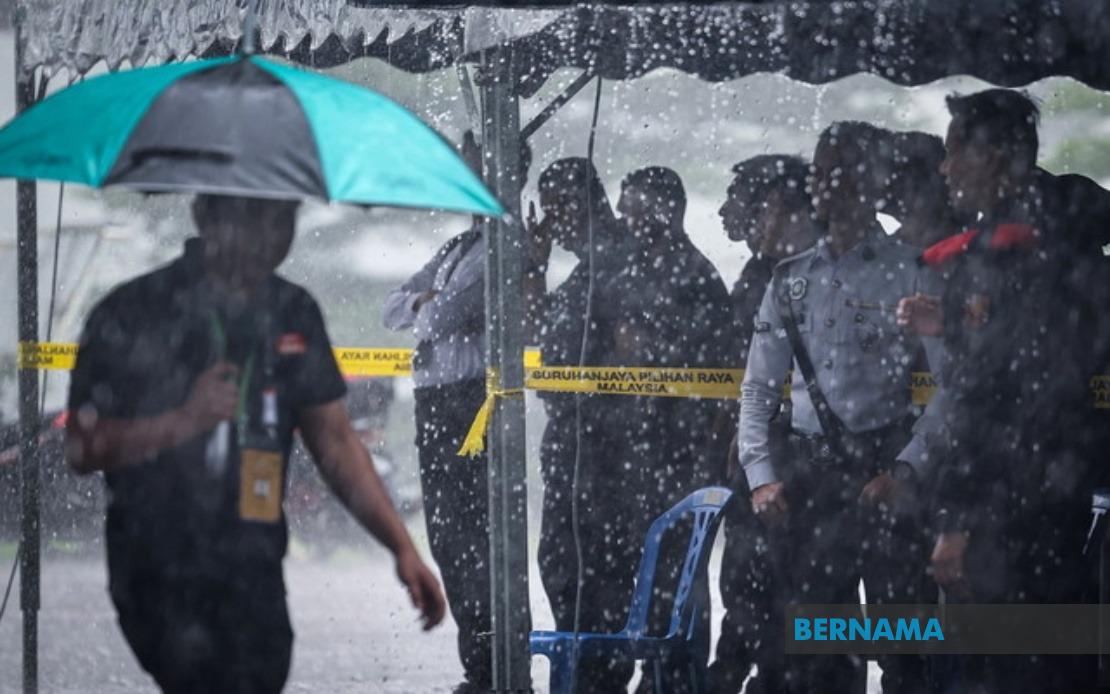
The 16th Johor state election got underway with its early voting phase on Wednesday as members of the police force turned out to cast their ballots, undeterred by severe weather conditions that swept through Johor Bahru during the morning session. A substantial downpour struck the State Police Contingent Headquarters at approximately 9.40 am, yet failed to create any meaningful disruption to voting procedures or logistics. The electoral process unfolded with the standard level of organisation and efficiency expected for such large-scale voting exercises, demonstrating the readiness of election administrators to manage the poll despite challenging atmospheric conditions.
Officers and personnel who arrived to participate in the early voting exercise were observed moving quickly through the rain towards the polling centre, displaying the determination typical of voters keen to fulfil their democratic responsibility. The steady flow of police staff continued throughout the morning and into the afternoon, with no reports of congestion, delays, or organisational failures. The sight of voters rushing through the downpour to reach the polling booths underscored the commitment among security force members to participate in the state electoral process, despite the inconvenience posed by the weather.
A notable scene unfolded as members of the media corps covering the early voting proceedings sought shelter under temporary tents erected at the polling centre, from where they continued their observation and documentation of the voting exercise. This arrangement ensured that press coverage of the event could continue uninterrupted, allowing the public and national audience to remain informed about the conduct of early voting despite the inclement conditions. The presence of media scrutiny further reinforced the transparency of the voting process, a key element in maintaining public confidence in electoral integrity.
The scale of police participation in this particular voting phase reflects the significant logistical considerations involved when security personnel require dedicated voting opportunities. A combined total of 12,067 police officers and their spouses were eligible to vote in person at specially designated polling centres across Johor on the day, representing a substantial portion of the state's law enforcement workforce. This figure underscores the comprehensive nature of electoral participation arrangements, which seek to ensure that members of the security apparatus can exercise their voting rights without compromising their operational duties and readiness.
Beyond the in-person early voting component, an additional 643 police personnel opted to exercise their franchise through postal voting arrangements, a mechanism that allows those unable to attend physical polling centres to participate remotely. The availability of alternative voting methods reflects the electoral commission's acknowledgment that certain groups, particularly those with operational commitments or geographic constraints, require flexible voting options. The combination of in-person and postal voting mechanisms ensures comprehensive participation across the entire eligible population.
The broader context of the 16th Johor state election encompasses a competitive contest that has mobilised significant political interest across the state. With 172 candidates contesting across 56 state assembly seats, the election reflects the diverse political landscape and competing visions for Johor's governance and development priorities. The magnitude of candidate participation suggests that multiple parties and independent contenders view the election as an opportunity to advance their respective political agendas and secure representation in the state legislative assembly.
The general election proper is scheduled for Saturday, when more than 2.7 million registered voters across Johor will be entitled to cast their ballots. This figure represents the overall electorate that will determine the composition of the state assembly and, consequently, the formation of the state government. The scale of voter participation anticipated for Saturday's main polling day significantly exceeds the early voting numbers, though the early voting exercise serves important functions in managing electoral logistics and accommodating voters with scheduling constraints or specific operational requirements.
For Malaysian observers and those with interests in regional electoral dynamics, the Johor election holds particular significance given the state's political weight within the federation. As one of Malaysia's largest and most economically important states, electoral outcomes in Johor often carry implications extending beyond state boundaries, influencing national political calculations and coalition dynamics. The voting procedures and turnout patterns observed during early voting phases provide preliminary indicators of potential participation rates and voter sentiment heading into the main polling day.
The successful conduct of early voting despite adverse weather conditions demonstrates the operational resilience of Malaysia's electoral machinery. Rain and other environmental challenges are not uncommon during monsoon seasons, yet electoral commissions must ensure that such factors do not compromise the integrity or accessibility of voting processes. The ability to maintain smooth operations during the police early voting exercise provides confidence that Saturday's mass polling exercise will similarly proceed without weather-related disruptions or complications that might impede voters' access to polling stations or affect the overall credibility of the election.

