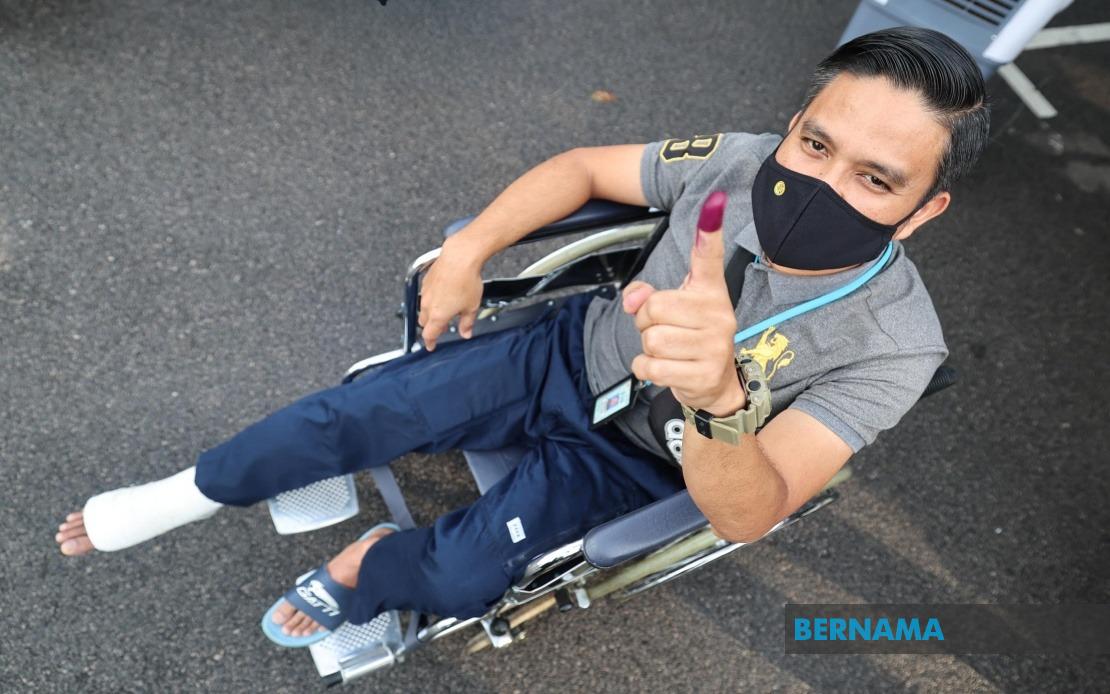
A police sergeant's determination to participate in the 16th Johor state election underscored the importance of voter engagement, even as he navigated significant physical challenges on election day. Sergeant Syahrizal Musa, 40, arrived at the early voting centre at Johor Police Contingent Headquarters in a wheelchair on Thursday, having sustained an Achilles tendon injury while playing sepak takraw just days earlier. His appearance at the polls, despite being on medical leave until July 16, sent a powerful message about the civic duty that Malaysians hold dear, regardless of personal circumstances.
The injury, confirmed by medical examination as a minor tear to the tendon, would have provided legitimate reason for most to defer their vote to polling day. Yet Syahrizal, attached to the Internal Security and Public Order Department at Johor Police Contingent Headquarters, chose otherwise. Travelling from police quarters in Tampoi with assistance, he made the deliberate choice to participate in the early voting process afforded to law enforcement and military personnel. His presence at the centre resonated with the broader message that electoral participation transcends individual hardship.
For Syahrizal, voting represented more than a formal obligation—it reflected a principle he has maintained throughout his policing career. Over his 22 years of service with the Royal Malaysia Police, he has consistently participated in every electoral exercise, never allowing circumstance to prevent him from casting a ballot. This consistency takes on particular weight in the Malaysian context, where civic participation, while theoretically guaranteed, can sometimes falter when personal challenges emerge. His decision to vote while wheelchair-bound challenged that tendency.
Before his recent injury, Syahrizal was an accomplished sepak takraw player, having represented the police contingent in multiple tournaments. The sport requires agility, coordination, and physical resilience—qualities that the sergeant possessed in abundance. His injury during recreational play illustrated the unpredictability of life, yet his response demonstrated that such setbacks need not diminish one's engagement with democratic processes. This juxtaposition—a physically active officer temporarily immobilised by injury, yet determined to exercise political voice—underscored the distinction between bodily limitation and civic participation.
Syahrizal's career trajectory reflected his commitment to his profession and his state. After nine years at Muar IPD, he transferred to Johor Police Contingent Headquarters in 2014, deepening his roots in the state. His decade-long association with Johor provided him with a stake in its governance and future direction. For a police officer with such longevity of service, the election represented an opportunity to influence policy on law and order, state development, and institutional support—matters directly relevant to his professional life.
The early voting exercise on Thursday accommodated personnel from the Malaysian Armed Forces and law enforcement agencies, recognising their deployment obligations and shift schedules. A total of 64 polling centres operated across Johor to facilitate 24,751 early voters, comprising 12,041 armed forces personnel and their spouses alongside 12,710 police and General Operations Force members and their families. This institutional arrangement acknowledged that security personnel often cannot participate in ordinary polling day schedules, necessitating alternative voting windows. Syahrizal's participation demonstrated the practical importance of these provisions.
The broader electoral context framed Syahrizal's actions within a significant democratic exercise. The 16th Johor state election involved 172 candidates competing for 56 seats, with ordinary polling scheduled for Saturday. The state's 2.7 million eligible voters represented one of the nation's largest and most demographically diverse electorates. Within this landscape, Johor's political direction carries implications not merely for the state but for national political dynamics. As a police officer, Syahrizal understood these stakes perhaps more acutely than many voters, given law enforcement's relationship with state governance and policy implementation.
Syahrizal's public articulation of his voting rationale provided insight into how many Malaysian voters prioritise electoral participation. He explained that his injury and temporary disability were not reasons to abandon his responsibility. This framing—presenting voting as an individual responsibility rather than a convenience or optional civic activity—aligns with democratic citizenship theory. For Syahrizal, his vote represented his voice in determining Johor's future direction, regardless of personal circumstance. This perspective carried particular resonance in Malaysian political culture, where voter turnout has historically varied and external factors sometimes influence participation.
The sergeant's comment that he hoped more Malaysians would exercise their voting rights reflected a concern relevant to Malaysian electoral analysts. While Malaysia maintains relatively high voter registration rates, actual participation sometimes lags behind eligibility. Syahrizal's implicit argument was that the franchise represents a hard-won democratic right deserving protection through consistent participation. His appearance in a wheelchair, having travelled with assistance, physically embodied this commitment in ways that transcended rhetoric about civic duty.
As a Perak native based in Johor, Syahrizal's voting participation also reflected internal migration patterns within Malaysia. Many police and military personnel serve postings away from their home states, yet maintain electoral participation in their constituencies of residence. For Syahrizal, having spent a decade in Johor and transferred there from Muar, his participation in the Johor election represented engagement with his current state community. This phenomenon of migrant engagement in local politics carries implications for how demographic changes influence electoral outcomes across Malaysia's states.
The incident highlighted practical dimensions of electoral accessibility that often remain overlooked. Johor's provision of early voting specifically accommodated security personnel whose professional obligations would prevent Saturday participation. However, Syahrizal's experience also illustrated broader questions about ballot accessibility for voters with temporary or permanent disabilities. His determination to navigate the system as constructed suggested both the resilience of individual voters and the potential gaps in universal accessibility that electoral systems might address.
Looking forward, Syahrizal's participation offered a model for voter engagement during the ordinary polling phase scheduled for Saturday. With 2.7 million eligible voters across Johor, the turnout rate and demographic distribution of participation would shape the election's outcome. Voters like Syahrizal—committed to participation despite personal challenge—potentially contributed to determining whether the electorate's overall engagement met or exceeded historical participation benchmarks. His wheelchair at the polling centre represented not limitation but determination, sending a message that Australian democratic values remain cherished across Malaysia's security forces and broader society.

