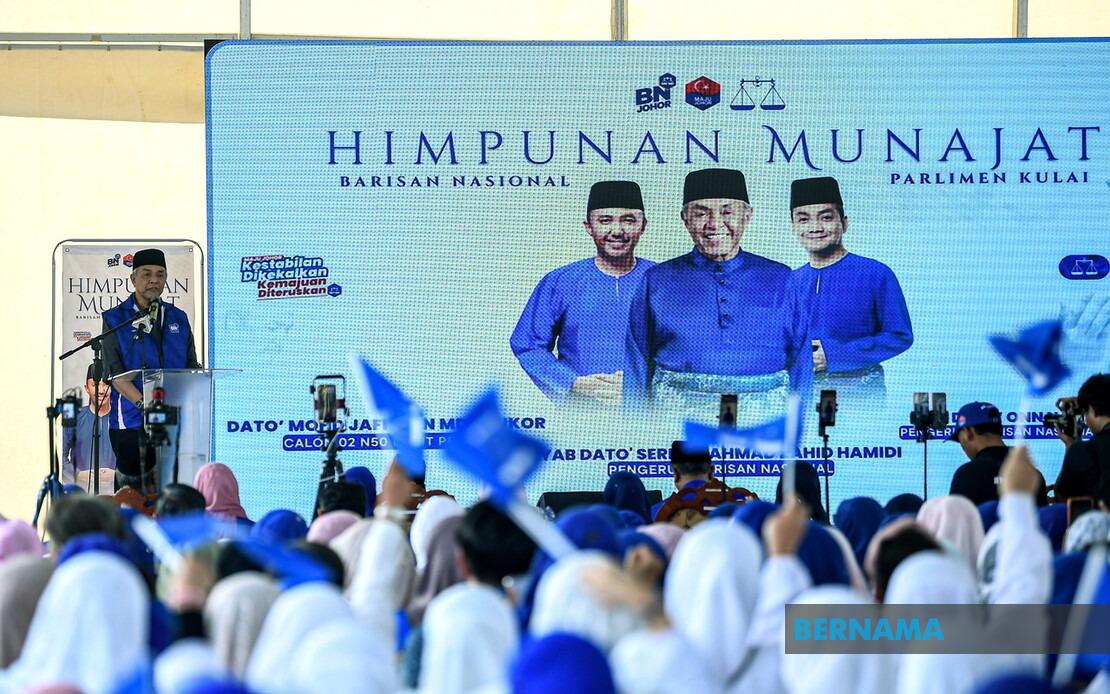
Barisan Nasional has moved to reassure the country that the 16th Johor State Election, scheduled for tomorrow, will have no bearing on the cohesion and functionality of Malaysia's federal government. Speaking in Kulai on Thursday, BN chairman and Deputy Prime Minister Datuk Seri Dr Ahmad Zahid Hamidi stressed that regardless of how the polling concludes, the administration will continue operating smoothly with uninterrupted cooperation among coalition members.
The pledge carries weight given the competitive intensity of the Johor campaign, where BN and Pakatan Harapan are locked in a battle for all 56 state seats. Despite the high stakes at the state level, Zahid's remarks underscore the coalition's commitment to maintaining the delicate balance that has underpinned federal stability since the 2022 general election. This separation between state-level electoral contests and federal-level governance has become increasingly important as Malaysia navigates political realignment, with rival coalitions sharing power in some states and federal administrations remaining relatively insulated from these contests.
Zahid, who also serves as Rural and Regional Development Minister, elaborated on how the federal Cabinet has managed this division of focus. He noted that ministers and deputy ministers have consistently demonstrated professionalism and carried out their duties without allowing regional political competition to intrude into national policymaking. This compartmentalisation reflects a broader maturation in Malaysian politics, where personal ambitions and party rivalries at the state level no longer automatically translate into dysfunction at the federal level, a pattern that would have been unthinkable during earlier periods of Malaysian political history.
The senior minister was particularly emphatic about the need for emotional restraint among party members and grassroots supporters following tomorrow's announcement of results. He called on activists and supporters from both BN and Pakatan Harapan to learn from the measured approach adopted by top leadership in both coalitions, which he credited with maintaining professional conduct even amid intense competition. This appeal suggests awareness within BN's hierarchy that volatile reactions to election outcomes—particularly among younger party members and social media-active supporters—could jeopardise the federal arrangement.
Zahid acknowledged that political differences naturally emerge during state campaigns, with parties raising issues and highlighting candidates' strengths as part of normal electoral strategy. However, he emphasised that these tactical disagreements should be entirely confined to the campaign trail and should never compromise the collegial atmosphere required for effective Cabinet functioning. His remarks paint a picture of a government where ministers from competing parties can vigorously contest state elections while simultaneously collaborating on national budgets, economic policy, and legislative priorities.
The emphasis on Cabinet professionalism is noteworthy given Malaysia's political history of unstable governments and shifting alliances. The 2022 general election result, which produced no clear victor, forced an unprecedented coalition arrangement that required BN, Pakatan Harapan, and other parties to negotiate a working arrangement. This experience appears to have instilled a recognition that the federal government's survival depends on deliberate compartmentalisation and mutual restraint. Senior figures across the political spectrum have invested political capital in maintaining this equilibrium, aware that any rupture could trigger fresh elections and renewed uncertainty.
From a regional perspective, Johor's significance extends beyond state politics. As Malaysia's second-largest state by population and a major economic centre, its political direction influences investor confidence and perceptions of governmental stability throughout Southeast Asia. International observers often use state elections as barometers for federal cohesion, and Zahid's assurances appear calibrated to signal to both domestic and foreign stakeholders that whatever transpires at the ballot box tomorrow will not undermine Malaysia's broader political stability or economic governance.
The timing of Zahid's remarks, delivered at a BN gathering in Kulai the evening before polls opened, served multiple purposes. For BN supporters, it conveyed confidence and stability; for coalition partners, it reaffirmed commitment to the federal arrangement; and for the broader public, it provided reassurance that the election, whatever its outcome, would not precipitate the kind of political turbulence that has periodically roiled Malaysia. The message was carefully calibrated to avoid any suggestion that BN anticipated a defeat, while simultaneously preparing supporters for acceptance of results.
The governance model Zahid described—where state-level competition and federal-level cooperation coexist—requires extraordinary discipline from political actors. Cabinet members representing parties competing fiercely in Johor must sit together at the federal table, deliberate jointly on matters affecting the entire nation, and present a unified front on national policy even while their parties battle for supremacy in the state. This arrangement demands a level of political maturity and institutional robustness that was less evident in Malaysia's earlier coalition governments.
Zahid's invocation of lessons from leadership maturity suggests that top figures in both BN and Pakatan Harapan have internalized the costs of political instability and determined that maintaining the federal coalition, despite its inconveniences, serves the national interest better than perpetual electoral contestation. His call for grassroots supporters to emulate this restraint recognises that rank-and-file members and activists, particularly those energised by state campaigns, may be less inclined toward such composure without explicit guidance from senior leadership.
The election outcome itself remained uncertain as Zahid spoke. Johor has traditionally been a BN stronghold, but Pakatan Harapan made significant inroads in recent years, making the contest genuinely competitive. Yet Zahid's emphasis throughout was not on predicting victory but on framing the election as a contest that would resolve state political arrangements without destabilising national governance. This framing represents a significant evolution in how Malaysian political leaders think about elections—as contests for specific offices rather than zero-sum struggles for survival.
Moving forward, the success of this federal-state compartmentalisation will likely depend on the margin of victory in Johor. A decisive result for either coalition would simplify the political calculus; a narrow outcome could test the resolve of both camps to maintain the federal arrangement. Nevertheless, Zahid's articulation of the principle and his appeal for professional conduct establish clear expectations for how Malaysia's political class should behave regardless of electoral results, setting a template for how future state contests should be managed without jeopardising federal stability.

