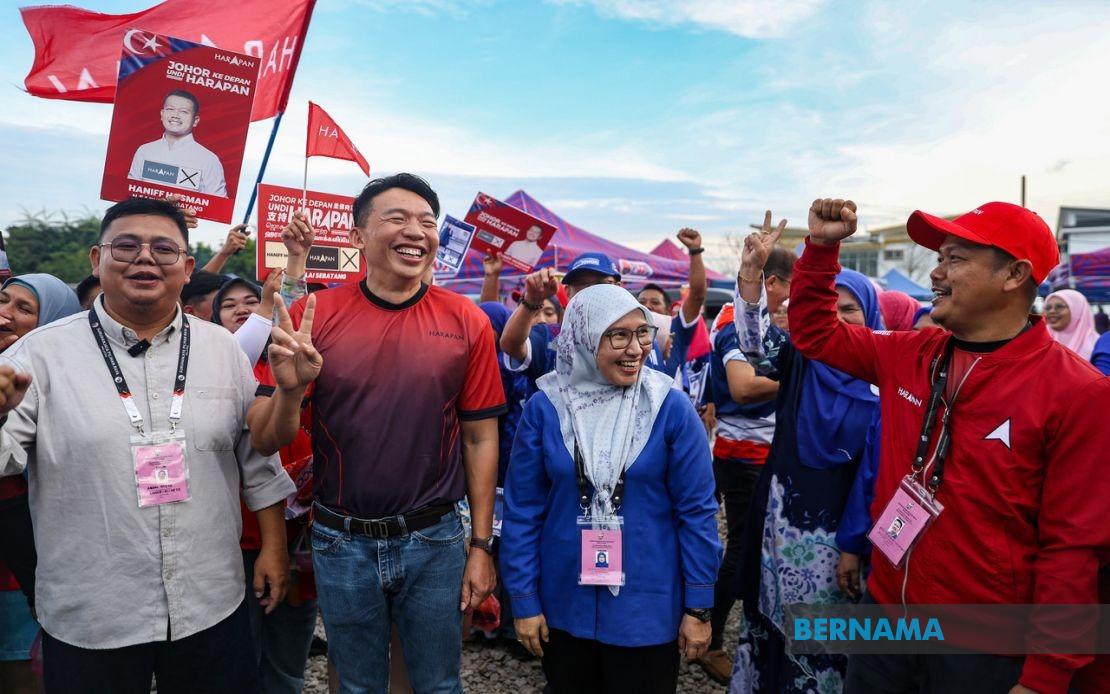
The Johor state election campaign demonstrated a moment of political civility when candidates from rival coalitions crossed paths at the Taman Megah night market in Pontian on June 29, underscoring the relatively harmonious tenor of grassroots electioneering in the state. Three Pakatan Harapan contenders—Haniff @ Ghazali Hosman (Pulai Sebatang), Abd Razak Ismail (Benut), and Cheah Chee Hong (Kukup)—encountered Barisan Nasional's Hasrunizah Hassan, also contesting Pulai Sebatang, while both groups were engaging voters and traders at the same location. The brief intersection between the red-flagged PH contingent and the blue-flagged BN team might have promised awkwardness, yet the candidates exchanged friendly greetings that caught the attention of market visitors and media observers alike.
For Malaysian observers accustomed to occasional heated campaign confrontations, such courteous interactions between opposing contestants carry symbolic weight. Haniff characterised the chance meeting as emblematic of healthy democratic practice, emphasising that the Pontian campaign environment had remained orderly and undisturbed. His framing reflected a deliberate messaging strategy: portraying his coalition's campaign as peaceful, organised, and focused on voter engagement rather than partisan aggression. This narrative positioning matters particularly in Johor, where electoral competition between BN and PH has intensified over successive state elections, yet the state has largely maintained a reputation for administrative stability despite political contestation.
Cheah, representing the Kukup state seat, used the encounter to reinforce coalition solidarity and voter messaging, calling on constituents in the three contested constituencies to maintain their support for Pakatan Harapan. His remarks highlighted how local candidates leverage such public moments to strengthen internal party cohesion and project confidence in their collective campaign strategy. The three PH candidates' joint walkabout itself suggested coordinated ground strategy, pooling resources and visibility across multiple constituencies to maximise reach and reinforce the message of unity within the opposition alliance.
Hashrunizah's response to the encounter proved equally calculated. By characterising such meetings as unremarkable and reflecting democratic maturity in Johor, the BN candidate framed her party as confident and unbothered by opposition presence. Her assertion that the campaign period, while intensifying, remained controlled and incident-free served dual purposes: reassuring voters that political stability persisted under BN stewardship, while also subtly claiming ownership of that stability. By invoking Maju Johor—BN's state-level campaign framework—she anchored her remarks to the broader party narrative of progress and development, attempting to elevate local contest into state-level achievement narrative.
The Taman Megah night market setting itself warrants consideration. Night markets remain vibrant spaces for political engagement in Malaysian constituencies, where candidates encounter diverse voter demographics in informal settings. The market environment—with traders, families, and shoppers as audience—meant the candidates' interaction played out before witnesses representing grassroots voter sentiment. That market visitors reportedly paused to observe the encounter suggests public curiosity about how political opponents interact away from formal campaign stages. This informal visibility can significantly influence voter perception of candidate character and party culture, making such moments strategically important despite their spontaneous appearance.
Johor's electoral landscape has shifted considerably in recent years, making both coalitions' campaign tone strategically significant. The state witnessed dramatic political realignment when Bersatu defected from PH to join BN, reshaping governmental coalitions and voter expectations. Consequently, campaigns in Johor carry particular weight as constituencies reassess their political commitments. The emphasis by both candidates on campaign civility and democratic maturity may reflect attempts to rebuild confidence in institutional politics after turbulent years of coalition-shifting and unexpected political reversals.
The civility displayed at Pontian contrasts with occasionally contentious campaign atmospheres witnessed in other Malaysian states, where personal attacks and inflammatory rhetoric sometimes characterise electoral competition. By highlighting peaceful, respectful engagement between rivals, both Haniff and Hasrunizah positioned their candidates and parties as capable of principled competition grounded in substantive policy differences rather than personal animosity. This messaging proves particularly valuable when addressing voter fatigue with divisive political rhetoric, a concern many Malaysian voters have expressed across successive election cycles.
Logistical coordination may have contributed to the encounter; both campaign teams' simultaneous presence at Taman Megah suggests either deliberate scheduling or coincidental timing during popular evening marketing hours. Regardless, the way candidates responded—with grace rather than confrontation—established a public record of respectful coexistence. Such moments generate local media coverage and social media circulation, shaping perceptions beyond those who physically witnessed the interaction, extending the campaign narrative to broader audiences across the state and region.
As the Johor state election approaches its climax with polling set for July 11 and early voting on July 7, the underlying competitive stakes remain substantial. Pulai Sebatang, Benut, and Kukup represent contests where PH seeks to expand presence while BN aims to consolidate support. The friendly public encounter between candidates cannot obscure genuine policy differences and contrasting visions for state governance; rather, the civility framing suggests both coalitions recognise that voters respond favourably when competition remains anchored in democratic norms and respectful engagement. This calibration of campaign tone—combining vigorous advocacy with principled restraint—reflects evolved campaign sophistication in Malaysian electoral politics, where personality and party reputation increasingly influence voter choice alongside substantive policy platforms.

