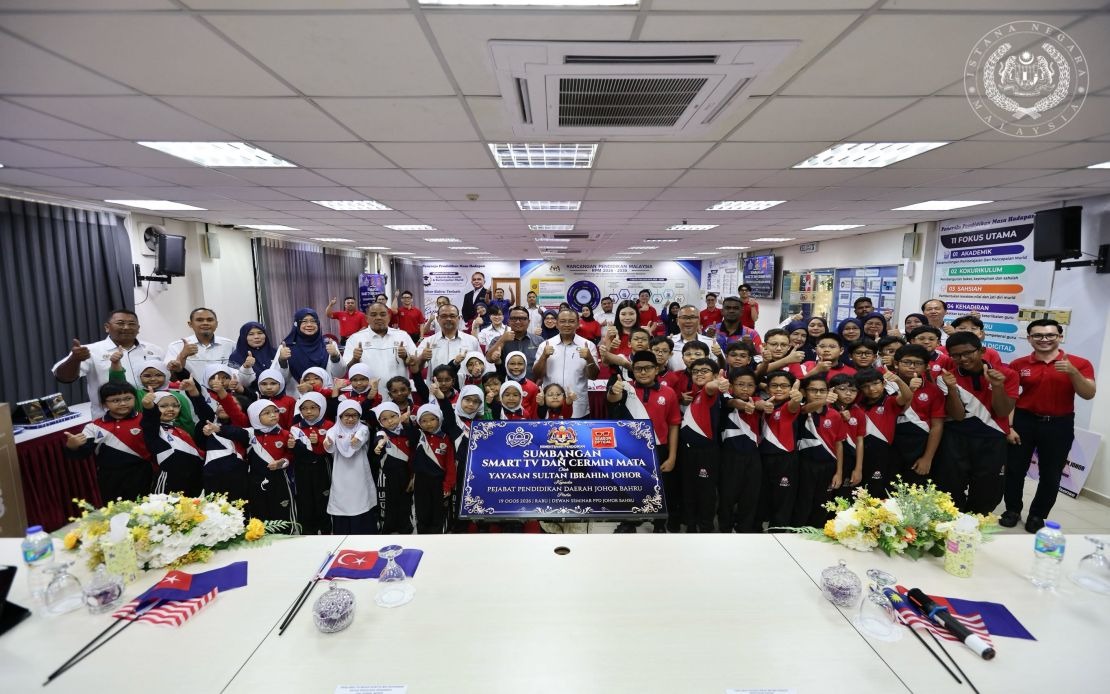
The Yayasan Sultan Ibrahim Johor (YSIJ) has reinforced its commitment to educational advancement and student wellbeing by distributing technology and healthcare resources across the Johor Bahru district. The foundation donated 10 smart televisions measuring 75 inches each to schools and provided 2,000 pairs of spectacles to economically disadvantaged students enrolled in 20 institutions, marking another significant intervention in the state's education system. This initiative, announced through Sultan Ibrahim Sultan Iskandar's official channels, represents a strategic push to bridge digital divides and address health barriers that impede learning outcomes.
The smart television donations directly target classroom instruction, enabling educators to leverage digital content and multimedia resources in ways that traditional teaching methods cannot replicate. Modern learning environments increasingly depend on visual presentation tools to enhance engagement, particularly for subjects requiring demonstration or simulation. By providing high-specification displays to selected schools, the foundation addresses infrastructure gaps that often constrain pedagogical innovation in rural or underresourced communities. The 75-inch screens facilitate whole-class viewing experiences essential for collaborative learning and can support interactive applications that transform passive consumption into active participation.
Equally important is the spectacles distribution programme, which tackles a frequently overlooked impediment to student success. Poor vision directly compromises academic performance through reading difficulties, board-work visibility problems, and reduced classroom participation. Students from low-income households often cannot afford optical correction despite significant visual impairment, creating a compounding disadvantage where economic barriers translate into educational setbacks. By providing 2,000 pairs of spectacles to B40 students—those in the bottom 40 percent of household income distribution—the foundation removes this specific obstacle while signalling that basic healthcare needs are prerequisites for educational equity.
Central to the programme's effectiveness is the incorporation of Columba Vision Screener technology, a sophisticated eye-screening device that Sultan Ibrahim donated to support the initiative. This device represents a technological leap in how schools can identify vision problems, completing comprehensive optical assessments in roughly 10 seconds per student. The speed and accuracy of this screening system enable mass testing programmes that would otherwise prove prohibitively time-consuming and costly for educational institutions. Early and accurate detection of refractive errors—myopia, hyperopia, and astigmatism—allows interventions that prevent compounding academic disadvantage from proceeding unchecked through years of schooling.
The spectacle frames and lenses sourced through this programme prioritise durability and age-appropriateness, recognizing that student eyewear must withstand the physical demands of school environments while matching contemporary aesthetics that encourage consistent wear. Students who feel self-conscious about eyeglass appearance frequently avoid wearing them despite visual need, undermining the health intervention entirely. By ensuring that corrective devices meet both functional and social acceptance standards, the foundation maximises the likelihood that students will consistently use their spectacles rather than experiencing the on-and-off usage patterns that characterize many school-based vision programmes.
The partnership between YSIJ and Season Optical demonstrates how private-sector collaboration can amplify public-sector educational initiatives. Season Optical's expertise in optical retail, combined with the foundation's funding capacity and institutional reach, creates a delivery mechanism far more efficient than either organisation could establish independently. This model—wherein charitable foundations coordinate with commercial enterprises to scale social programmes—increasingly characterises Malaysian development initiatives, particularly in sectors like education and healthcare where technical expertise and distribution networks matter as much as financial resources. The arrangement simultaneously supports corporate social responsibility objectives while achieving charitable aims.
The handover ceremony held at the Johor Bahru District Education Office formalised the donation within established administrative structures, ensuring integration with ongoing school operations and student services. The presence of Johor Education Department officials and the PPD chief officer underscores governmental endorsement and institutional commitment to sustaining the programme's impact beyond the initial distribution phase. When charitable initiatives receive official recognition and administrative anchoring, they prove more likely to persist as schools incorporate new resources into permanent pedagogical practices rather than treating donations as temporary supplements.
For Malaysian readers, this initiative carries implications extending beyond Johor Bahru itself. The programme exemplifies an emerging pattern wherein state-level foundations increasingly assume educational development responsibilities traditionally handled by federal programmes. As Johor YSIJ demonstrates institutional capacity and effectiveness, similar foundations operating in other states face implicit expectations to match these standards, potentially catalysing competitive improvements in state-level educational support. The spectacles distribution model, particularly, addresses a national equity challenge that affects disadvantaged students regardless of geographic location, suggesting potential for replication across peninsular Malaysia, Sabah, and Sarawak.
The choice to prioritise disadvantaged students reflects growing recognition that educational equity demands targeted intervention. Universal programmes that treat all students identically often perpetuate existing inequalities because students from low-income households enter educational systems with compounding disadvantages—inadequate home nutrition affecting cognitive development, limited early literacy exposure, parental time constraints limiting homework support, and precisely the health barriers like uncorrected vision that this programme addresses. By concentrating resources on B40 students, YSIJ acknowledges that genuine equity requires differentiated support responsive to documented need.
The technological dimension of this programme also illustrates how advancement in diagnostic capabilities can democratise access to previously scarce services. Vision screening equipment available only in private optical clinics decades ago now enables rapid assessment in school settings, removing gatekeeping barriers that previously restricted access to vision testing for students whose families lacked resources for private healthcare. This technological democratisation—where innovations eventually become affordable enough for scaled public deployment—represents a pathway toward addressing persistent inequities in health and education across Southeast Asia.
Looking forward, the success of this initiative depends substantially on sustainable implementation. Donated smart televisions require ongoing maintenance and teacher training to remain educationally effective. Spectacles require proper fit and periodic adjustment as students grow, necessitating follow-up optical services. The foundation's design of the programme, with its administrative anchoring in the education department and partnership infrastructure with Season Optical, suggests attention to sustainability. Nevertheless, maintaining momentum and expanding reach will demand continued institutional support and funding, underscoring the importance of viewing such donations as initiating ongoing commitments rather than discrete charitable acts.

