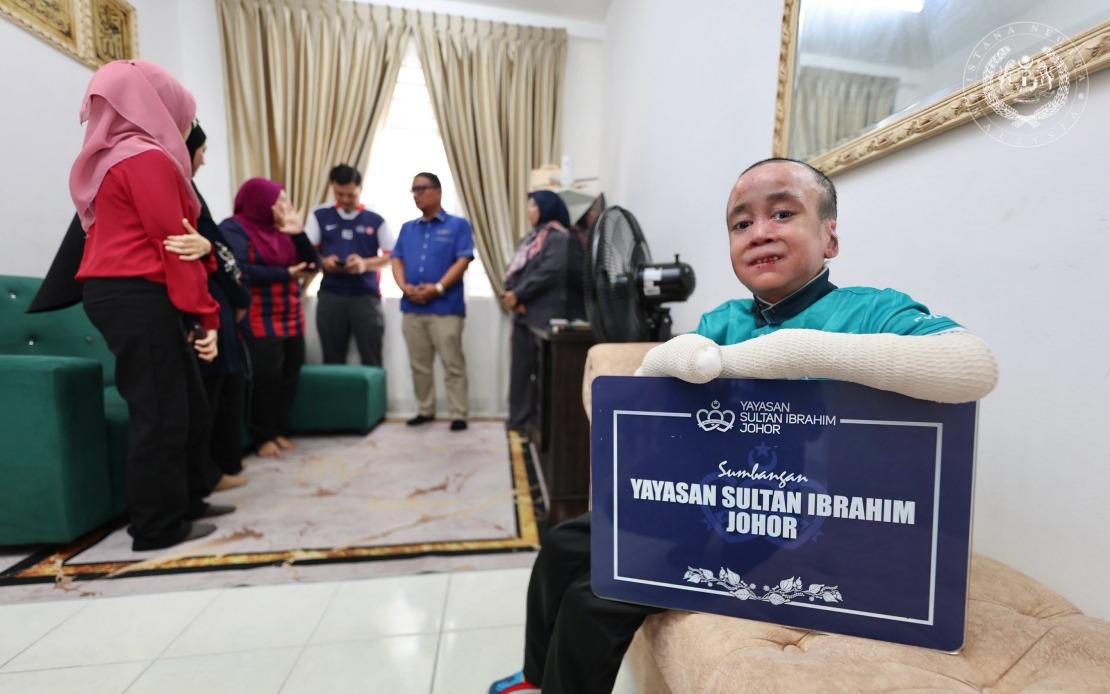
The Yayasan Sultan Ibrahim Johor (YSIJ) has delivered financial assistance to Muhammad Hazreel Mikhail Hizar, a 15-year-old battling epidermolysis bullosa (EB), a debilitating genetic skin condition that has affected him since infancy. The support package was formally presented at his residence in the Sungai Tiram People's Housing Project in Johor Bahru on August 18, delivered through the foundation's Ziarah Kasih programme, which focuses on providing compassionate aid to vulnerable families in the state.
Epidermolysis bullosa represents one of the more challenging chronic conditions to manage in a home setting. The disorder causes the skin to become extremely fragile, blistering and peeling with minimal trauma or friction. For Hazreel, this means his daily existence requires meticulous wound management protocols, including regular cleaning regimens designed to prevent bacterial infections that could prove life-threatening. The disease's severity demands that his living environment remain consistently cool and air-conditioned, as heat and humidity can exacerbate symptoms and trigger painful flare-ups that render normal activities impossible.
The financial burden associated with such conditions extends far beyond basic medical expenses. Specialized wound dressings, topical treatments, and the electricity costs for maintaining controlled environmental conditions represent substantial ongoing expenditures that stretch household budgets considerably. For families already living on limited incomes, these medical necessities can create impossible choices between purchasing medications and affording other basic needs.
Hazreel's mother, Noor Halimaton Hashim, represents the countless Malaysian caregivers who shoulder the emotional and physical weight of managing a child's serious illness. As a single parent raising three children, she faces the difficult reality that full-time employment remains incompatible with her son's medical requirements. His condition demands constant supervision and immediate response to any health complications, confining her to part-time work or irregular employment that fails to generate sufficient household income. The financial strain of her situation illustrates how chronic illness in the family can perpetuate cycles of economic vulnerability.
According to a statement released through the Royal Press Office and shared via the official Facebook page of Sultan Ibrahim Sultan Iskandar, Noor Halimaton expressed deep gratitude for the intervention. She emphasized that the foundation's assistance arrived precisely when her family needed support most, demonstrating how targeted charitable programmes can provide genuine relief during periods of acute financial stress. Her words underscored the psychological dimension of such support, which extends beyond material provision to include recognition and validation from broader society.
The YSIJ's intervention reflects a growing awareness among Malaysian charitable institutions regarding the hidden costs of rare and chronic diseases. Epidermolysis bullosa remains relatively uncommon in Malaysia, meaning families affected by the condition often struggle without established support networks or community resources. Many such families remain largely invisible in public discourse, their challenges unrecognized and their needs unaddressed by standard social safety nets designed for more prevalent conditions.
The Ziarah Kasih programme through which this assistance was delivered represents a structured approach to identifying and supporting vulnerable households within Johor. By combining personal visits with direct financial aid, the initiative ensures that assistance reaches those in genuine need while also documenting the lived realities of struggling families. This methodology generates valuable data regarding the nature and scale of need within communities, informing future policy and charitable priorities.
For families navigating chronic illness in Malaysia, access to reliable support systems remains inconsistent across different regions and income levels. While government schemes provide basic assistance, gaps persist that charitable organizations and royal foundations work to address. The financial aid provided to Hazreel's family represents one small yet meaningful intervention within a broader ecosystem of social support that remains fragmented and often insufficient relative to actual need.
The case of Hazreel and his family also highlights the particular vulnerability of single-parent households managing chronic illness. Women like Noor Halimaton frequently find themselves unable to participate in the formal workforce due to caregiving demands, resulting in permanent income reduction and increased poverty risk. Their situation demands recognition and targeted support mechanisms that account for the reality that caring for a seriously ill child constitutes full-time work, albeit unpaid and invisible to economic statistics.
As Malaysia continues to develop its social safety systems, cases like this underscore the importance of complementary charitable efforts that can provide rapid, flexible assistance when circumstances overwhelm formal bureaucratic structures. The integration of royal patronage with organized charitable delivery creates pathways through which vulnerable families can access support more efficiently than waiting for government programmes to respond.

