The Johor state government has unveiled an ambitious RM50 million initiative to revitalise its low-cost and public housing stock through comprehensive repainting work, marking a significant investment in the physical infrastructure supporting the state's lower-income communities. The scheme encompasses 170 housing blocks spanning 11,693 residential units distributed across 26 strategic locations throughout Johor, with implementation expected to directly improve the living environment for approximately 46,772 residents. Datuk Mohd Jafni Md Shukor, chairman of the State Housing and Local Government Committee, framed the project not merely as cosmetic enhancement but as a substantive intervention in community welfare, emphasising that fresh, well-maintained surroundings generate tangible psychological and social benefits for inhabitants.
The scope of this undertaking reflects a coordinated approach involving multiple government entities working in concert to ensure consistent execution. The Johor State Housing Development Corporation (PKPJ) and the Local Government Division of the Johor State Secretary's Office are designated as lead coordinating bodies, while operational support flows through four municipal councils: Johor Bahru City Council (MBJB), Iskandar Puteri City Council (MBIP), Pasir Gudang City Council (MBPG), and Kulai Municipal Council (MPKu). This layered administrative structure underscores the complexity of managing large-scale housing interventions across diverse urban and semi-urban contexts within Johor's boundaries.
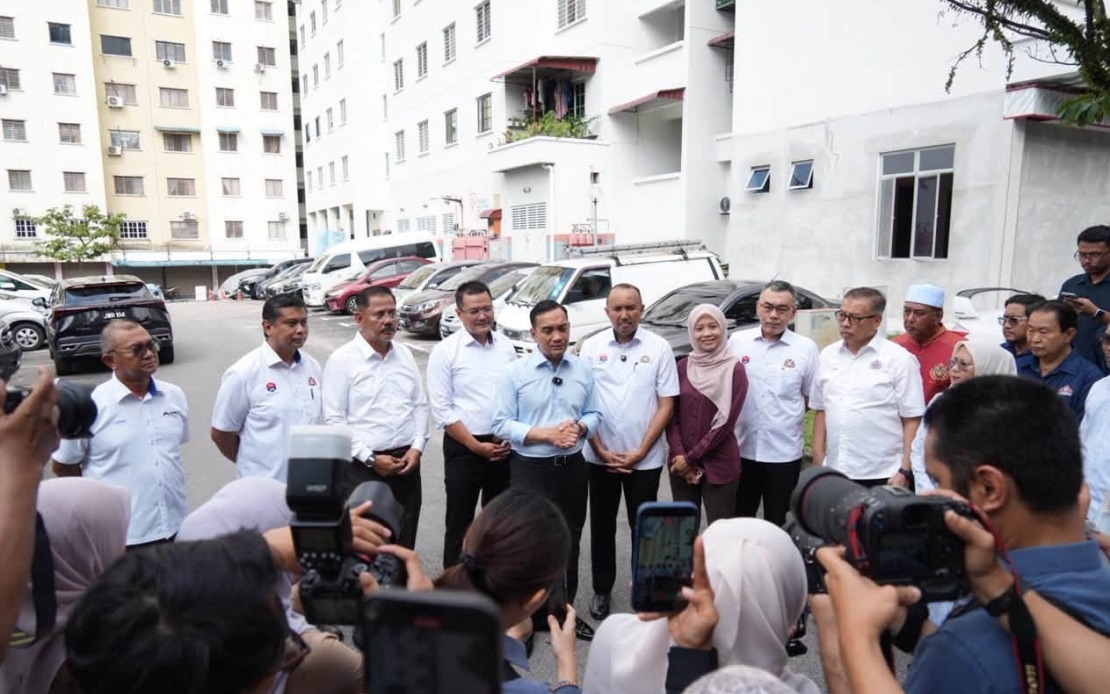
During an inspection visit to Desa Muafakat Apartments alongside Menteri Besar Datuk Onn Hafiz Ghazi, Mohd Jafni articulated the philosophy underpinning the investment. He contended that painting initiatives, whilst appearing superficial on the surface, carry profound implications for community morale and cohesion. A renewed, visually pleasant residential setting, according to his assessment, fosters enhanced comfort levels among residents, strengthens social bonds, and serves as a tangible signal from state authorities that the wellbeing of ordinary Johoreans constitutes a genuine priority rather than mere political rhetoric.
Beyond the core repainting mandate, the Desa Muafakat site visit revealed the Johor government's holistic engagement with housing infrastructure challenges. Officials were briefed on concurrent construction work for a Tabika KEMAS Bangsa Johor facility within the same complex, underscoring efforts to integrate childcare and early childhood development services into residential communities. Additionally, the visit addressed emergent structural concerns including slope subsidence issues in proximity to apartment parking facilities and deterioration of internal road networks within the housing complex, matters that extend beyond cosmetic refresh but demand urgent remedial attention.
Mohd Jafni emphasised stringent quality control mechanisms to ensure that the renovation programme delivers enduring benefits rather than temporary visual improvements followed by rapid deterioration. He stressed that all implementing agencies and contractor partners have received explicit reminders regarding adherence to the highest standards in workmanship, occupational safety, and site cleanliness. This quality-assurance framework addresses a perennial challenge in public housing maintenance: projects that achieve temporary aesthetic gains but subsequently suffer from poor construction standards, inadequate materials, or insufficient maintenance protocols that ultimately burden residents and undermine public confidence in government initiatives.
The initiative carries significance for Malaysia's broader housing policy landscape. Johor, as the nation's second-largest state by population and a major economic centre encompassing the Iskandar Malaysia development corridor, faces substantial demands for affordable housing maintenance and upgrades. The concentration of 11,693 units across the renovation programme demonstrates the scale of the public housing stock requiring periodic intervention, whilst the RM50 million allocation provides insight into government resource commitment to preventative maintenance rather than reactive crisis management.
For lower-income Johoreans, many of whom reside in these housing complexes as their primary or sole asset, environmental improvements carry material implications beyond mere aesthetics. Fresh, well-maintained premises can enhance property perceptions, potentially affect rental values, reduce health risks associated with deteriorating paint and building surfaces, and contribute to psychological wellbeing through improved surroundings. These factors align with broader social policy objectives to enhance quality of life for lower-income communities and reduce disparities in living standards across economic strata.
The repainting initiative also reflects evolving approaches to public housing governance in Malaysia. Rather than large-scale clearance and redevelopment programmes, which prove costly and disruptive, state authorities increasingly pursue targeted improvement strategies that preserve existing housing stock whilst enhancing conditions. This approach proves more fiscally prudent and minimises social disruption compared to wholesale renewal, though it requires sustained commitment to cyclical maintenance and upgrade cycles.
The involvement of multiple municipal councils indicates recognition that housing quality assurance demands local-level coordination and oversight. Municipal bodies possess granular knowledge of individual housing complexes, existing maintenance backlogs, and community-specific challenges, enabling them to contextualise state-level initiatives within localised realities. This distributed implementation model, whilst potentially complicating coordination, can ultimately yield more responsive and contextually appropriate outcomes than centralised top-down directives.
Mohd Jafni's insistence on compliance with specifications and schedules suggests acknowledgment of endemic implementation challenges in Malaysian public sector projects. Delays, cost overruns, and quality shortcomings have historically plagued housing initiatives, eroding public confidence in government capacity. Explicit quality commitments and oversight mechanisms represent attempts to address this credibility deficit, though sustained delivery across 170 blocks will test institutional capacity and political resolve throughout the programme's duration.

