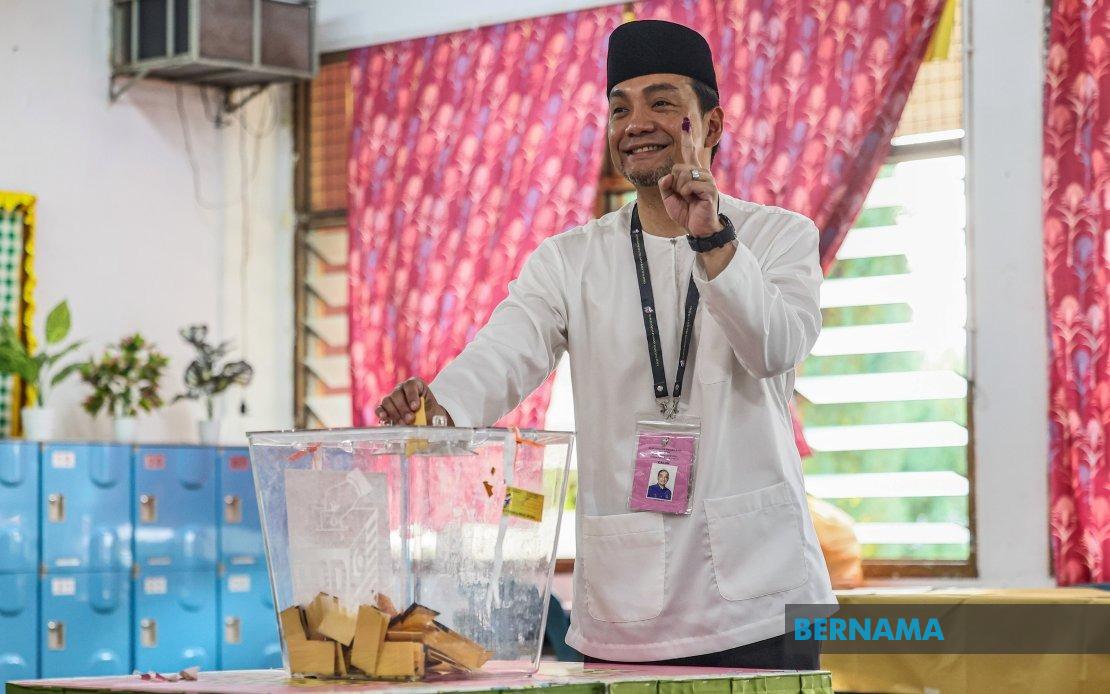
Johor Menteri Besar Datuk Onn Hafiz Ghazi fulfilled his democratic duty early on July 11, arriving at Sekolah Kebangsaan Simpang Renggam to cast his vote in the 16th Johor state election. The incumbent leader completed his ballot at 8.33 am, participating in what represents a critical democratic process for the state as voters determine the composition of the state assembly for the next term.
Before proceeding to the polling stream, Onn Hafiz, who doubles as chairman of the Johor branch of Barisan Nasional, took time to engage with other residents at the polling station. His interaction with fellow voters underscored the grassroots engagement that typically characterises Malaysian electoral campaigns, with the Menteri Besar making himself accessible to constituents on polling day itself.
Onn Hafiz is contesting for a second term in his seat, marking a significant moment in his political trajectory. The contest has crystallised into a two-way battle between the incumbent and Nur Hafiz Roslan of Pakatan Harapan, reflecting the intense competition between the two major political coalitions that has characterised Malaysian politics in recent years. This direct confrontation will heavily influence the balance of power in the Johor state assembly.
After voting, Onn Hafiz appealed to the wider public to participate actively in the electoral process. His message to voters centred on the importance of arriving early to cast their ballots, framing turnout as both a civic responsibility and a practical measure to ensure that polling operations proceeded without congestion or delays. Such appeals carry particular weight when made by political leaders who have themselves just participated in voting.
Elsewhere in the Simpang Renggam area, the Puteri Wangsa state seat saw its own significant polling activity. Dr Maszlee Malik, the Pakatan Harapan candidate for that constituency, arrived at SJK (C) Tuan Poon to cast his ballot at 8.58 am. The former education minister's participation highlighted the continued involvement of established political figures in the Johor electoral contest.
The Puteri Wangsa race itself reflects the increasingly fragmented nature of Malaysian electoral competition. Rather than a straight contest between two candidates, Dr Maszlee Malik faces opposition from four other contenders, each representing different political movements or independent aspirations. Rashifa Aljunied contests the seat representing MUDA, the newer political movement that has sought to carve out space in Malaysia's political landscape. Teow Chia Ling carries the Barisan Nasional banner, while Parti Bersama Malaysia fields Nicholas Paul Vincent as its representative. An independent candidate, Wang Wee Siong, completes the five-cornered contest.
This multi-candidate scenario in Puteri Wangsa illustrates a broader trend in Malaysian elections where voter choice has become increasingly diverse. The presence of MUDA, which emerged as a political force in recent years with particular appeal to younger voters, reflects generational shifts in the electorate. Meanwhile, independent candidates continue to attract support from voters who feel disconnected from established parties. The five-way split could significantly affect which candidate ultimately secures the seat, depending on how votes distribute across the various options.
The Johor state election carries implications that extend beyond the state itself. As one of Malaysia's most populous and economically significant states, the outcome will influence the broader balance of power at the national level. Coalition dynamics at state level often foreshadow national political developments, making Johor's electoral result closely watched by political observers and analysts throughout Southeast Asia.
For incumbent Menteri Besar Onn Hafiz, victory would provide validation for his first term's performance and allow continuity in his policy agenda. His leadership during the period between elections will be weighed by voters against the alternatives presented by opposition candidates. The result will also determine whether Barisan Nasional can consolidate its position in Johor, a state where the coalition has maintained significant influence despite challenges elsewhere in Malaysia.
For Pakatan Harapan and other opposition candidates, the election represents an opportunity to expand their representation and influence at state level. The coalition's performance in Johor will contribute to the overall picture of its electoral strength across Malaysia and its viability as an alternative government at state level. Smaller parties like MUDA will be seeking to translate their growing organisational presence into concrete electoral gains.
The voting process itself proceeded smoothly in the constituencies observed, with polling stations managing the flow of voters efficiently. The early morning voting by prominent candidates typically signals strong participation expectations, as do appeals from political leaders for high turnout. Malaysian elections have historically seen substantial participation rates, reflecting the electorate's engagement with the democratic process despite occasional criticism of electoral mechanics or fairness concerns.
As polls continued throughout July 11, the outcome would ultimately reflect voter preferences across Johor's constituencies. The results would reshape the composition of the state assembly and determine which coalition or individual candidates would hold legislative and potentially executive power in the state for the next term. This electoral process remains fundamental to Malaysia's democratic system, notwithstanding ongoing debates about political reforms and institutional strengthening that characterise discussions among policymakers and civil society observers.

