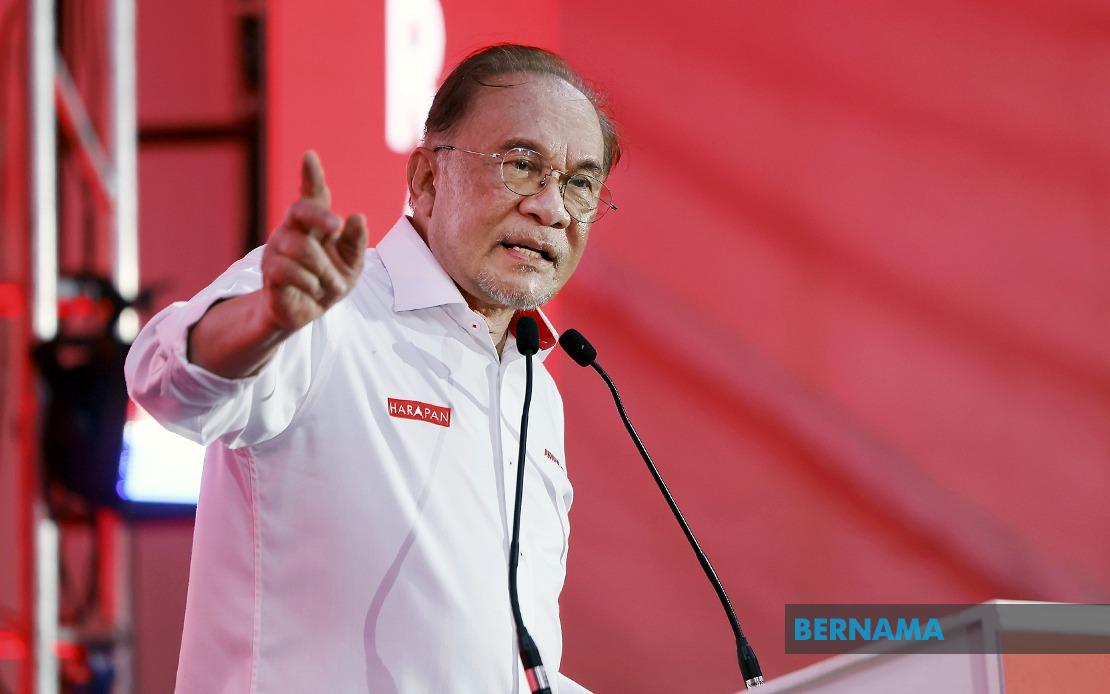
Prime Minister Datuk Seri Anwar Ibrahim has challenged Johor voters to select representatives who combine intelligence with political courage, arguing that the state deserves leaders genuinely connected to community concerns. Speaking during Pakatan Harapan's first campaign day for the 16th Johor state election, Anwar emphasised that the coalition would remain committed to amplifying public voices and advancing the interests of Malaysia's southern economic powerhouse.
Anwar's appeal carries particular weight as the Johor election represents a significant test of PH's grip on federal and state politics. The coalition has fielded candidates across all 56 state constituencies, fielding 20 PKR representatives, 19 from Amanah, and 17 from DAP. This complete slate reflects PH's determination to consolidate control of a state that has historically shaped national political dynamics. The decision to contest every seat signals confidence but also reveals the stakes involved in retaining Johor's political machinery.
The Prime Minister framed his campaign message around inclusivity and collaborative governance. He specifically referenced the need for elected officials who can galvanise support across Johor's diverse population—emphasising cooperation among Malay, Chinese, and Indian communities. This framing addresses a persistent challenge in Malaysian politics: ensuring that state development benefits all communities equitably and that representation reflects genuine cross-community needs rather than narrow factional interests.
During his first campaign day, Anwar undertook an intensive seven-programme schedule across multiple constituencies, participating in grassroots meetings, town halls, and community engagement activities. Such ground-level campaigning has become essential in Malaysian state elections, where local concerns often diverge from federal issues. Johor voters frequently prioritise economic opportunities, infrastructure investment, and governance effectiveness at the state level, making these direct community interactions crucial for building momentum.
The competitive landscape reflects the state's political significance. A total of 172 candidates across all parties are contesting the 56 available seats, indicating robust competition and alternative choices for voters. This three-way or multi-way competition in many constituencies could fragment the vote, potentially affecting final outcomes. The saturation of candidates suggests that both established parties and emerging political forces view Johor as winnable territory.
Johor's electoral importance extends beyond state-level implications. As Malaysia's second-largest state economy and a crucial federal constituency contributor, Johor's political direction influences national governance dynamics. A decisive PH performance would strengthen Anwar's political position ahead of the 2025 federal election cycle, while setbacks could embolden opposition parties and complicate coalition stability in Parliament. Regional observers are watching closely, given that Johor's outcome could signal shifting voter preferences in Malaysia's broader political realignment.
The timing of the campaign also reflects broader national considerations. Held mid-year, the Johor election occurs when economic pressures—inflation, employment concerns, and cost-of-living issues—dominate public discourse. These practical governance challenges often supersede ideological messaging in determining voter behaviour. Anwar's emphasis on representation quality and collective development rather than partisan rhetoric suggests PH recognises that Johor voters reward pragmatism and competence over divisive political theatre.
Early voting is scheduled for July 7, with polling day set for July 11. This compressed campaign timeline—beginning in early July for mid-July elections—limits the window for persuasion and organisation. Political machinery effectiveness becomes paramount, as parties must rapidly mobilise supporters and secure voter commitment. For PH, maintaining coalition discipline across three parties while executing coordinated messaging presents organisational challenges that could affect campaign effectiveness.
Anwar's appeal for "wise" and "courageous" leaders touches on ongoing debates within Malaysian politics about governance quality and decisive leadership. His implicit critique—that Johor requires representatives superior to those currently available—establishes a positive frame for PH candidates while subtly questioning alternatives. This rhetorical approach attempts to elevate the election above personalised attacks or negative campaigning, though such intentions often collapse under campaign pressures.
The broader context reveals that Johor remains a microcosm of Malaysian political tensions. Balancing federal-state coordination, managing inter-coalition relationships, addressing regional economic inequality, and maintaining representative legitimacy across diverse constituencies occupy state government attention constantly. Voters are increasingly sophisticated in evaluating whether elected representatives deliver tangible improvements or merely occupy positions. Anwar's emphasis on quality representation acknowledges this voter maturity and rising expectations for governance performance.

