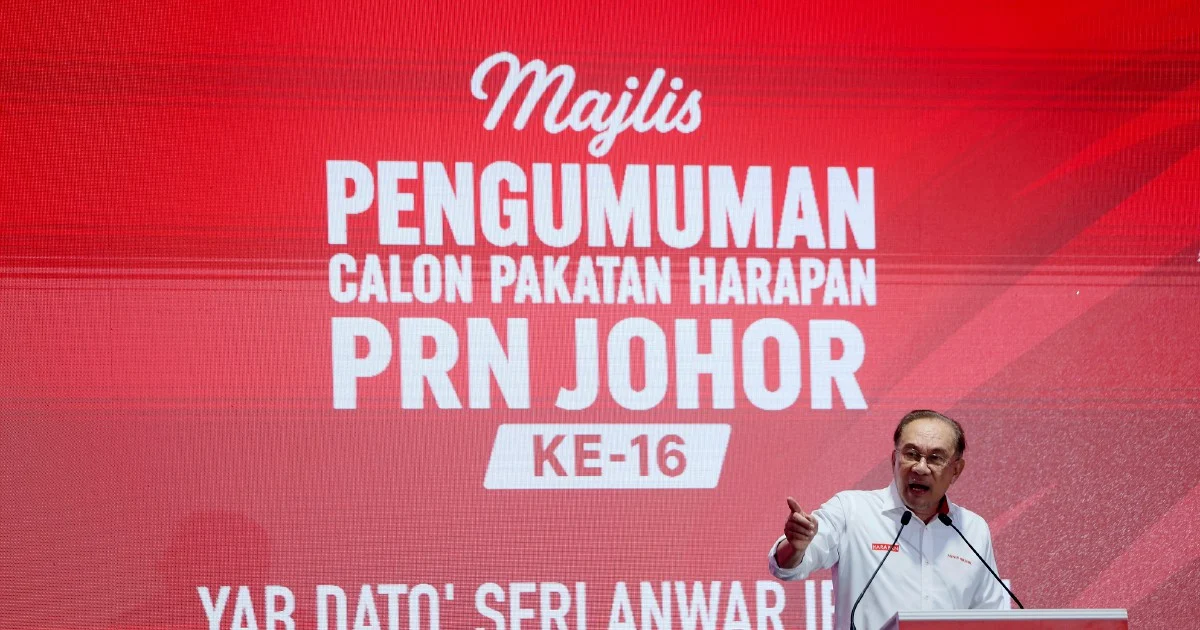
Prime Minister Datuk Seri Anwar Ibrahim has underscored the federal government's commitment to equitable resource distribution, revealing that Johor has benefited from substantially higher federal funding than its direct tax contributions in recent years. Speaking in Tangkak, the premier disclosed that while Johor generated approximately RM14 billion in revenue for the federal coffers over the three-year period, the state received RM16 billion in federal allocations, demonstrating a positive fiscal transfer worth roughly RM2 billion.
This fiscal dynamic illuminates a fundamental principle embedded within Malaysia's federal system: the redistribution of resources to ensure that all states, regardless of their revenue-generation capacity, receive adequate funding for public services and development. Johor, despite being one of the nation's economically significant states with a diversified economy spanning manufacturing, agriculture, logistics, and services, nonetheless benefits from this mechanism designed to level developmental disparities across Malaysia.
The announcement carries particular significance given recent political dynamics in Johor. The state has been a focal point of policy attention and electoral considerations, making transparent accounting of federal-state fiscal relationships both politically sensitive and administratively important. By publicly articulating these figures, Anwar sought to demonstrate the Pakatan Harapan-led federal administration's equitable treatment of all states regardless of their political affiliation or economic standing.
Malaysia's fiscal federalism model represents a deliberate policy framework wherein the federal government collects the bulk of revenue through income tax, goods and services tax, and corporate taxation, then redistributes funds to states through grants, development allocations, and shared revenue arrangements. States like Johor that generate substantial internal revenue still participate in this pooling mechanism, contributing to a national fund that supports development in less economically developed states while simultaneously receiving allocations that exceed their direct contributions.
The three-year reference period spanning the measurement encompasses a transformative phase in Malaysian governance, following the historic 2022 general election that returned Anwar's coalition to power after years of political turbulence. During this interval, the federal government has pursued various strategies to stabilise the economy, manage post-pandemic recovery, and address accumulated fiscal pressures. Within this context, the allocation decisions reflect broader policy priorities including infrastructure development, social safety nets, and sectoral support programmes.
For Johor specifically, this additional federal resource injection has implications across multiple domains. The state hosts significant manufacturing hubs, major port facilities at Pasir Gudang and Tanjung Pelepas, and serves as a critical economic corridor linking Malaysia to Singapore. Enhanced federal funding enables upgraded infrastructure, improved public services, and targeted industrial development initiatives that benefit not only Johor residents but also contribute to broader regional economic integration within Southeast Asia.
The figures also merit contextualisation within Malaysia's broader fiscal sustainability conversation. As the federal government navigates significant debt levels and competing demands for public investment, maintaining transparent communication regarding federal-state fiscal transfers helps build public understanding of government priorities. The disclosure demonstrates that despite constraints on overall fiscal space, deliberate decisions ensure that resource allocation mechanisms remain oriented toward equitable development outcomes.
From a regional perspective, Johor's status as a key economic and strategic gateway positions fiscal policy decisions affecting the state within a wider Southeast Asian economic context. The state's proximity to Singapore, its role in regional supply chains, and its demographic significance all mean that decisions regarding federal resource allocation to Johor ripple across the broader region. Adequate federal funding supports the state's capacity to maintain competitive infrastructure and business environments relative to neighbouring economies.
The premier's disclosure also reflects evolving expectations around fiscal transparency in Malaysian governance. Detailed information regarding federal-state financial flows enables independent analysis, supports informed public discourse, and strengthens accountability mechanisms. As Malaysia navigates complex economic challenges including inflation, employment fluctuations, and structural economic shifts, transparent fiscal communication becomes increasingly important for maintaining public confidence in government resource stewardship.
Looking forward, the sustainability of such positive fiscal transfers for individual states depends on continued federal revenue collection capacity and broader macroeconomic performance. Economic growth rates, employment levels, and business investment directly influence the tax base available for redistribution. Consequently, state governments possess vested interest in supporting policies that enhance national economic performance, even where specific federal spending decisions may not benefit their particular constituencies.
Anwar's statement reflects broader messaging around federal-state cooperation and equitable governance principles that the current administration has emphasised. By highlighting concrete fiscal data demonstrating federal commitment to Johor's development, the premier simultaneously addressed potential scepticism about resource allocation fairness and reinforced the notion that federal government policies serve all Malaysian states regardless of electoral considerations or historical allegiances.
The revelation ultimately underscores how Malaysia's federal structure inherently involves redistributive mechanisms that transcend simple revenue accounting. States contribute to a collective national enterprise while receiving allocations determined by needs-based assessments, development priorities, and policy objectives that extend beyond transactional fiscal calculation. Understanding these dynamics proves essential for Malaysians seeking to comprehend government resource allocation decisions and their implications for regional development across the country.