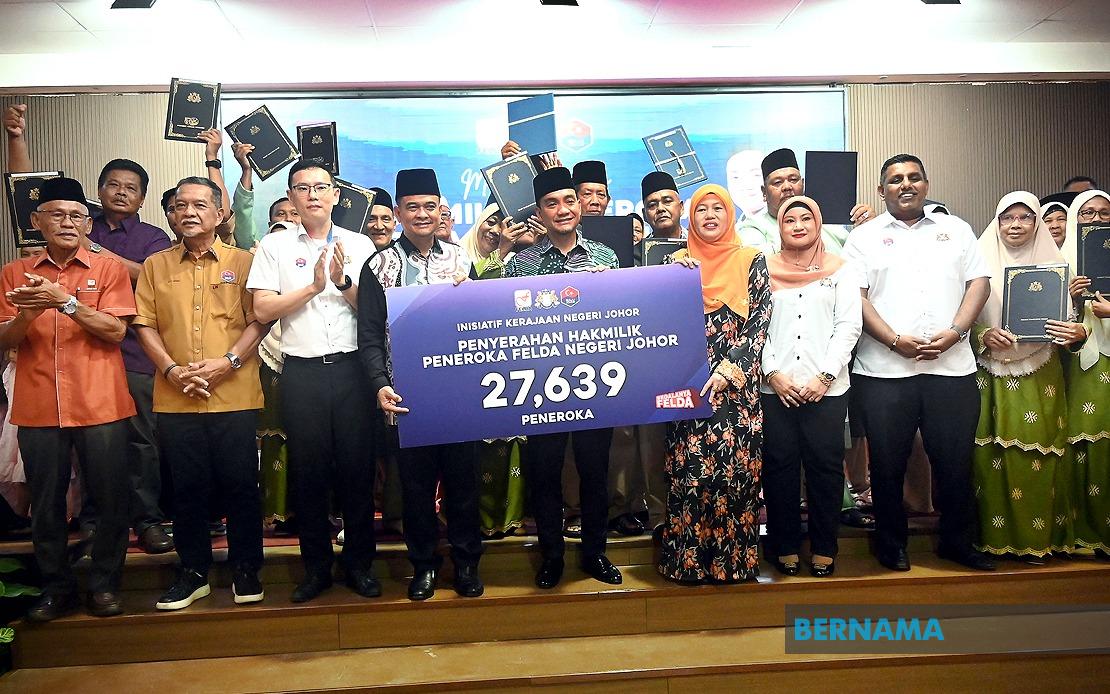
A protracted struggle by Federal Land Development Authority settlers in Johor to secure formal ownership of their holdings has reached near-complete resolution, with the state government confirming that 27,639 out of 27,642 land title applications have been successfully processed. The breakthrough represents a watershed moment for FELDA communities across the state, many of whom have operated their smallholdings for decades without the legal certainty that formal title documents provide.
Menteri Besar Datuk Onn Hafiz Ghazi announced the achievement at a ceremonial presentation in Kluang, where 210 settlers from the districts of Kluang, Kota Tinggi and Mersing received their long-awaited documentation. The presentation marked both a symbolic and practical conclusion to what the state government characterised as a persistent welfare concern affecting rural communities that have historically formed the backbone of Malaysia's agricultural sector.
The significance of this resolution extends beyond mere paperwork. Land titles serve as fundamental economic instruments, enabling settlers to access credit facilities, secure insurance coverage, and participate fully in formal property transactions. Without proper documentation, smallholders have historically faced barriers when attempting to leverage their assets for business expansion or to facilitate intergenerational transfers to their children. The resolution of these cases therefore carries profound implications for economic mobility within FELDA settlements.
For Johor's rural development strategy, this milestone reflects a deliberate policy shift toward prioritising grassroots community grievances. The Menteri Besar explicitly framed the land title resolution as integral to the state government's broader rural development agenda, signalling that addressing settler concerns represents more than administrative housekeeping but rather a fundamental governance principle. This positioning suggests that similar systemic issues affecting other rural constituencies may receive heightened attention in coming years.
The near-complete success rate of 99.99 per cent raises interesting questions about the remaining three applications still pending. While the state government has not publicly detailed reasons for the outstanding cases, typical complications in land title disputes can involve unclear boundary demarcations, inheritance disputes within settler families, or administrative records requiring further verification. The extremely low number of unresolved cases indicates that the vast majority of title claims were substantiated and administratively straightforward once priority was assigned to processing them.
Historically, FELDA settlers have experienced inconsistent treatment across Malaysian states. While some state governments moved relatively quickly to formalise land ownership among scheme participants, others dragged their feet, leaving settlers in legal limbo. Johor's demonstration that systematic resolution is achievable within a reasonable timeframe may pressure other states to accelerate similar efforts within their own FELDA populations. The political cost of appearing indifferent to settler welfare has clearly weighed on the state government's calculations.
The involvement of Johor Agriculture, Agro-based Industry and Rural Development Committee chairman Datuk Zahari Sarip in the ceremony underscores the multi-agency coordination required to navigate what was evidently a complex administrative challenge. Securing land titles demands cooperation between the state land office, local district administrations, survey departments, and legal advisors. The successful completion suggests that political will at the highest levels translated into effective coordination across bureaucratic boundaries.
For Malaysian policymakers observing from other states, the Johor experience demonstrates that long-standing settler grievances need not become intractable problems. The willingness to mobilise resources and assign personnel to process applications systematically proved effective. This lesson carries particular relevance for Peninsular Malaysia's other FELDA-heavy states including Pahang, Terengganu, and Perak, where similar backlogs may persist.
The timing of this announcement also carries political undertones. By delivering tangible benefits to a traditionally important rural constituency, the Johor government reinforces its commitment to the FELDA community ahead of future electoral contests. FELDA settlers represent a concentrated demographic bloc with identifiable interests, and demonstrable government responsiveness to their concerns translates into political capital. The ceremonial nature of the presentation, with the Menteri Besar presiding personally, amplifies this message.
Looking forward, the state government's declaration that FELDA settlements will continue to receive priority status suggests ongoing engagement with settler concerns beyond land titling. Other persistent issues within FELDA schemes include infrastructure maintenance, access to agricultural extension services, market access arrangements, and intergenerational land succession planning. The resolution of the titling issue may open pathways for addressing these secondary concerns that have accumulated over years of relative neglect.
For the broader Southeast Asian context, Malaysia's approach to formalising smallholder land rights stands in contrast to some neighbouring countries where millions of farmers operate without documented ownership. The Johor initiative, while focused on a specific population, demonstrates political feasibility of modernising rural land administration. As agricultural commodification accelerates across the region, countries grappling with informal land tenure arrangements may observe Johor's experience as a potential model for systematic regularisation programmes.