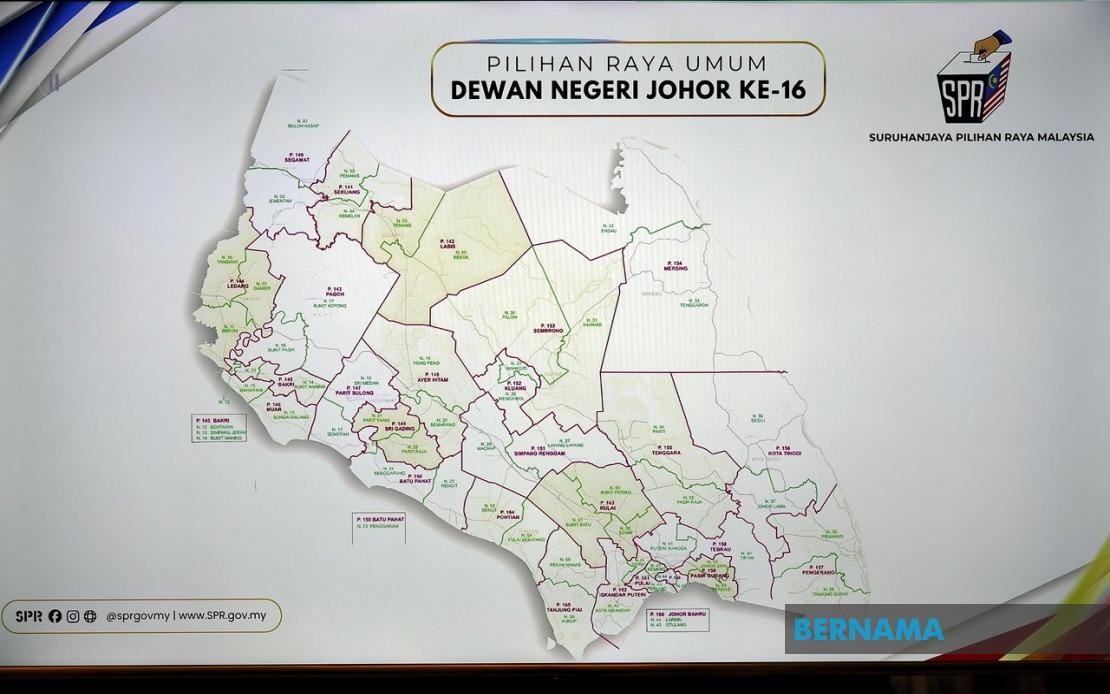
Johor's 16th state election formally commences tomorrow as nomination day opens the gateway to one of the state's most significant political contests. The legislative assembly was dissolved on June 1, triggering this electoral showdown that will determine the direction of Malaysia's most industrialised state. Candidates will submit their nomination papers between 9 am and 10 am at various designated centres throughout the state, with the official roster of contenders to be released following the screening process. The actual polling will take place on July 11, with early voting available on July 7 for those who require it.
The electoral roll reflects the scale of this undertaking, with the Election Commission confirming that 2,727,926 voters are registered to participate. This figure includes just over 2.7 million ordinary voters, alongside 12,041 military personnel and their spouses, and 12,710 police officers and their spouses. The composition of the electorate underscores the diversity of Johor's population and the varied interests that candidates must address throughout the campaign.
Pakatan Harapan has adopted an all-or-nothing strategy by fielding candidates in every single seat, demonstrating the coalition's commitment to challenging the incumbents across the state. The coalition's internal arrangement divvies up the 56 seats among its three component parties, with Parti Keadilan Rakyat claiming 20 nominations, Amanah receiving 19, and the Democratic Action Party securing 17. This distribution reflects the relative sizes and negotiated positions of each party within the alliance, though it will also test the cohesion of a coalition that has experienced tensions in other electoral contests.
Barisan Nasional has countered with its own comprehensive candidate slate, fielding aspirants for all 56 seats as well. The coalition has allocated 36 seats to UMNO, its dominant partner, while the Malaysian Chinese Association receives 16 nominations and the Malaysian Indian Congress gets four. This distribution mirrors the historical pecking order within the ruling coalition, though it represents a delicate balance that can provoke discontent among smaller partners when electoral results disappoint.
Perikatan Nasional, the third major political force, has also entered the competition with a mixed slate that demonstrates its growing presence in the state. The Pan-Malaysian Islamic Party is contesting 11 seats, Bersatu has fielded 16 candidates, and the Malaysian Indian People's Party has put forward five hopefuls. The coalition's strategy reflects its attempt to position itself as an alternative to both the establishment BN and the opposition-led PH, though its performance in Johor will significantly influence its national trajectory.
Beyond the three major coalitions, several other political entities are participating, adding complexity to an already intricate electoral landscape. The Malaysian United Democratic Alliance, which emerged as a surprise player in the 2022 elections, is seeking just four seats. The Socialist Party of Malaysia has nominated a single candidate, maintaining its minimal but consistent presence. Most notably, Parti Bersama Malaysia is preparing to make its debut in Johor state elections with 15 candidates, attempting to carve out political space in an increasingly crowded field.
The Election Commission has issued practical reminders to prospective candidates regarding the nomination process, urging them to verify their submission documents in advance at the Returning Officer's Office or State Election Office. Such precautions are intended to prevent the procedural rejections that occasionally derail candidacies on nomination day. Candidates are also being advised to settle deposit payments promptly and retain receipts, as these represent essential proof of compliance when submitting their formal nomination papers.
Anticorruption enforcement will remain a significant element throughout the campaign. The Malaysian Anti-Corruption Commission has issued explicit warnings to all candidates and political parties to avoid unlawful conduct under either the MACC Act 2009 or the Election Offences Act 1954 (Amendment 2012). To facilitate oversight, the MACC has established five 24-hour operations rooms strategically positioned at Tampoi, Batu Pahat, Kluang, Segamat, and Mersing, providing members of the public with dedicated channels to report suspected corruption or misuse of authority during the election period.
The context of the previous election looms large over this contest. In the 2022 Johor state election, Barisan Nasional secured a commanding 40 of the 56 seats, consolidating its hold on the state government. Pakatan Harapan managed to capture 12 seats, Perikatan Nasional won three, and Malaysian United Democratic Alliance claimed one. These results established the BN's substantial parliamentary majority, though the opposition blocs have invested considerable effort in developing new strategies and recruiting stronger candidates for this rematch.
The significance of tomorrow's nomination day extends well beyond Johor itself. The state election will serve as a crucial barometer of political sentiment in one of Malaysia's most developed regions, home to significant urban, industrial, and rural constituencies. Political parties will use the results to refine their approaches ahead of the next federal election, making this state contest a de facto trial run for broader national strategies. The turnout, demographic patterns of voting, and performance of individual candidates will all receive intensive analysis by political observers and party strategists seeking to understand the evolving preferences of Malaysian voters.

