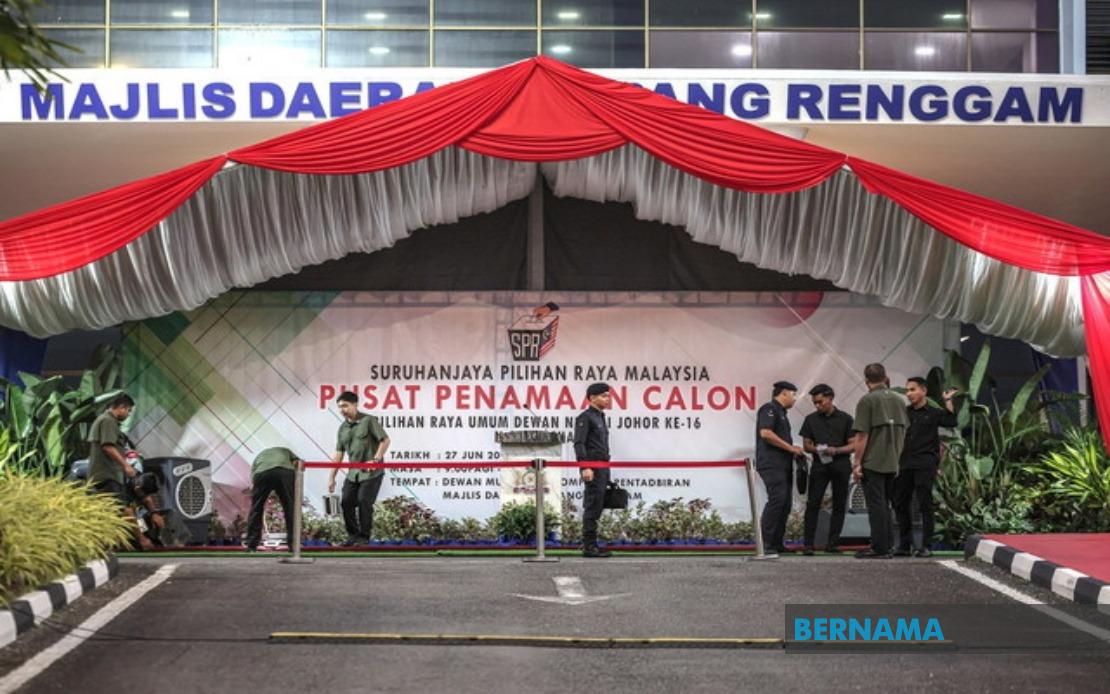
The 16th Johor State Election moved into its formal nomination phase this morning as all 56 polling centres across the state opened their doors simultaneously at 9am, marking the official commencement of the electoral process. Candidates and their representatives had a narrow one-hour window until 10am to lodge their nomination documents with the respective returning officers, a compressed timeframe that underscored the administrative precision required to manage such a large-scale operation across the state's diverse districts and constituencies.
The nomination submission process itself permits flexibility in its execution. Candidates may present their papers either personally alongside their proposer and seconder, or through any combination whereby at least two of these three parties attend the submission. This procedural latitude recognises the practical challenges candidates and their supporters face in coordinating movements across geographically dispersed nomination centres, whilst maintaining the statutory integrity of the filing process that underpins electoral legitimacy.
Once the Election Commission completes its verification of submitted nominations—a process that scrutinises candidate eligibility, documentation completeness, and compliance with electoral regulations—the state will transition into a structured 14-day campaign period. This officially sanctioned window for political messaging and constituency engagement runs through to 11.59pm on July 10, providing parties and independent candidates with a defined timeframe to mount their campaigns before voters head to the polls.
The atmosphere at nomination centres reflected the competitive intensity of Johor state politics. Supporters representing various political parties began congregating from as early as 6.30am, demonstrating the mobilisation capacity of electoral machinery across the state's political landscape. These early gatherings served not merely as expressions of party loyalty, but as visible manifestations of campaign infrastructure and grassroots organisation, factors that historically correlate with electoral success in Malaysian state contests.
Weather conditions added an element of uncertainty to the morning's proceedings. The Malaysian Meteorological Department had forecast scattered rainfall affecting several districts including Johor Bahru, Muar, Batu Pahat, Kota Tinggi, Pontian, Tangkak and Kulai, whilst other areas such as Segamat, Kluang and Mersing were anticipated to experience clear skies. Afternoon thunderstorms were predicted across most districts, presenting logistical challenges for maintaining smooth operations and ensuring all candidates could fulfil their nomination obligations within the prescribed timeframe.
Security arrangements reflected the significance of this electoral milestone for Malaysia's second-largest state by population. Police units, bolstered by personnel from the People's Volunteer Corps (RELA), implemented comprehensive security protocols and traffic management measures surrounding nomination centres throughout the state. These precautions sought to preserve the integrity of the electoral process whilst preventing any security incidents that might disrupt nominations or undermine public confidence in the administration of this important democratic exercise.
The electoral register underpinning this contest encompasses nearly 2.73 million eligible voters, according to Election Commission statistics released ahead of nomination day. This electorate comprises 2,703,175 ordinary voters drawn from Johor's resident population, supplemented by 12,041 military personnel and their spouses, and 12,710 police officers and their families. This composition highlights how Malaysia's electoral framework accommodates uniformed services personnel within the democratic process, acknowledging their stake in governance outcomes that affect their professional and personal circumstances.
For supporters and candidates alike, the timeline established by the Election Commission structures the remaining weeks of this contest with precision. Early voting has been scheduled for July 7, providing military and police personnel with advance ballot access befitting their unique deployment circumstances. This arrangement, standard in Malaysian electoral practice, ensures these groups can participate without compromising operational commitments. Polling day itself is set for July 11, when the state's broader electorate will exercise their franchise across all constituencies.
Johor's electoral significance within the Malaysian federation cannot be understated. As the nation's second-largest state, political outcomes in Johor have historically influenced broader national political trajectories, given the state's population size and economic importance. The composition of the state assembly resulting from this election will shape policy directions across numerous domains affecting Johor residents—from state land development and agricultural affairs to education and infrastructure priorities that ripple into neighbouring states and influence federal-state relations.
The successful completion of nomination day represents a critical juncture in this electoral cycle. Having surpassed this administrative hurdle, Johor now enters the substantive campaign phase where candidates will articulate their policy platforms, address constituent concerns, and mobilise support through both traditional canvassing and digital engagement strategies. For Malaysian observers and political analysts tracking regional electoral dynamics, these coming weeks will reveal shifting voter sentiments, coalition dynamics, and thematic priorities that resonate across Johor's diverse constituencies.

