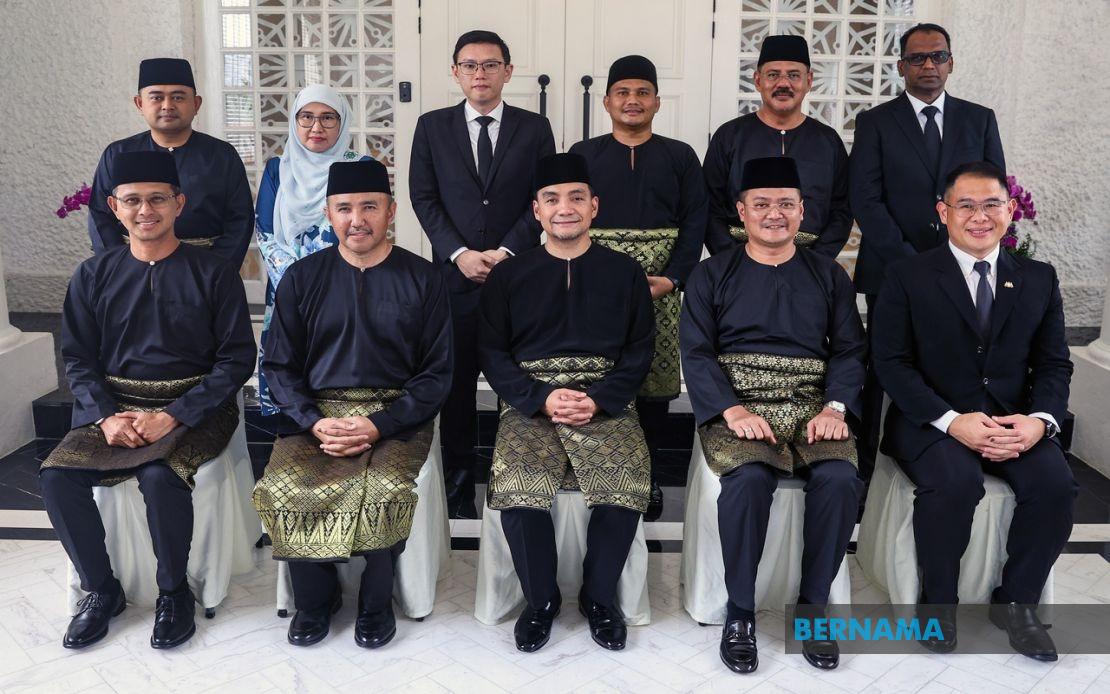
Johor's new State Executive Council has been formally constituted with the swearing-in of all ten members before Tunku Mahkota Ismail at Istana Bukit Serene, completing the administrative framework that will govern the state for the coming term. The composition balances continuity and renewal, retaining six experienced exco members from the previous administration while integrating four newcomers into the leadership structure.
The four newly appointed exco members bring fresh perspectives to the state government's strategic committees. Md Israk Abdullah, representing the Kukup seat, has assumed leadership of the Agriculture, Agro-Based Industry and Rural Development Committee, positioning him to shape agricultural policy in a state with significant rural constituencies. P. Pannir Selvam from Perling now heads the Unity, Heritage and Culture Committee, reflecting the growing emphasis on social cohesion across Malaysia's diverse communities. Dr Muhammad Naqib Md Ghazali, though not representing a specific assembly seat, takes charge of the Education and Information Committee—a particularly influential portfolio given its role in knowledge dissemination and public communication. Hasrunizah Hassan rounds out the new appointees as chairman of the Women, Family and Community Development Committee, addressing demographic-specific policy areas that have gained prominence in recent years.
The structural appointments reveal deliberate portfolio distribution across state priorities. By entrusting agriculture to Md Israk, the administration signals ongoing commitment to rural development and agro-enterprise, sectors that remain economically vital despite Johor's urbanisation. The elevation of cultural and unity matters through Pannir Selvam's appointment underscores a broader Malaysian political emphasis on maintaining interethnic harmony at the state level. Education and information oversight, granted to Dr Muhammad Naqib, carries particular significance in an era of rapid digital transformation and competing narratives around public knowledge.
The six retained exco members represent institutional memory and proven administrative experience. These incumbents continue steering their respective portfolios—Housing and Local Government, Youth and Sports Development, Islamic Religious Affairs, Health and Environment, Investment and Trade, and Public Works—ensuring policy consistency and leveraging their established networks. This bifurcated approach, mixing continuity with renewal, mirrors governance patterns across Malaysian states seeking to balance stability with fresh energy.
This exco formation arrives in the wake of Barisan Nasional's commanding performance in Johor's sixteenth state election, where the coalition secured 48 of 56 available seats, a result that substantially exceeds the thirty seats needed for government formation. Menteri Besar Onn Hafiz, who retained his Machap seat with a majority of 15,375 votes, was sworn in for a second consecutive term, providing political continuity at the apex of state leadership. His dual role as Johor BN chairman reinforces the party machinery's alignment with executive governance.
The margin of victory underscores BN's resilience in Johor, traditionally one of its strongest redoubts in peninsular Malaysia. With nearly eighty-six per cent of state seats in hand, the ruling coalition enjoys substantial latitude for legislative action without requiring support from opposition benches. This comfortable supermajority allows the exco to pursue multi-term policy initiatives without navigating fractious cross-party negotiations, a structural advantage that shapes how ambitiously the administration can pursue its agenda.
For Malaysian observers, the Johor result holds broader significance as a barometer of voter sentiment and coalition viability. Johor's size, economic importance, and electoral weight position it as a bellwether for national politics. A strong BN performance here suggests sustained voter confidence in the establishment coalition, even as challenges persist elsewhere in the country. The composition and capability of the new exco will largely determine whether this mandate translates into effective governance that strengthens public trust in state institutions.
The appointment of Dr Muhammad Naqib to oversee education policy deserves particular attention given Malaysia's ongoing debate around curriculum reform, digital learning infrastructure, and the role of educational institutions in nation-building. His committee assignment positions him centrally in discussions that extend beyond Johor into national education discourse. Similarly, Pannir Selvam's cultural portfolio arrives at a moment when Malaysian society continues negotiating questions of identity, heritage preservation, and multicultural expression.
Hasrunizah Hassan's appointment to the women's development portfolio reflects a broader trend of formalising gender-focused administration at state level. Her committee's work on family-centric policies and women's economic participation carries implications for workforce participation rates and household economic resilience across Johor. The portfolio's elevation within the exco structure suggests recognition that gender-inclusive development strategies are integral rather than peripheral to state governance.
The swearing-in ceremony at Istana Bukit Serene invested these appointments with formal constitutional weight, binding the exco members through oath to their respective duties and the state. The Regent's presence underscored the institutional gravitas of the occasion and the constitutional framework within which all executive authority operates in Johor's Westminster-style system.
Moving forward, the exco's effectiveness will depend partly on how seamlessly the four newcomers integrate with retained colleagues and partly on broader political conditions affecting Johor's development trajectory. Economic headwinds, infrastructure pressures, and competing demands across urban and rural constituencies will test whether this leadership configuration can translate electoral mandate into tangible improvements in service delivery and economic opportunity. The coming months will reveal whether the portfolio assignments prove strategically calibrated to address Johor's most pressing governance challenges.

