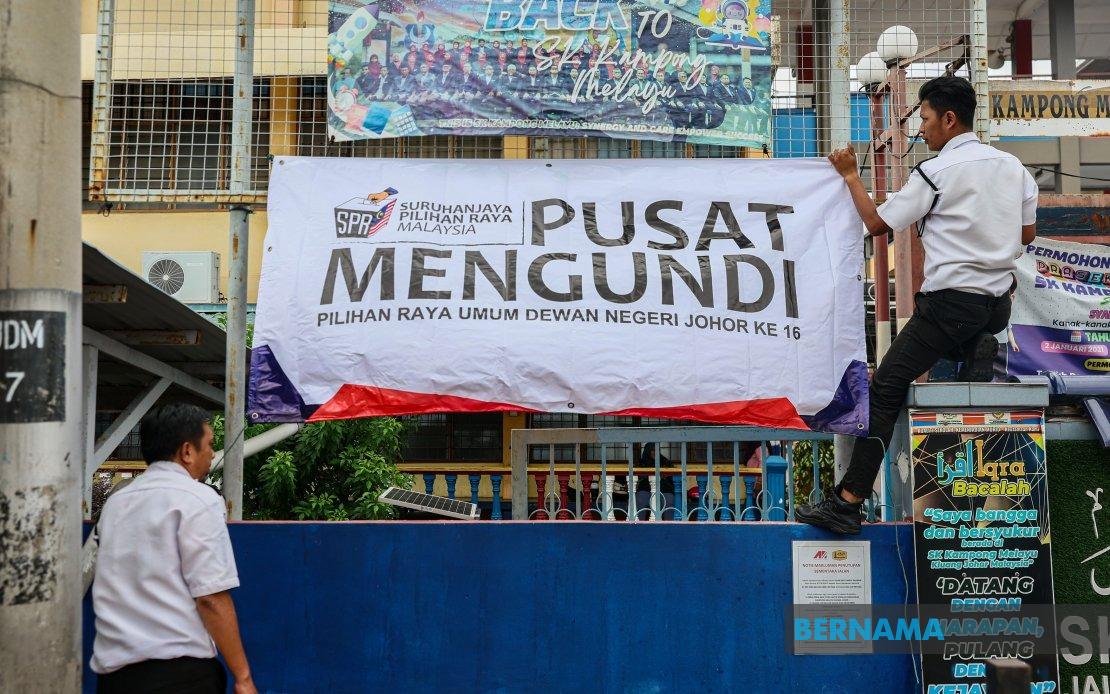
Johor enters election day with more than 2.7 million eligible voters preparing to determine the composition of the state's Legislative Assembly, with polling stations opening simultaneously across the state at 8 am. The electorate will decide the future representation across all 56 seats in what constitutes the 16th state election since the current boundaries were established. The scale of the exercise is substantial, with the Election Commission mobilising significant resources to ensure the process runs smoothly throughout the voting day.
A comprehensive electoral infrastructure has been deployed to accommodate the anticipated turnout. Across Johor, 1,076 polling centres have been established with a combined total of 4,889 individual voting streams, allowing the administration to process voters efficiently while maintaining the integrity of the electoral process. The Election Commission has positioned 43,036 workers throughout the state to manage operations, verify voter credentials, and oversee the counting process. This extensive deployment reflects the logistical complexity of managing an election of this scale across a geographically diverse state.
The voting process will conclude in staggered fashion rather than simultaneously across all locations. Most polling centres will remain open until 6 pm, though facilities on smaller islands operate on earlier schedules—Pulau Besar closes at 11 am, while Pulau Aur and Pulau Pemanggil shut down at noon. This variation accommodates the practical constraints of island-based polling, where transporting materials and election workers requires additional coordination. The Commission expects to begin tabulating results shortly after the final polls close, with preliminary outcomes potentially available by 10 pm.
Postal ballots represent an additional layer of complexity in the electoral administration. A total of 24,677 postal votes have been issued to voters unable to attend in person, and all must be returned by 6 pm to be counted in the final tally. This component of the election extends the registration and verification process beyond polling day itself, requiring meticulous record-keeping to ensure no eligible votes are excluded from the final count.
The campaign period leading to today concluded at midnight yesterday, capping a 14-day period during which candidates and parties presented their platforms to voters. This compressed timeline differs from longer campaign periods in other electoral cycles, reflecting the current political landscape and the timing of the dissolution. The candidate field demonstrates considerable diversity, with 172 individuals contesting the 56 available seats—a ratio indicating genuinely contested races across most constituencies.
The major political blocs—Pakatan Harapan and Barisan Nasional—each fielded 56 candidates, fielding complete slates across all seats. Perikatan Nasional contested with 33 candidates, while Parti Bersama Malaysia presented 15. Smaller parties and independent candidates round out the field, with MUDA contesting four seats, Parti Orang Asli Malaysia and Parti Sosialis Malaysia each fielding single candidates, and six independent contenders. This configuration reflects significant realignments within Malaysian politics, particularly the expansion of multi-coalition competition beyond the traditional two-bloc framework.
The previous legislature, dissolved on June 1, saw Barisan Nasional holding a substantial majority with 40 seats, a significant achievement that reflected voter preferences in the 2022 election. Pakatan Harapan held 12 seats, Perikatan Nasional controlled three, and MUDA secured a single seat. Today's election will determine whether this configuration persists or whether voter sentiment has shifted during the intervening years. The substantial majority held by BN provides context for understanding what shifts might constitute significant electoral movement.
The Election Commission has set an ambitious turnout target of 70 per cent, representing a substantial increase compared to the 2022 state election when 54.92 per cent of eligible voters participated. Achieving this figure would require mobilising an additional 15 percentage points of the electorate, a challenging but not unprecedented target for state-level contests. Employers have received reminders to grant employees reasonable time away from work to fulfil their civic responsibilities, an administrative measure designed to reduce barriers to participation.
Advanced voting by security personnel and their families occurred on Tuesday, with 20,607 early votes cast by police, armed forces members, and their spouses. This voting stream ensures continuity of essential services on polling day while enabling uniformed personnel to participate in the electoral process. The early voting mechanism has become standard practice in Malaysian elections, allowing these critical services to maintain operations while facilitating participation.
Weather conditions present a variable factor across the state's geography. The Malaysian Meteorological Department's forecast indicates morning rain for Johor Bahru, Batu Pahat, Kulai, Muar, Pontian, and Tangkak, with conditions expected to improve during afternoon and evening hours. Thunderstorms are anticipated in Kluang, Kota Tinggi, and Segamat during the afternoon, extending into evening hours in Mersing. While rain might temporarily affect traffic flow and accessibility to some polling centres, such conditions are manageable within the extended polling hours and are unlikely to prevent motivated voters from participating.
For the broader Malaysian political context, today's Johor election serves as a significant indicator of voter sentiment within the country's largest southern state. Johor's economic importance and demographic weight give its results disproportionate significance in national political calculations. The election will test whether coalition arrangements and governance performance since the 2022 contest have solidified voter preferences or generated demand for change. Results will likely influence political calculations ahead of the next federal general election, potentially affecting coalition negotiations and party positioning at the national level.

