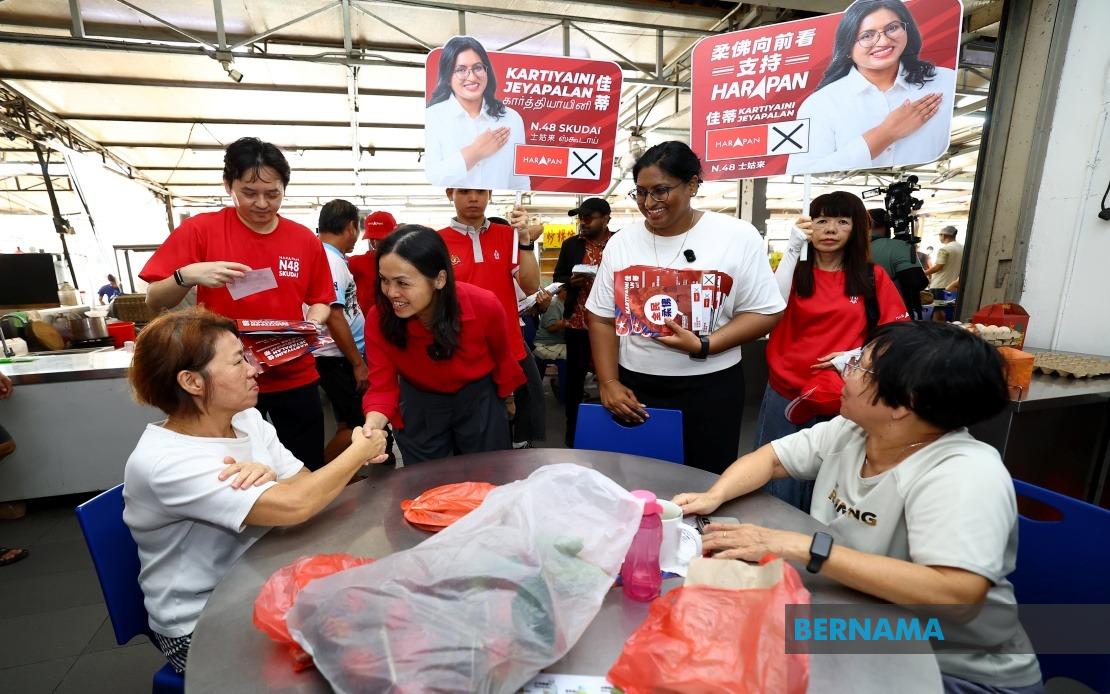
Johor's state election this Saturday has become the focal point of an intensive campaign to mobilize voters, particularly those who have migrated for work or study. Teo Nie Ching, the Johor DAP chairman and Deputy Communications Minister, has made an emotional appeal to the electorate, drawing a stark contrast between the dedication of Malaysians abroad and the potential apathy of those within the region. Her message resonates against a broader backdrop of voter participation concerns that have plagued recent Malaysian electoral contests, where turnout in certain demographics has declined despite the significance of state-level governance.
The stories Teo recounted during her campaigning in Skudai paint a vivid picture of the lengths some citizens will travel to participate in democracy. An elector in Queensland was so determined to ensure his postal ballot reached home by the July 11 deadline that he personally sought out passengers at the airport willing to hand-carry his vote, after discovering that conventional courier networks could not guarantee timely delivery. These anecdotes serve a dual purpose: they humanize the voting process and implicitly challenge those closer to home to recognize the privilege of proximity. The narrative is particularly powerful in a Malaysian context, where labour migration to Singapore and other regional hubs has created a significant transient population whose participation can meaningfully influence outcomes.
The financial sacrifice embedded in these stories amplifies their persuasive power. A postgraduate student pursuing studies in China determined that voting was sufficiently important to warrant purchasing a new airline ticket at a cost exceeding RM1,000, absorbing the additional expense without apparent hesitation. Similarly, a voter in the United States invested considerable effort locating a Malaysian citizen to witness postal voting procedures, navigating bureaucratic requirements that many domestic voters might not even consider. These examples underscore a philosophy that treats electoral participation not as an inconvenience but as a civic responsibility worth substantial personal investment, a framing that Teo clearly intended to shame or inspire those with easier access into action.
The mobilization effort extends beyond rhetoric into concrete fieldwork. Kartiyaini Jeyapalan, the Pakatan Harapan candidate for Skudai, has coordinated campaign activities at the Sultan Iskandar Building Customs, Immigration and Quarantine Complex from early morning, directly engaging cross-border commuters during their daily transit. Teams have boarded buses transporting workers into Singapore, creating opportunities for direct voter contact at moments when the audience is most receptive. This ground-level strategy reflects an understanding that persuading workers to reverse their daily flow requires meeting them where they actually are, rather than expecting them to seek out political messaging on their own initiative.
Fast-growing concerns about election integrity have prompted warnings against misinformation alongside voter mobilization drives. Teo emphasized the dangers of deliberately fabricated social media accounts and false narratives designed to exploit the final stages of campaign fever when voters are most emotionally engaged but least inclined toward critical evaluation. The speed with which false information propagates through digital networks has become a recognized electoral vulnerability, particularly in a state where internet penetration is high and social media usage widespread among younger demographics. Her call for a "verify before you share" culture addresses a structural problem: the architecture of social media platforms rewards rapid amplification regardless of accuracy, creating inherent advantages for misleading content.
The digital literacy dimension of this election discourse reflects broader anxieties about information ecosystems in Southeast Asia. Malaysia, like its regional neighbours, has experienced multiple documented instances of coordinated inauthentic behaviour and sophisticated disinformation campaigns preceding major electoral contests. Voters capable of distinguishing between credible sources and fabricated accounts possess a genuine advantage in forming election judgments, yet such literacy cannot be assumed among the general population. Teo's emphasis on personal verification habits targets this gap, though the effectiveness of such appeals remains contested among researchers studying online behaviour.
The Johor election carries particular significance within Malaysia's federal structure, as state governments control land, local authority operations, and regional development priorities with immediate impact on residents' daily lives. Kartiyaini's framing of the state election as equally consequential as federal balloting attempts to elevate these contests beyond their sometimes overshadowed status. In political discourse, federal elections typically dominate media attention and voter consciousness, yet state administrations determine policies on education infrastructure, transportation networks, environmental management, and housing development that tangibly shape citizens' experiences.
With 2.7 million registered voters expected to participate across 56 state assembly seats, the Johor election represents a substantial electoral exercise. The turnout achieved will partly indicate whether campaigns emphasizing voter sacrifice and democratic responsibility successfully mobilize those with convenient access to polling stations. Cross-border workers constitute a notably mobile segment whose participation could prove decisive in competitive constituencies, making the targeted outreach at transit points strategically rational. The response reported as "very positive" by campaign coordinators suggests momentum, though translation of campaign enthusiasm into actual ballot-box outcomes remains uncertain.
The convergence of these campaign elements—emotional appeals drawing on overseas voters' sacrifices, ground-level mobilization of cross-border commuters, and explicit warnings against misinformation—reflects an integrated strategy acknowledging multiple dimensions of contemporary electoral challenges. Beyond simply encouraging turnout, the campaign tacitly addresses voter confidence in the integrity of both the electoral process and the information environment surrounding it. For Malaysian voters accustomed to navigating increasingly complex media landscapes, the explicit permission to be skeptical and to demand verification before sharing content represents a subtle but significant acknowledgment that electoral participation now involves not just casting ballots but also defending the information commons.

