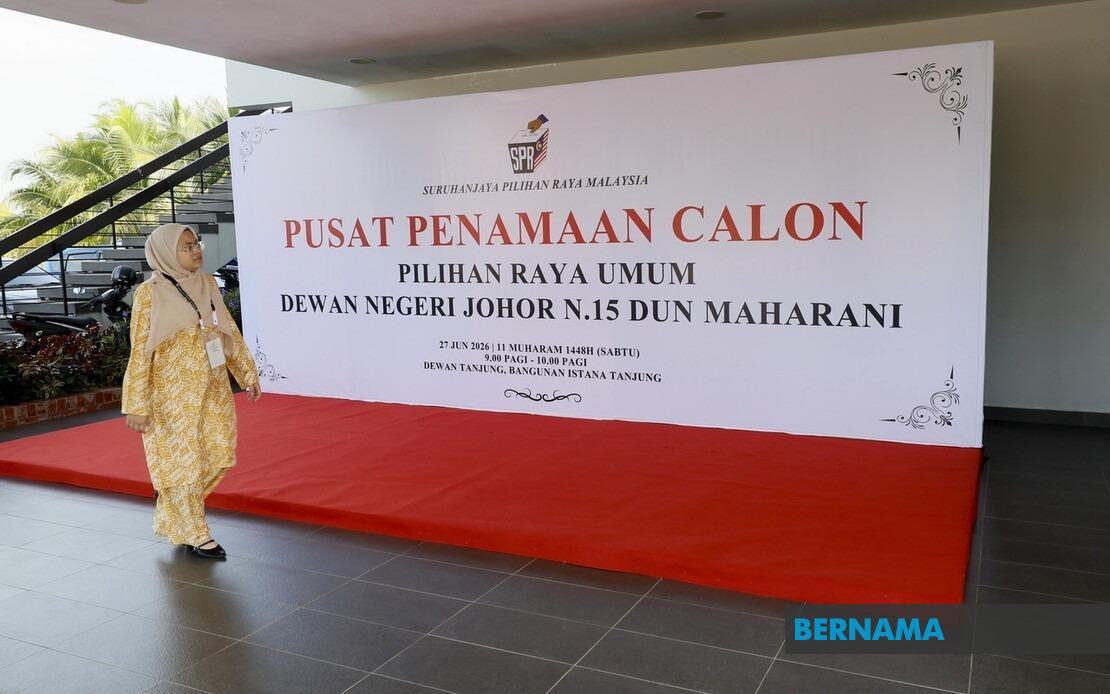
The 16th Johor State Election formally commenced today as nomination procedures got underway simultaneously across 56 nomination centres throughout the state, beginning at 9 am. Prospective candidates had a narrow one-hour window to lodge their nomination documents with the relevant Returning Officers before the official cut-off at 10 am, after which the Election Commission would publicly declare which hopefuls had met all eligibility requirements and could proceed to contest.
Following the formal announcement of eligible candidates, the official campaign period was set to unfold over exactly 14 days, concluding at 11.59 pm on July 10 in accordance with Election Commission directives. The actual polling will take place on July 11, with advance voting available on July 7 for those unable to cast their ballots on the main election day. This timetable follows the dissolution of the Johor State Legislative Assembly on June 1, which triggered the electoral process.
By the morning before nomination day, the machinery was already in motion. A total of 593 nomination forms had been distributed to prospective candidates, while 133 individuals had formally committed to running by submitting the required election deposits. These figures indicated strong interest from various political factions seeking representation across the state's constituencies, though the final tally of candidates would only become apparent once the nomination period officially closed and the Election Commission completed its verification process.
The electoral exercise encompasses a substantial voter population, with the Election Commission registering 2,727,926 eligible voters across Johor. This figure breaks down into 2,703,175 ordinary voters, alongside 12,041 military personnel and their spouses, and 12,710 police personnel and their spouses. This broad electoral base underscores the significance of Johor as a major electoral battleground within Malaysia's political landscape, containing nearly one-fifth of the national voter roll.
The contest promises a multifaceted political contest featuring a complex array of contenders. The three main coalition blocs are fielding comprehensive candidate slates. Pakatan Harapan is mounting a full-strength campaign across all 56 seats through its three constituent parties: PKR with 20 nominees, Amanah with 19, and DAP contributing 17 candidates. Barisan Nasional is similarly contesting every seat via its traditional allies UMNO fielding 36 candidates, MCA 16, and MIC four. Perikatan Nasional, meanwhile, is pursuing a coalition strategy with PAS contesting 11 seats, Bersatu 16, the Malaysian Indian People's Party five, and Parti Pejuang Tanah Air one seat.
Beyond the establishment coalitions, several smaller parties are also seeking representation, adding further complexity to the electoral dynamics. MUDA, which won a seat in the previous assembly, is contesting four constituencies. Parti Sosialis Malaysia is fielding a single candidate, while Parti Bersama Malaysia, making its electoral debut at the state level, is expected to contest 15 seats. This proliferation of candidates across multiple parties reflects evolving voter preferences and the emergence of alternative political voices challenging the traditional two-coalition paradigm that has long dominated Malaysian electoral politics.
Nomination day traditionally generates considerable excitement and activity at polling centres, with party faithful converging to demonstrate their backing for selected candidates. To maintain order and ensure compliance with electoral law, the Election Commission has issued explicit reminders regarding restrictions under the Election Offences Act 1954. Specifically, campaign activities involving musical instruments or loudspeaker systems mounted on vehicles are prohibited during the nomination process, designed to prevent chaos and preserve the integrity of the administrative proceedings.
Weather conditions presented an additional variable for those gathering at nomination centres. Malaysia's Meteorological Department forecast rain across several Johor districts during the morning hours, with afternoon thunderstorms anticipated in certain areas. Such weather patterns are not uncommon during Malaysia's monsoon season and can affect turnout and logistics, though they typically do not derail the nomination process itself.
Security arrangements were comprehensively mobilised to manage the expected activity. The Police Force deployed 4,832 personnel across the state to maintain order, regulate traffic flows, and oversee road management. Nineteen major thoroughfares near nomination centres were subject to temporary closures and diversions to ensure public safety and smooth movement of candidates, party machinery, and general traffic around these congested zones.
The existing political composition before dissolution provides important context for understanding what this election represents. In the previous assembly, Barisan Nasional held commanding dominance with 40 seats, Pakatan Harapan controlled 12, Perikatan Nasional held three, and MUDA secured one seat. This distribution reflected the aftermath of the 2022 state election and subsequent constitutional developments, suggesting that the upcoming contest will likely determine whether these patterns persist or whether significant electoral realignments are underway within Johor's electorate. The involvement of new political players and the comprehensive candidate coverage by established coalitions indicate that voters across all constituencies will have meaningful choices, potentially facilitating genuine shifts in representation if electoral sentiment has evolved since the previous contest.

