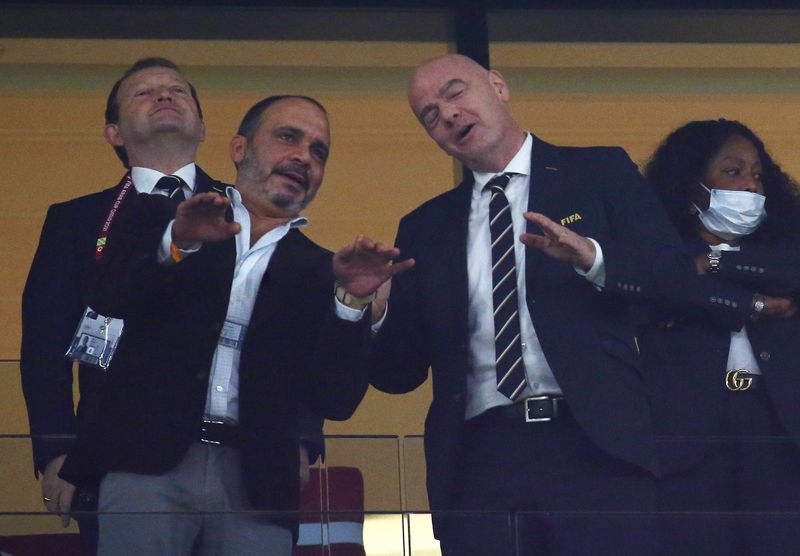
The head of Jordan's football governing body has launched a scathing public critique of FIFA President Gianni Infantino, claiming the global soccer authority engaged in coercive conduct by tying organisational support to a personal endorsement. Ali bin Hussein's statement on Tuesday marks an escalation in friction between smaller football nations and FIFA's leadership, occurring as Infantino confronts mounting dissent within soccer's institutional structure over contested proposals and governance questions.
According to bin Hussein, FIFA officials communicated verbally during the World Cup that supporting Infantino's leadership would facilitate assistance to the Jordanian FA after the organisation had stonewalled requests for help on multiple fronts. The accusation transforms what might have appeared as routine diplomatic engagement into something far more troubling—a quid pro quo arrangement that bin Hussein characterised as fundamentally incompatible with ethical governance. The Jordan FA president emphasised his association's commitment to maintaining moral standards, declaring both a refusal to endorse Infantino historically and a categorical rejection of any future endorsement under such circumstances.
Bin Hussein's grievances extend well beyond the endorsement controversy to encompass a catalogue of practical frustrations that reveal the structural inequalities facing smaller football nations within FIFA's ecosystem. Jordan, operating with constrained financial resources, has encountered difficulties securing visas for supporters attempting to attend World Cup matches, a particular indignity when combined with the steep pricing structures imposed on ticket sales. The situation underscores how major tournaments, while celebrated globally, can create substantial barriers for fans and nations with fewer resources to navigate administrative procedures and financial demands.
A particularly contentious issue involves taxation obligations that Jordan faced uniquely among North American World Cup participants. The kingdom's squad, unlike teams based in Canada and Mexico, incurred significant U.S. federal tax liabilities through FIFA during their World Cup participation. This differential treatment reveals what bin Hussein views as systemic unfairness—financial burdens imposed not equally but based on geographic circumstances beyond a nation's control. The funds consumed by these tax obligations represent resources that should have benefitted players and coaching staff, creating direct financial harm to the individuals whose performances earned the tournament qualification.
The matter of unpaid bonuses adds another layer to bin Hussein's frustrations. Jordan's squad reached the final of the Arab Cup, a FIFA-organised competition held in Qatar, yet the prize money promised for achieving that milestone remains undelivered months later. Since December, the association has awaited compensation while FIFA simultaneously publicises its substantial financial reserves. This disconnect between FIFA's institutional wealth and its apparent inability or unwillingness to distribute earned payments to participating nations reflects governance failures that affect athletes and organisations across the sport's lower tiers.
Bin Hussein's accusations arrive during a period of significant turbulence within FIFA's leadership structure. Infantino recently abandoned a controversial proposal to monetise World Cup commercial operations by selling minority stakes, a scheme projected to generate billions of dollars for sports development initiatives. The proposal faced unified resistance from football confederations and national associations, who imposed firm rejection following FIFA's own September 19 deadline. This calculated pushback demonstrates that even the organisation's authority has limits when member associations coalesce around shared objections.
The leadership challenges extend beyond the failed privatisation proposal. Mattias Grafstrom, FIFA's Secretary General, and Arsene Wenger, a prominent football executive, have distanced themselves from Infantino's governance approach. These defections from within FIFA's executive apparatus signal significant fractures in institutional confidence and suggest that concerns about leadership direction transcend external criticism. Bin Hussein's accusation of blackmail arrives within this context of internal discord, potentially emboldening other smaller associations to voice previously suppressed grievances about how FIFA wields its institutional power.
Jordan's situation exemplifies the vulnerabilities of emerging football nations navigating participation in major tournaments. The country achieved a historic milestone by qualifying for the World Cup for the first time, yet that achievement carried unexpected costs and administrative complications that larger, more established football powers do not face. The experience has apparently disillusioned the FA leadership regarding FIFA's commitment to supporting equitable participation across the global game.
The timing of bin Hussein's statement appears deliberate, capitalising on visible instability within FIFA's decision-making apparatus to amplify calls for governance reform. By framing the endorsement request as blackmail and connecting it explicitly to the broader pattern of inequitable treatment, bin Hussein positions Jordan's concerns within a larger narrative about FIFA's failure to serve smaller member associations equitably. For other nations facing similar pressures and financial obstacles, his public denunciation may provide validation and perhaps encouragement to challenge FIFA practices that disadvantage smaller football federations.
The accusation also highlights an uncomfortable reality within international sports governance: that institutional power dynamics can create leverage for implicit coercion, where direct demands would be imprudent but verbal suggestions carry unmistakable pressure. Whether FIFA officials explicitly articulated a conditional arrangement or simply conveyed subtle implications, the perception among Jordan's leadership is clear—support for Infantino was positioned as beneficial to the FA's interests. This interpretation reflects how smaller organisations operating within hierarchical systems may interpret seemingly routine communications through the lens of power disparity.
For Malaysia and other Southeast Asian football associations, bin Hussein's statement carries instructive implications. Nations participating in FIFA-sanctioned tournaments and competitions encounter similar bureaucratic complexities, financial burdens, and potential for unequal treatment. The Jordanian experience with unpaid prize money, unexpected tax obligations, and difficulty securing visa access for supporters represents challenges that could affect associations across the region. Malaysian stakeholders monitoring international football governance should note how systemic inequities can disadvantage smaller confederations and how those power imbalances occasionally manifest through subtle pressure tactics involving institutional support.
FIFA has been contacted for comment regarding all allegations raised by bin Hussein, though the organisation has not yet issued a public response. The silence may reflect deliberation about how to address accusations of coercion from a member federation, a situation that demands careful handling to preserve institutional legitimacy. Infantino's ability to navigate this criticism while addressing broader governance concerns will likely shape perceptions of FIFA's commitment to equitable treatment of all member associations, particularly those with limited financial and political resources. The Jordan FA's decision to speak publicly suggests that internal channels for redressing grievances have proven insufficient, raising questions about FIFA's complaint mechanisms and responsiveness to smaller member organisations.
Bin Hussein's statement ultimately represents not merely a personal dispute with FIFA's president but a challenge to institutional practices that systematically disadvantage smaller nations within global football. Whether through explicit conditioning, implicit pressure, or structural inequities in tournament participation, the mechanisms through which power operates within FIFA affect how nations experience international competition. The Jordan FA chief's willingness to articulate these dynamics publicly may encourage broader scrutiny of FIFA's governance and potentially catalyse pressure for reforms addressing how the institution balances the interests of football's largest and smallest stakeholders.

