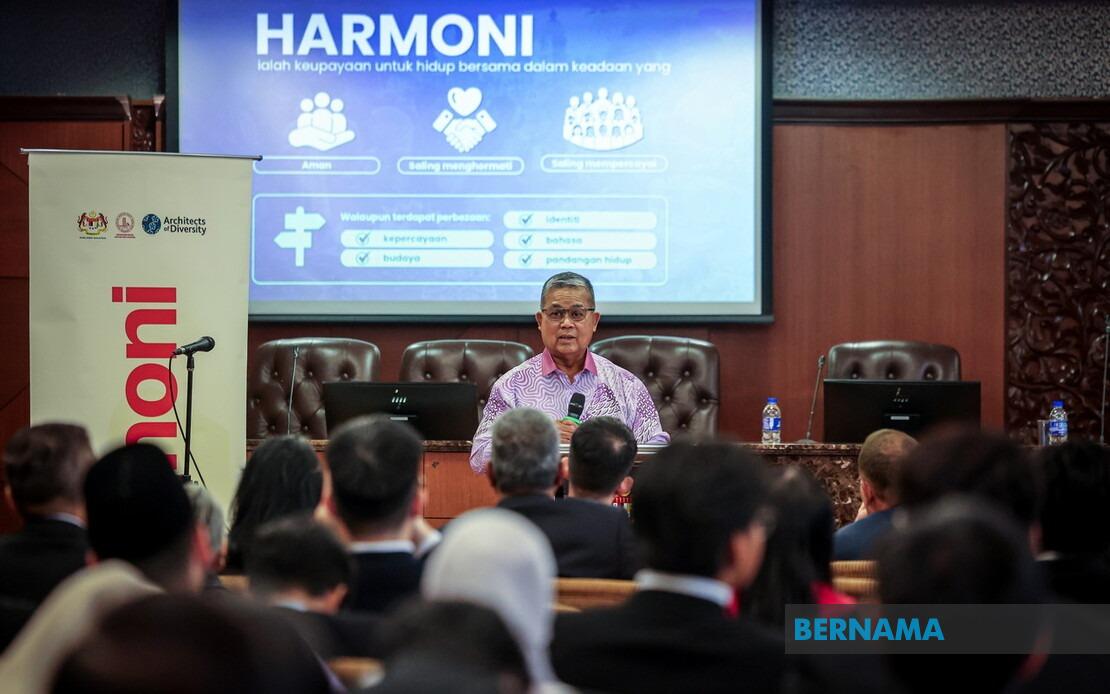
The Department of National Unity and National Integration is embarking on an ambitious research programme to construct a Community Tension Index, an analytical framework designed to quantify the health of social cohesion across Malaysia and track emerging vulnerabilities related to sensitive cultural and religious matters. Minister of National Unity Datuk Aaron Ago Dagang unveiled the initiative at the 2026 Harmony Symposium, organised by the Malaysian Parliamentary Cross-Party Group on Racial and Religious Harmony, signalling the government's commitment to more sophisticated, data-driven approaches to preserving national harmony.
The index represents a significant methodological shift in how the government monitors threats to unity. Rather than responding reactively to crises as they emerge, the framework will allow policymakers to identify warning signs of community friction before tensions escalate into larger confrontations. Aaron explained that the empirical findings generated by the index would serve as a foundation for strategic government intervention, enabling authorities to craft targeted early-warning responses and address divisive issues with greater precision and cultural sensitivity.
The timing of this initiative reflects growing government concern about the evolving nature of threats to national cohesion. Digital platforms have fundamentally altered the landscape of potential discord, with polarising content now spreading instantaneously across borders and demographic groups. The Malaysian Communications and Multimedia Commission removed 1,493 items of online material connected to the 3R issues—race, religion, and royalty—during the fourteen-month period from January 2025 through January 2026, underscoring the scale and persistence of incendiary digital speech in Malaysia.
Minister Aaron highlighted a particularly insidious challenge posed by contemporary social media infrastructure: the algorithmic creation of "filter bubbles" and "echo chambers" that isolate individuals within ideologically homogeneous information environments. These algorithmic effects fragment the national conversation, progressively narrowing spaces for genuine dialogue between communities and deepening mutual misunderstanding. The consequence is a society increasingly stratified into parallel information universes, where different demographic cohorts develop diverging perceptions of shared reality.
For Malaysian readers, this structural fragmentation carries particular weight given the nation's delicate multicultural equilibrium. Unlike more homogeneous societies, Malaysia's stability depends on continuous active bridge-building between distinct ethnic and religious communities. When digital platforms inadvertently encourage self-segregation into ideologically pure clusters, the informal daily interactions and cross-community relationships that historically served as friction-reduction mechanisms begin to atrophy. The Community Tension Index is thus not merely a measurement tool but a response to this qualitative shift in how Malaysian society communicates with itself.
Beyond the index, JPNIN has initiated comprehensive stakeholder engagement to explore establishment of a National Harmony Commission. This proposed institutional body would operate on three integrated levels: preventing discord before it manifests, mediating disputes that emerge despite preventive measures, and investigating incidents that pose systemic risks to national stability. The commission would marry early-detection capabilities with mediation expertise and formal investigative authority, creating a comprehensive institutional response architecture.
The proposed commission's investigative component merits particular attention for regional observers. Unlike purely preventive bodies, the SKN would possess powers to examine matters that threaten national harmony, suggesting the government views institutional capacity-building as essential to national security. This reflects a matured understanding that social cohesion cannot be imposed through decree but rather cultivated through patient institutional work, dialogue facilitation, and structural reform.
For Southeast Asia more broadly, Malaysia's initiatives carry instructive significance. The region contains multiple ethnically and religiously diverse nations facing parallel challenges of digital polarisation. Thailand, Indonesia, and Singapore are among neighbours wrestling with similar phenomena—how to preserve social harmony when digital technology enables unprecedented atomisation of public discourse. Malaysia's development of measurement frameworks and institutional mechanisms for harmony preservation may offer lessons applicable across the region's diverse contexts.
The Community Tension Index initiative also signals recognition that harmony requires continuous monitoring rather than periodic intervention. By treating social cohesion as a measurable variable worthy of sophisticated data collection and analysis, the government elevates harmony preservation from symbolic rhetoric to empirical governance. This professionalisation of unity management could enhance the sophistication of interventions across multiple policy domains, from education to local policing.
Implementation challenges should not be underestimated, however. Constructing valid metrics for measuring social tension demands rigorous methodological work, and stakeholder buy-in will prove essential to the commission's ultimate effectiveness. Yet the underlying recognition—that Malaysia's diversity is both an asset and a responsibility requiring active institutional cultivation—represents sound governance logic. In an era when polarisation threatens democratic stability across the democratic world, Malaysia's deliberate effort to strengthen its institutional architecture for conflict prevention and resolution exemplifies a pragmatic approach to protecting the conditions necessary for diverse societies to flourish.

