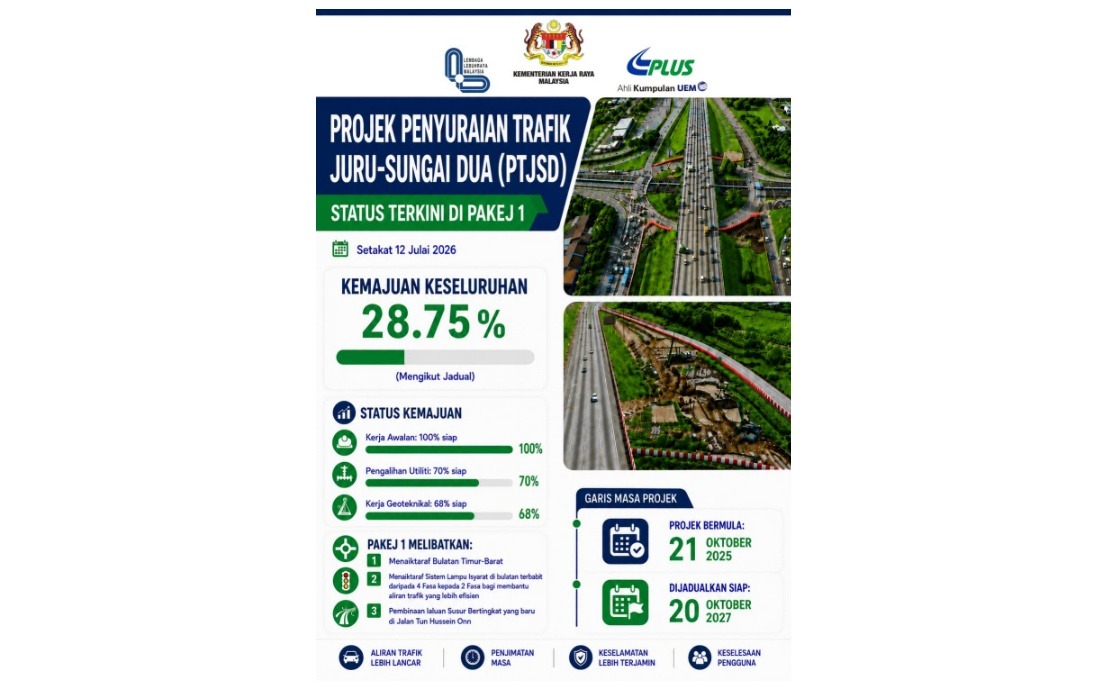
The Juru-Sungai Dua Traffic Dispersal Project (PTJSD) is progressing steadily toward its ambitious October 2027 completion date, with Package 1 recording 28.75 per cent overall advancement as of July 12, according to an announcement from PLUS Malaysia Berhad. The project, which stretches across three districts in Seberang Perai, has already achieved several foundational milestones that position it to accelerate toward subsequent phases of construction.
Among the tangible accomplishments to date, preliminary works have been entirely finished, clearing the way for more intensive construction activities. The utility relocation component—critical for avoiding disruptions to essential services—has advanced to 70 per cent completion, while geotechnical investigations and soil preparation work stands at 68 per cent. These parallel workstreams represent the unglamorous but indispensable groundwork that determines whether large infrastructure projects ultimately succeed or face costly delays.
Package 1 specifically encompasses three major components designed to systematically untangle one of Penang's most congested traffic arteries. The first involves upgrading the East-West Roundabout, a critical junction that currently struggles to handle peak-hour volumes. The second element upgrades the traffic light coordination system at the roundabout itself, employing smart traffic management to optimize flow patterns. The third creates an entirely new elevated slip road at Jalan Tun Hussein Onn, introducing a grade-separated facility that allows vehicles to bypass the surface-level junction altogether—a solution increasingly adopted in Southeast Asian cities facing similar bottlenecks.
The broader context for this project reflects Penang's role as a crucial economic and demographic hub in Malaysia's northern corridor. Approximately 200,000 people traverse the Juru-Sungai Dua route daily, making this corridor far more than a local convenience—it functions as a vital artery connecting Penang's manufacturing and tourism sectors with the rest of peninsula Malaysia. The chronic congestion affecting this route carries real economic costs, from lost productivity and increased logistics expenses to degraded air quality and frayed commuter patience.
The RM3 billion investment in the PTJSD addresses traffic flow through a multi-pronged strategy. The signature achievement will be the new direct Juru-Sungai Dua route, projected to siphon 30 per cent of existing corridor traffic onto this purpose-built facility. The impact on travel times would be transformative—current peak-hour journeys consuming 60 minutes would compress to approximately 20 minutes once the new route becomes operational. For a region where traffic congestion costs businesses millions annually in inefficiency, such reductions represent substantial economic benefit.
Implementation of the PTJSD reflects a collaborative governance approach, with the Ministry of Works and the Malaysian Highways Authority partnering alongside PLUS Malaysia. This multi-agency structure, while sometimes complex, ensures that road connectivity planning aligns with broader public works priorities and that financial responsibility is appropriately distributed. For residents and businesses in Seberang Perai's South, Central, and North districts, this coordination translates to infrastructure tailored to local needs rather than imposed by distant planners.
The project's timeline carries particular significance for Malaysian infrastructure delivery. The October 2027 target remains nearly three years distant, providing considerable buffer for the inevitable delays that plague major construction projects in tropical climates, where monsoon seasons and humidity-related complications frequently disrupt schedules. That the project currently maintains alignment with this timeline despite geotechnical complexities suggests either conservative initial scheduling or effective project management—both positive indicators for ultimate delivery.
Beyond mere traffic throughput, the PTJSD explicitly targets improvements in road safety and user comfort, objectives often secondary in traditional congestion-focused approaches. Enhanced traffic signal systems reduce conflict points and rear-end collisions. Elevated slip roads eliminate dangerous merging conflicts. Better-designed facilities inherently improve the experience of traveling through the corridor, benefiting not just motorists but also motorcycle riders, who constitute a significant portion of Penang's traffic mix.
For regional observers in Southeast Asia, the PTJSD represents a cautionary tale and a template simultaneously. Multiple countries across the region struggle with similar corridor congestion as rapid urbanization and motorization outpace infrastructure development. How successfully Malaysia executes this RM3 billion intervention—whether it delivers on schedule, remains within budget, and genuinely alleviates congestion—will offer valuable lessons for planners in Thailand, Vietnam, Indonesia, and the Philippines wrestling with comparable challenges.
The project also carries implications for Malaysia's broader infrastructure ambitions during a period of constrained public finances. Successfully delivering the PTJSD on time and budget would demonstrate that the country can execute complex, expensive transport infrastructure projects efficiently. Conversely, significant cost overruns or schedule slippages could further diminish public confidence in government project management and complicate future infrastructure financing discussions.

