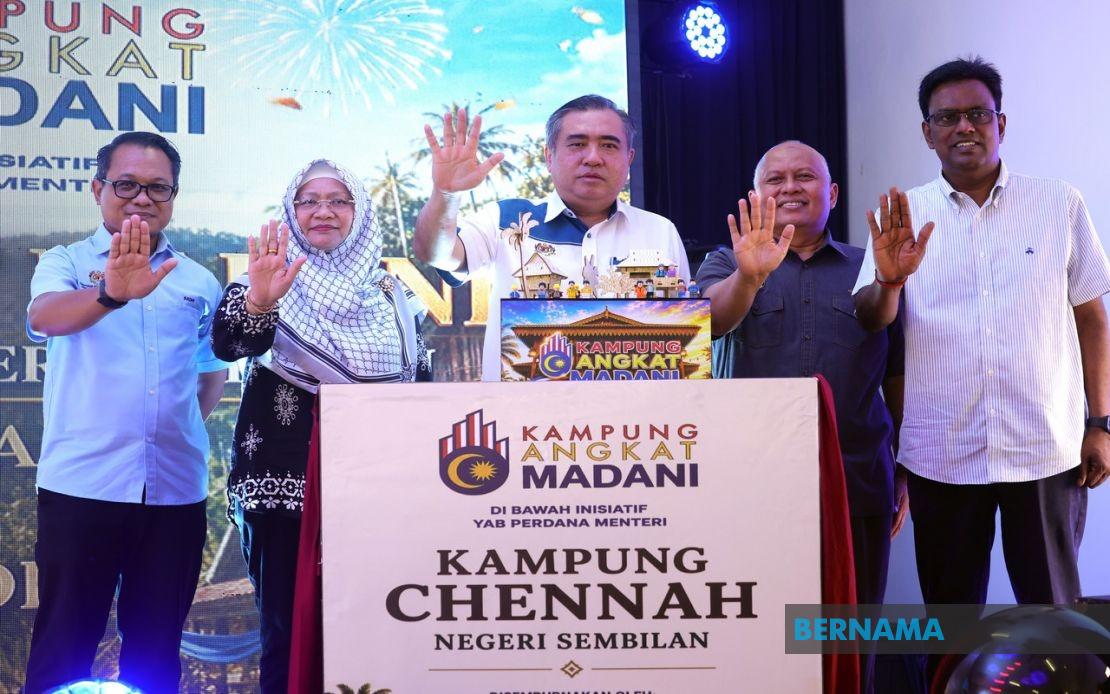
Transport Minister Anthony Loke Siew Fook has moved to distance the "Kampung Angkat MADANI" programme from concurrent state elections, characterizing the initiative as part of a longstanding nationwide development strategy rather than a politically timed intervention. Speaking at the launch of the Land Public Transport Agency's (APAD) village improvement scheme in Kampung Chennah, Jelebu, Loke explained that the phased rollout targets remote rural communities facing acute shortages in basic amenities and economic opportunities.
The minister underscored that implementation predates the current electoral cycle by two years, positioning the scheme within the Transport Ministry's broader portfolio of infrastructure and community engagement commitments. Loke noted that analogous projects had already been executed across multiple localities in the preceding year, including work undertaken in an Orang Asli settlement at Lenggeng, demonstrating the programme's established trajectory independent of electoral considerations.
Loke emphasized the government's adherence to electoral regulations that prohibit official government programming during campaigning periods. He revealed that activities under the scheme must be completed before nomination day to ensure strict compliance with the prohibition against state-sponsored events in contested constituencies during the official campaign window. This disciplinary approach reflects directives introduced by the Prime Minister as part of what Loke characterized as a recalibrated administrative culture prioritizing electoral propriety.
The minister clarified his personal position within these constraints, noting that although he continues performing ministerial duties, he will abstain from attending official government programmes in election-affected constituencies throughout the campaign phase. This self-imposed restriction, he suggested, demonstrates the government's commitment to maintaining separation between developmental initiatives and electoral machinery.
Kampung Chennah's selection for this year's Kampung Angkat MADANI reflects its geographic isolation and the population's acute infrastructure deficits. The government has committed RM500,000 to address five priority interventions, encompassing renovation of the community library, refurbishment of the futsal facility, and enhancement of drainage infrastructure surrounding the village mosque. These projects, scheduled for completion within two to three months, directly respond to identified community needs rather than predetermined political calendars.
Loke signalled that his ministry would maintain active oversight of project delivery timelines, committing institutional resources to ensure implementation remains on schedule and budgetary allocations are efficiently deployed. This supervisory commitment reflects broader ministerial responsibility for the programme's success and the government's stated intention to deliver tangible outcomes in participating villages.
Beyond the specific allocation to Kampung Chennah, Loke positioned the Kampung Angkat MADANI framework as emblematic of an expanded ministerial mandate transcending traditional regulatory and developmental functions in transport infrastructure. He articulated that the Transport Ministry's purview now encompasses explicit social responsibilities, requiring engagement with rural populations and substantive contributions to community wellbeing beyond core regulatory duties concerning ports, airports, railways, and public transport systems.
This reconceptualization of ministerial scope reflects evolving expectations for government agencies to operate as comprehensive development actors rather than functionally specialized entities. For Malaysian rural communities, particularly those inhabiting peripheral regions distant from commercial and administrative hubs, such programming potentially expands access to government resources previously concentrated in urban localities or allocated through constituency-specific channels.
The Kampung Angkat MADANI programme carries implications for Malaysia's developmental federalism and the mechanisms through which rural communities access government support. By framing village improvement as a nationwide systematic initiative rather than discretionary political patronage, the government attempts to depoliticize rural development while simultaneously claiming credit for tangible infrastructure gains. This approach may reshape rural constituents' expectations regarding government responsiveness and the legitimacy of development claims during electoral campaigns.
For Southeast Asian observers, Malaysia's explicit separation of developmental programming from electoral cycles offers comparative context regarding institutional autonomy and democratic governance standards. The government's stated compliance with electoral regulations through self-imposed programming restrictions contrasts with models elsewhere in the region where campaign-period development remains endemic to electoral competition, though questions persist regarding enforcement mechanisms and elite adherence in politically sensitive constituencies.
The programme's emphasis on identifying village-specific needs through systematic assessment potentially creates institutional capacity for ongoing rural engagement beyond individual electoral cycles. Should the Kampung Angkat MADANI framework mature into a durable mechanism for identifying and prioritizing rural infrastructure gaps, it could establish infrastructure for more responsive governance structures attuned to peripheral community demands.
Loke's ministerial statements reflect broader governmental messaging regarding institutional reform and electoral integrity, though implementation across diverse constituencies and competing political interests will ultimately determine whether the programme functions as described or becomes subordinated to localized political dynamics. The Transport Ministry's willingness to accept ministerial visibility restrictions in election-affected areas represents a notable departure from conventional Malaysian political practice, where incumbent advantages in accessing government resources remain structurally embedded.
As Malaysia continues navigating questions regarding democratic governance quality and state capacity for equitable rural development, the Kampung Angkat MADANI programme's trajectory warrants sustained observation regarding resource allocation patterns, community satisfaction outcomes, and whether similar systematic approaches extend across other governmental agencies and development sectors.

